Why your sex chromosomes shape how you age without asking your hormones
Sex chromosomes alter cell metabolism and disease risk entirely on their own, operating independently of circulating sex hormones like oestrogen or testosterone.
Reading level
The full story with proper science words explained.
Beyond the body's chemical signals
Why do our bodies age differently as the years tick by? For decades, people assumed sex hormones like testosterone and oestrogen drove every major health difference between sexes. But a systematic review reveals that sex chromosomes and aging are bound together by an internal biological system.
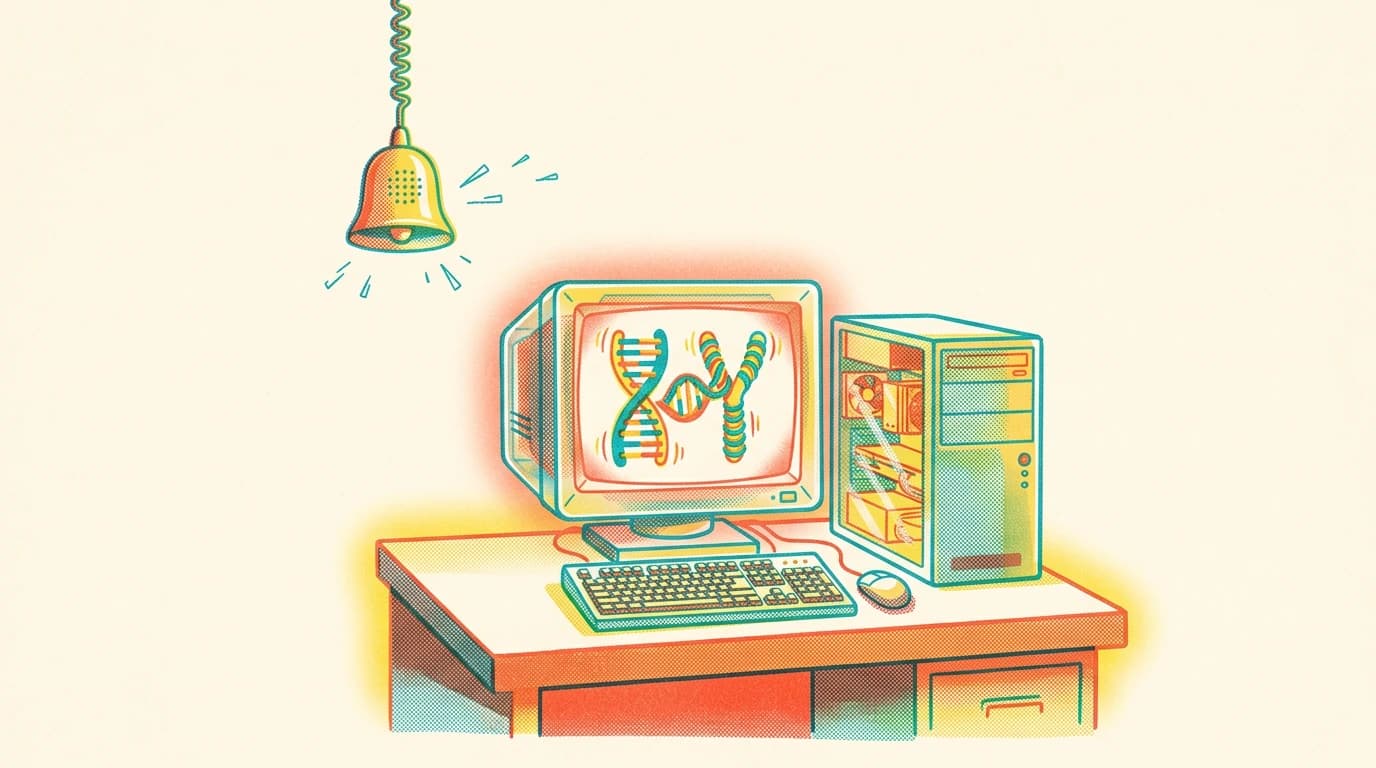
Think of hormones like building-wide intercom announcements. Your sex chromosomes, XX or XY, act like the hardwired operating system running silently inside each individual workstation. Even if you turn off the intercom messages, each terminal still runs on its own internal code. That is what biologists call a cell-autonomous effect: a change driven purely from within the cell itself.
The hidden power of X and Y
Researchers examined evidence showing that these chromosomes alter metabolism, immune signalling, and cell stress. In XX cells, one X chromosome normally shuts down through X chromosome inactivation to keep gene doses balanced. However, some genes break the rules.
This escape from X chromosome inactivation allows certain genes to stay turned on, giving XX cells a double dose of specific proteins. Scientists also mapped out X reactivation, parent-of-origin effects, and X-skew, where cells unevenly silence maternal or paternal X chromosomes.
The Y chromosome is just as active. As men age, dividing cells can suffer Y loss, spontaneously dropping the entire chromosome. This loss, along with regular Y gene functions, directly links to altered immunity, cancer, neurologic conditions, and cardiometabolic disease. Together, both chromosomes direct epigenetic programming, chemical tags that control gene activity without altering the DNA code itself.
What we still do not know
A clear limit remains: much of this evidence comes from mouse models. Scientists still need to confirm these exact pathways in human populations. We also do not know the exact clinical extent to which Y loss or X escape dictates disease outcomes. Turning these chromosomal discoveries into targeted drugs and smarter clinical trials will take time.
Science words
- Cell-autonomous
- A biological process driven entirely from inside an individual cell rather than by outside triggers like hormones.
- X chromosome inactivation
- The process where female cells silence one of their two X chromosomes to balance gene activity.
- Escape from X chromosome inactivation
- When genes on a silenced X chromosome stay active, producing higher protein doses in XX cells.
- X-skew
- An unequal silencing of mother-inherited versus father-inherited X chromosomes across a group of cells.
- Y loss
- The spontaneous loss of the Y chromosome in dividing cells as an individual grows older.
- Epigenetic programming
- Chemical tags on DNA that turn genes on or off without altering the genetic sequence.
Check it yourself
This story is based on a real research paper in Science by Dubal, Ambrosio, Stout et al. We write with AI help and check it against the paper, but the original is the final word.