Why your brain confuses a sharper sound with a higher note
Brain scans reveal that the auditory cortex maps pitch and brightness together, showing why people mix up tone colour with musical pitch.
Reading level
The full story with proper science words explained.
A stubborn trick of the ear
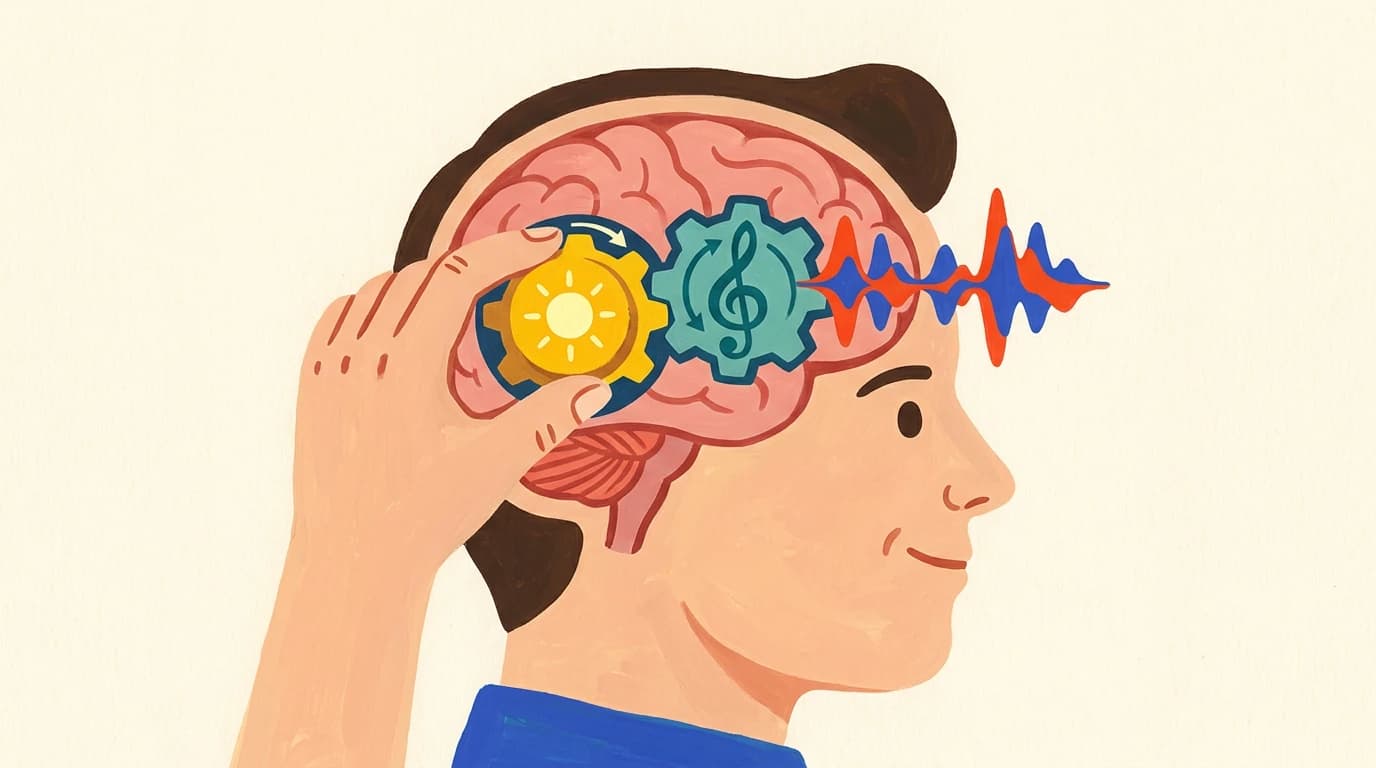
Play middle C on a warm wooden flute, then play the exact same note on a trumpet. Even though the musical pitch matches, the brass note often seems higher. This mix-up, known as pitch and timbre confusion, happens because our ears struggle to split pitch from tone brightness. Timbre describes the tone colour that tells two sound sources apart. Pitch depends on fundamental frequency, which is the lowest repetition rate of a sound wave. When a note gains a higher spectral centroid, its wave balance shifts toward sharper upper parts. People then judge the note as higher in pitch, even when it is not.
Inside the brain's hearing centre
To test this link, researchers asked 20 adults to spot small shifts in pitch and brightness. These tests proved that changes in brightness strongly skewed how people judged pitch. Changes in pitch also swayed how people heard brightness, though brightness exerted a stronger pull. Years of music training and speaking a tone language made no difference to the mix-up. This shared bias points to basic brain wiring rather than daily habits.
Next, 10 of these adults completed brain scans using functional magnetic resonance imaging. They listened to synthetic tones built from 25 combinations of pitch and brightness. Brain models revealed that individual voxels do not track these features in isolation. A voxel is a tiny three-dimensional pixel representing scanned brain tissue. Instead, a combined interaction model best explained activity in the hearing cortex.
Think of it like adjusting a screen where turning the brightness dial nudges the colour knob. The comparison works because changing one feature shifts how the brain tunes into the other. It breaks down if you imagine real brain cells physically bumping into one another. Inside individual voxels, the preferred pitch actually shifted downward as brightness climbed. This downward shift inside brain cells directly mirrors how people mix up the two cues in hearing tests.
Shared maps in the head
The hearing cortex also revealed overlapping tonotopy for both properties. Tonotopy means the orderly spatial mapping of sound frequencies across brain tissue. When pitch and brightness moved in the same direction, brain patterns became clearer and easier to tell apart. These shared maps support efficient coding, where sensory circuits shape their resources to manage sounds that naturally change together.
A key caveat is that this perceptual confusion did not depend on music training or language background, showing up equally across all tested adults. The scan results also did not differ between the left and right sides of the brain. The study used a modest group of 10 scanned adults, so wider variation across larger groups remains open. The team also focused purely on spectral centroid using simple synthetic tones. Natural sounds carry other traits, such as how quickly a note starts. Scientists still need to test whether these other traits share the same brain maps.
Science words
- Timbre
- The unique tone colour that distinguishes different instruments playing the same note.
- Fundamental frequency
- The lowest repetition rate of a sound wave, which determines musical pitch.
- Spectral centroid
- The centre of mass of a sound's frequency spectrum, which sets perceived sharpness or brightness.
- Voxel
- A tiny three-dimensional pixel representing a specific measurement volume in brain scans.
- Tonotopy
- The orderly spatial mapping of sound frequencies across the auditory pathway and cortex.
- Efficient coding
- The sensory principle where neural circuits adapt resources to best process sound features that naturally change together.
Check it yourself
This story is based on a real research paper in iScience by Ou, Allen, Kay et al. We write with AI help and check it against the paper, but the original is the final word.