Why tigers and leopards clash with humans in completely different places
A 24-year study across South Asia reveals that tigers and leopards react to people in opposite ways, meaning human carnivore conflict cannot be solved with a single strategy.
Reading level
The full story with proper science words explained.
Heads up: this study is a preprint, which means other scientists haven’t finished checking it yet.
Two cats, two different worlds
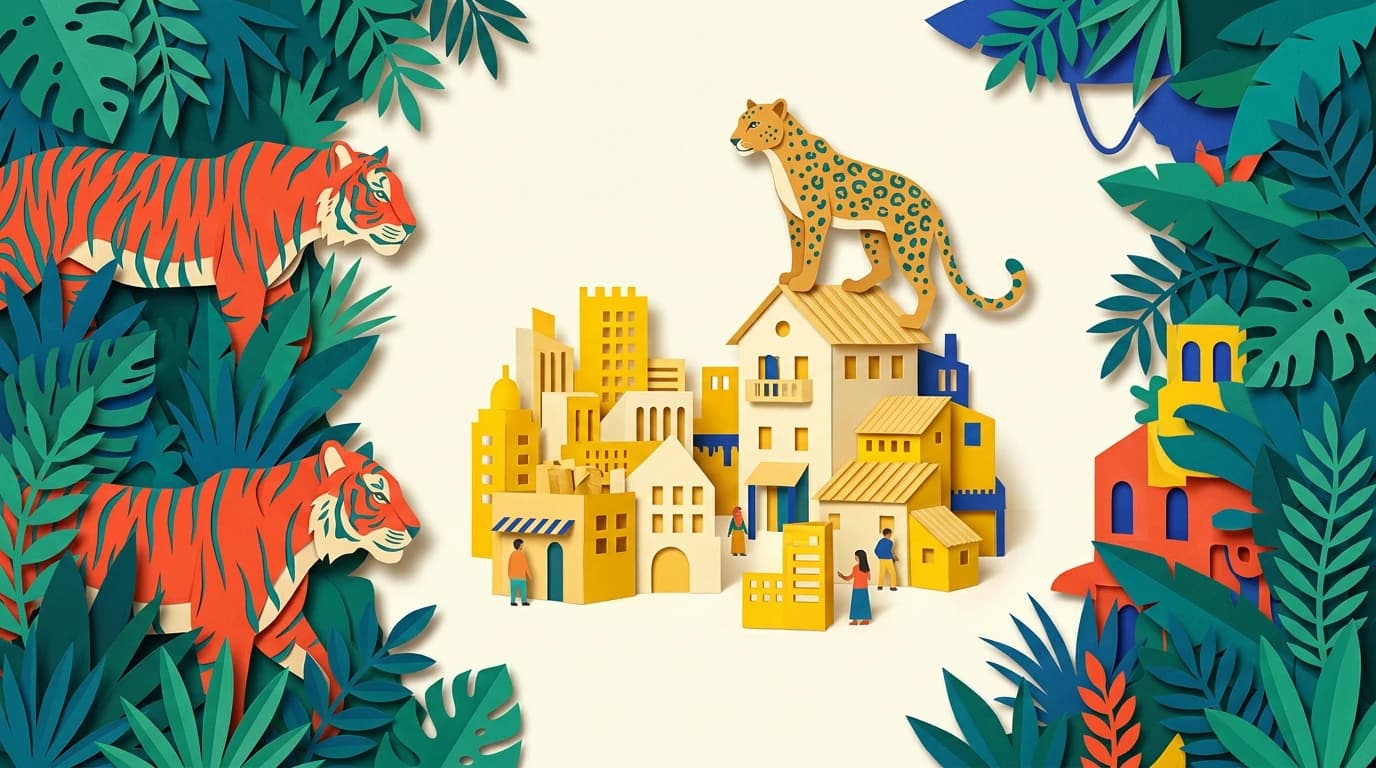
Imagine two very different neighbours reacting to expanding development. One creeps only as far as the quiet outskirts, while the other moves straight into the bustling town centre. Across South Asia, growing big cat populations have driven a steep rise in human carnivore conflict, which means negative interactions such as attacks on people or livestock. Yet tigers and leopards handle human presence quite differently.
Mapping the danger zones
Scientists collected 2,563 tiger conflict records and 4,457 leopard conflict records across Bangladesh, Bhutan, India, and Nepal between 2000 and 2024. They compared these hotspots against 33 environmental, topographic, and human factors across three distinct spatial scales. To calculate the risks, they used binomial generalized linear regression, a statistical modelling method used to predict an outcome with two states, like conflict presence versus absence.
They also tested background sampling, a technique where random points across a region represent available habitat. Both cats were best understood by zooming out to the largest spatial scale. However, their patterns split completely. Tigers clash with people near forest edges and villages, yet encounters drop where overall anthropogenic disturbance—disruption caused directly by human activity—becomes too intense. They thrive on the fringes of forest fragmentation, the breaking up of continuous forest tracts into smaller patches, but they avoid deeply altered areas. Leopards, by contrast, concentrate heavily in wetter, highly productive, human-modified landscapes.
What we still don't know
Because leopards adapt to modified land while tigers skirt the borders, a single conservation plan will fail. Authorities need targeted plans suited to each species. Even so, clear gaps remain. The models did not measure actual carnivore numbers, local prey densities, or socioeconomic factors. How wild prey counts and human community wealth directly alter these conflict hotspots remains unknown.
Science words
- Human carnivore conflict
- Negative interactions between humans and predatory animals, such as attacks on people or livestock.
- Binomial generalized linear regression
- A statistical modelling method used to predict an outcome that has two possible states, such as presence versus absence of conflict.
- Background sampling
- A technique in species modelling where random points across a region are selected to represent the overall available environment.
- Anthropogenic disturbance
- Environmental changes and habitat disruptions directly caused by human activity.
- Forest fragmentation
- The breaking up of continuous forest tracts into smaller, isolated patches.
Check it yourself
This story is based on a real research paper in Scientific Publication by Banerjee. We write with AI help and check it against the paper, but the original is the final word.