Why This Tiny Chemical Bridge Makes Perovskite Solar Cells Way More Efficient
Source PublicationScientific Publication
Primary AuthorsKim DH, Jeong MJ, Lee S, Oh OJ, Woo MY, Kim SY, Kang DH, Kim CY, Shin CH, Noh JH.
"It is like upgrading from using loose sticky notes to hold two pages together, to using double-sided superglue that chemically fuses the paper fibres."
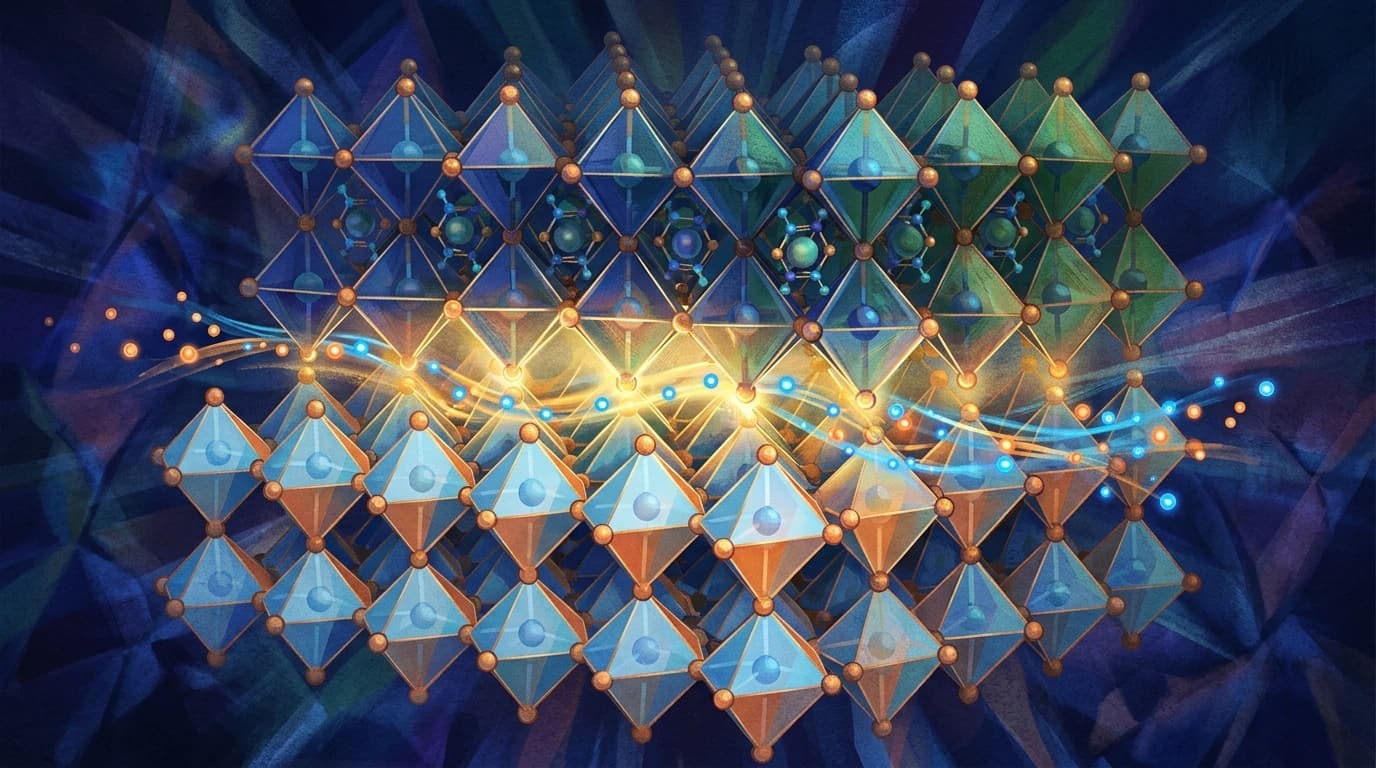
Did you know that the biggest limit on next-generation solar panels isn't the sunlight, but how the internal layers touch? ☀️ Standard silicon panels are great, but perovskite solar cells are the new contenders aiming to capture even more energy.
The Trouble Inside Perovskite Solar Cells
The issue lies deep inside the device. When the internal layers do not bond perfectly, electrons get trapped at the boundary, wasting precious energy as heat instead of sending it to the grid.
The Molecular Bridge Discovery
To fix this, researchers introduced a smart molecule called Na-BCS at the critical boundary. Unlike previous passive coatings, this molecule acts like a double-sided chemical anchor. It chemically binds to the bottom transport layer whilst grabbing the perovskite crystal lattice. This molecular bridge reduces defects and helps the perovskite crystals grow in a highly organised structure.
What This Means for Clean Energy
The results are highly promising. The team measured a 26.02% enhancement in power conversion efficiency. Additionally, the cells retained 86% of their initial efficiency after 762 hours of operation, suggesting a path toward highly stable, durable solar tech.