Why the world's oldest tortoise refuses to age like the rest of us
Genetic analysis of Jonathan, a 194-year-old Aldabra giant tortoise, shows that key switches controlling his cellular powerhouses remain remarkably tidy despite his extreme age.
Reading level
The full story with proper science words explained.
A century past his biological bedtime
Jonathan the Aldabra giant tortoise is roughly 194 years old. For his species, the expected upper limit of life is about 94 years, with an average around 80. Jonathan has lived an entire extra century beyond what biology predicts, quietly munching grass while empires rose and fell.
Understanding giant tortoise aging could teach us how some animals resist biological decline. To uncover his secret without harming him, researchers gathered saliva and mouth swabs from Jonathan. They mapped his DNA and compared it with a younger Aldabra tortoise named Tank and three others.
Tuning out the biological static
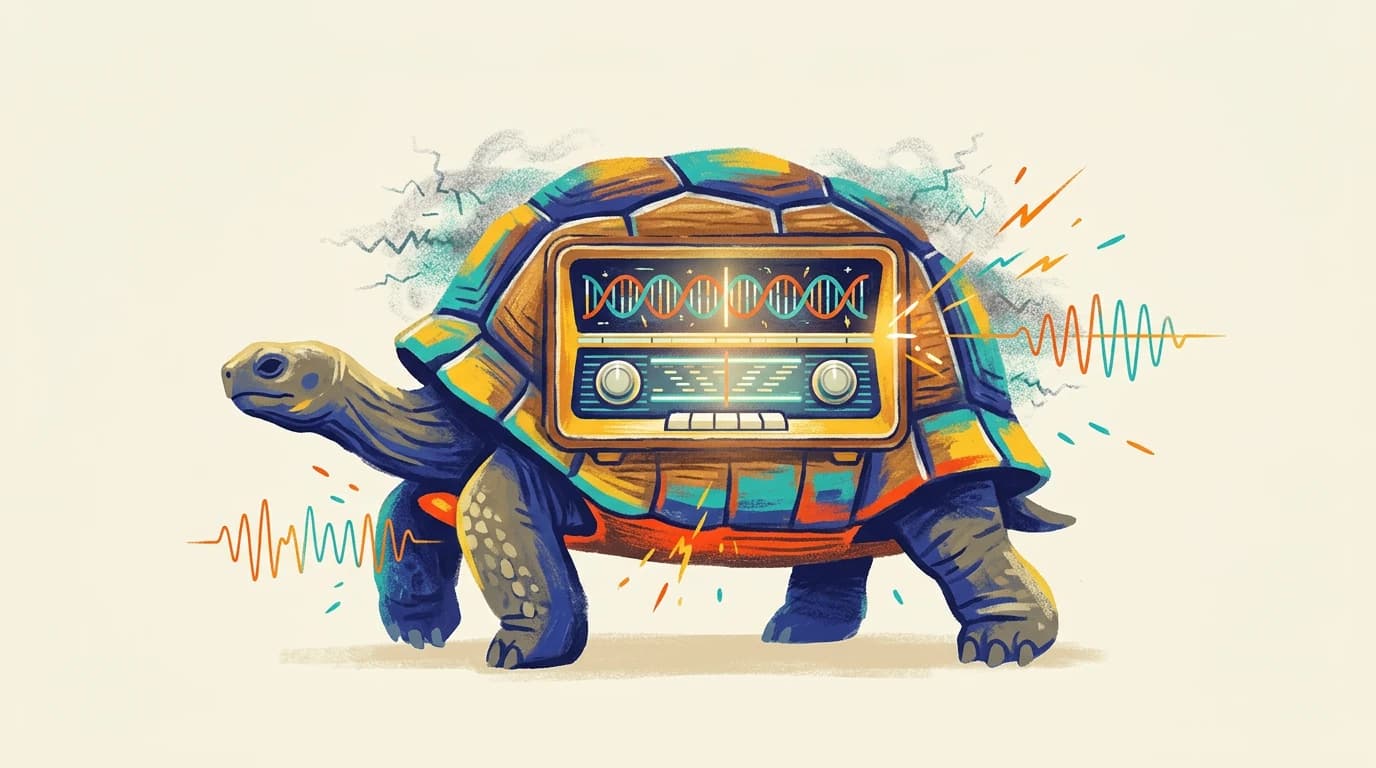
Aging usually scatters tiny chemical tags called methyl groups across DNA. You can picture these tags like tuning dials on an old analogue radio. In youth, every station comes in crisp and clear. As bodies age, background static creeps in across the dials.
Scientists call this clutter methylation entropy, a measurement of disorder in those chemical tags. Jonathan showed this expected rise in overall genomic static, which matched the ages of the tortoises closely. Yet when researchers looked at 272 specific gene switches, called promoters, the static vanished.
These protected promoters had disorder levels as low as those seen in juvenile tortoises. Remarkably, 35 of these tidy control switches run genes for mitochondria, the tiny batteries powering our cells, while 25 govern how RNA is processed. The analogue radio analogy works well here, though it breaks down because real DNA repair actively replaces the dials rather than just leaving them untouched.
Armed with extra shields
Jonathan does not just rely on clean chemical tags. His underlying genetic code holds 770 genes showing positive selection, an evolutionary signal where helpful protein alterations are favoured. His genome also holds unique nonsynonymous single-nucleotide variants, DNA mutations that swap an amino acid in a protein.
Twelve of these altered genes, including POT1, ERCC1, and FOXO3, are famous for controlling longevity and DNA repair. Jonathan also carries 10 copies of Prf1, a gene tied to immune defence, compared to seven copies in Lonesome George, the famous Pinta Island tortoise. Together, these tweaks point to a biological loop where steady mitochondrial energy powers robust DNA repair crews, keeping the cell running smoothly.
What we still do not know
This study had clear limits. Local officials rightly banned taking blood from Jonathan to prevent infection risks, meaning researchers could not check active RNA levels directly. Furthermore, researchers could only check methylation entropy across about 10% of the tortoises' gene promoters.
Because Jonathan is just one exceptional animal, we cannot yet prove whether these neat switches directly prevent transcriptional noise, which is unwanted randomness in how genes are copied. We also do not know Jonathan's precise island ancestry, or whether his cellular fuel molecules, called NAD, dwindle over time as human stores do.
Science words
- Methylation entropy
- A measure of the disorder or randomness in the chemical tags placed on DNA.
- Promoter
- A stretch of DNA sitting before a gene that acts as an on/off switch.
- Positive selection
- An evolutionary process that favours genetic mutations that change a protein's function.
- Nonsynonymous single-nucleotide variant
- A single-letter DNA change that alters an amino acid in the resulting protein.
- Transcriptional noise
- Accidental randomness or fluctuations in how much a gene gets copied into RNA.
Check it yourself
This story is based on a real research paper in Science Advances by Vaisvil, Schmitt, Jones et al. We write with AI help and check it against the paper, but the original is the final word.