Why the cloud aerosol interaction takes a full day to show up
Marine clouds do not react to pollution straight away; their cover peaks a day later and hundreds of kilometres downwind. This delay reshapes how scientists calculate cloud cooling effects.
Reading level
The full story with proper science words explained.
Heads up: this study is a preprint, which means other scientists haven’t finished checking it yet.
A slow ripple in the sky
What if pollution released over the ocean today changes clouds tomorrow, hundreds of kilometres away? For decades, satellites checked for this cloud aerosol interaction by looking straight at the source of airborne particles. Yet clouds drift across open water, continually evolving as they go.
Tiny airborne particles, called aerosol perturbations, enter marine air from smoke or ship exhausts. In theory, these specks should rapidly alter how clouds reflect sunlight. This cooling or warming power is known as their radiative effect. However, fixed satellite images kept giving messy, inconsistent results.
Chasing moving air
Researchers decided to stop looking at fixed spots on the map. Instead, they tracked marine low clouds along three-day paths across three subtropical ocean areas. By following drifting air masses, they observed how clouds alter downwind.
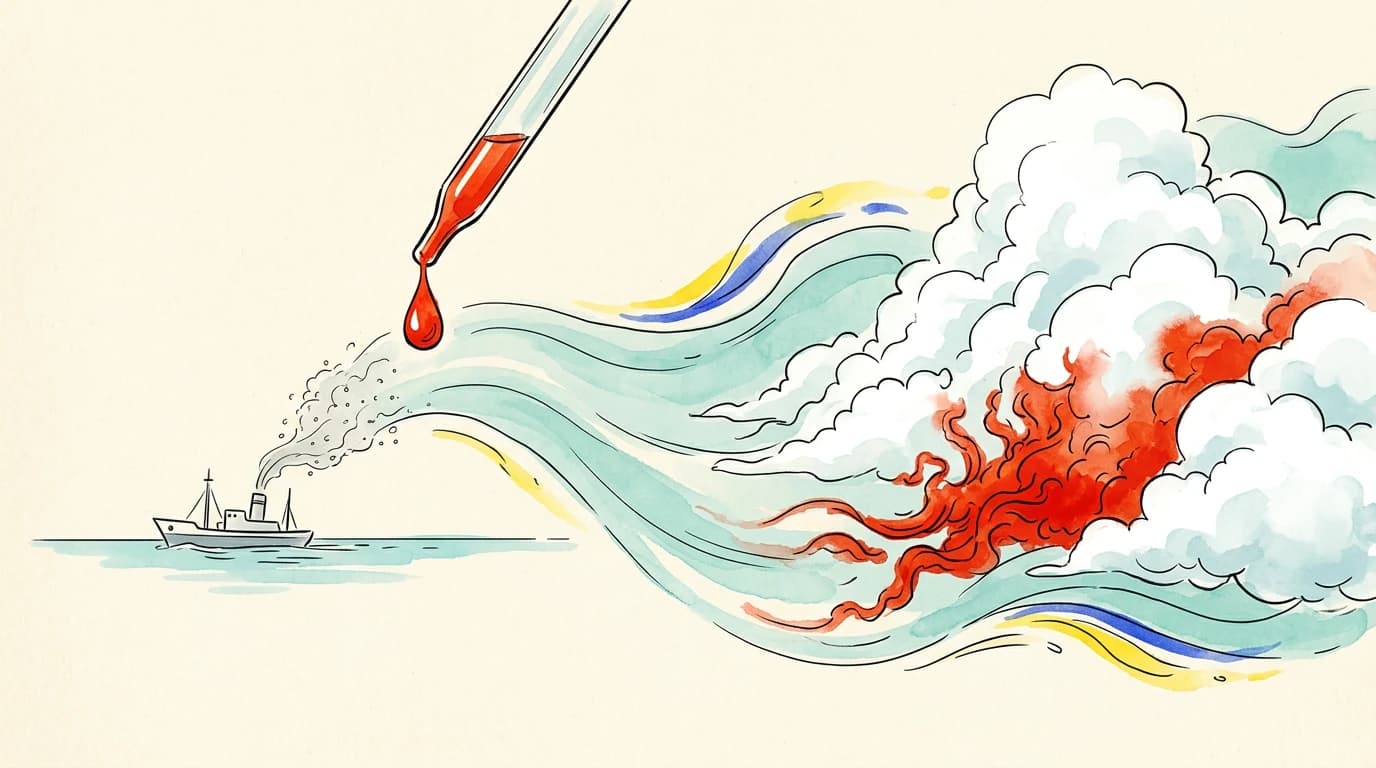
Think of it like dropping food dye into a flowing river. The brightest, widest spread does not sit where the drop landed, but spreads out downriver as the water carries it.
The team discovered that the cloud-fraction adjustment—the change in how much sky is covered—does not happen on the spot. It peaks roughly one day later and hundreds of kilometres downstream. This 24-hour lag remained steady across seasons and ocean basins. How strongly clouds responded depended on droplet effective radius, which measures the cloud water droplets' size, and lower-tropospheric stability, a measure of air resistance to vertical mixing.
What we still do not know
Assuming clouds react instantly has skewed estimates of aerosol indirect effects, which are climate shifts driven by particle-modified clouds. Still, this research tracked air over three days across three subtropical ocean regions. We do not yet know how this lag behaves over land, in different cloud types, or how it alters long-term global climate projections.
Science words
- aerosol perturbations
- Sudden or localized changes in the concentration of fine airborne particles such as smoke, dust, or pollution.
- radiative effect
- How clouds influence Earth's balance of energy by reflecting sunlight or trapping heat.
- cloud-fraction adjustment
- The change in the proportion of the sky covered by clouds following an environmental change.
- droplet effective radius
- A measure of the average size of water droplets inside a cloud.
- lower-tropospheric stability
- A measure of how resistant the lower atmosphere is to vertical motion and mixing.
- aerosol indirect effects
- Climate impacts caused when airborne particles modify cloud properties like brightness, thickness, or lifetime.
Check it yourself
This story is based on a real research paper in Scientific Publication by Chun, Eastman, Wood. We write with AI help and check it against the paper, but the original is the final word.