Why the Atlantic conveyor belt is losing its power
Measurements show that the northern Atlantic has lost roughly 18% less surface heat since 1985, causing a key ocean current system to slow down.
Reading level
The full story with proper science words explained.
Heads up: this study is a preprint, which means other scientists haven’t finished checking it yet.
A slowing ocean engine
The northern Atlantic Ocean is holding onto its warmth. From 1985 to 2023, the heat escaping the sea between lines of latitude 26.5°N and 70°N dropped by about 18%. That drop matters because venting heat into the cold northern air is what keeps the ocean moving.
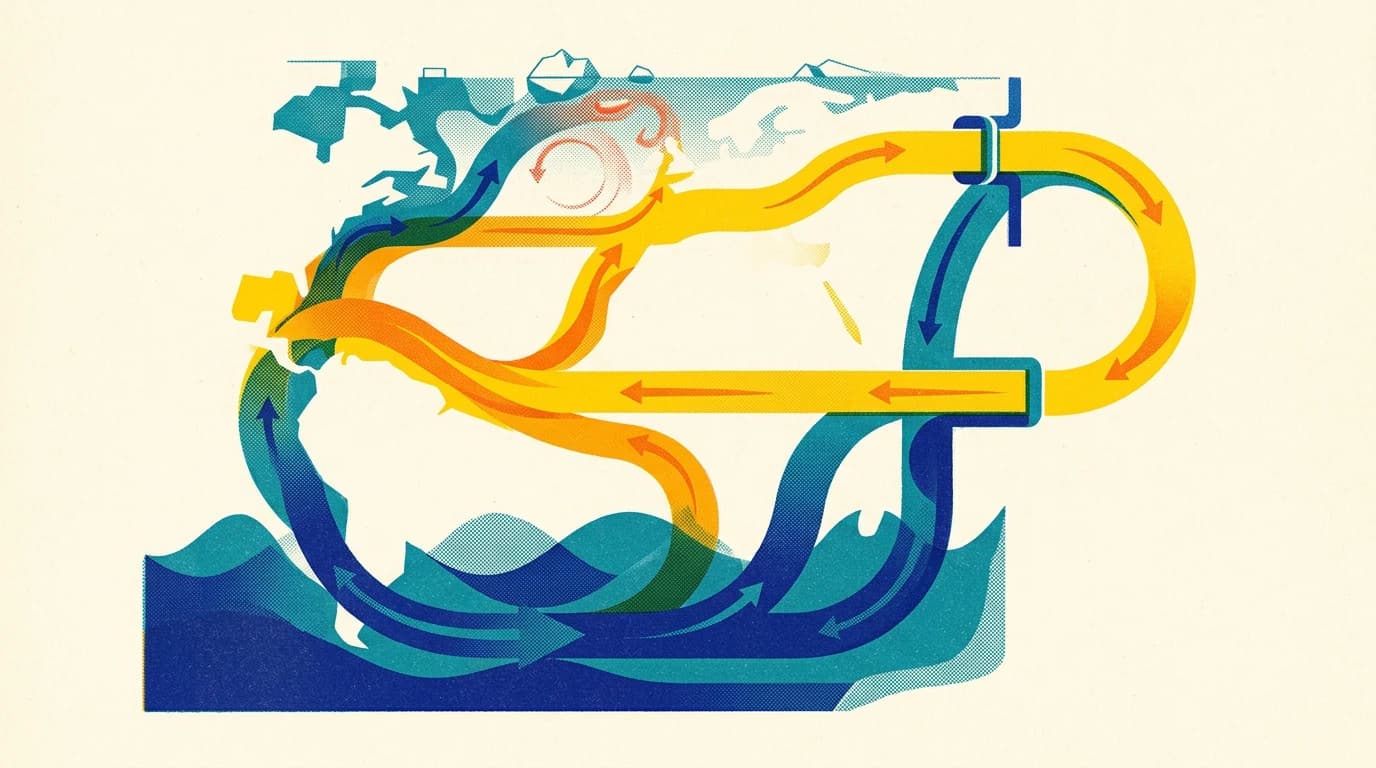
Think of it as a hot-water heating loop in a house. Warm surface water travels north, dumps warmth into the sky, turns cold and heavy, and sinks deep down to flow south again. Scientists call this loop the AMOC, short for the Atlantic Meridional Overturning Circulation. If water cannot cool down fast enough, it will not sink with the same force, which slows down the entire loop.
Tracking the lost heat
To measure this drop, scientists checked net surface heat fluxes, which mean the total balance of heat moving in and out of the sea surface. They tested these records from 1985 to 2023 against pre-industrial control simulations, which are model runs showing world climate before human smoke and smokestacks. Shifts this large over 40 years almost never happen on their own in these runs. That tells us the shift comes from forced climate change, which means shifts caused by human greenhouse gases rather than natural wobbles.
Next, the team tied the heat loss trends to a standard model set called CMIP6. They worked out that the ocean flow at latitude 26.5°N has slowed by 14.2% over the last 30 years. Watching ocean heat loss offers a stronger, more direct view of this slowdown than older indirect signs, because losing heat is the actual motor that drives the current.
What remains uncertain
This method has clear limits. The 14.2% figure comes with a wide spread of plus or minus 13.9%, meaning the real slowdown could be quite small or very large. The result also comes from computer models rather than nonstop, direct tools placed in the water for decades.
Researchers do not yet know how fast this flow will weaken across the rest of the century. They also do not yet know the exact weather patterns the slowdown will bring across Europe.
Science words
- AMOC
- The Atlantic Meridional Overturning Circulation, a system of ocean currents moving warm water north and cold water south.
- Net surface heat fluxes
- The overall balance of thermal energy entering or leaving the ocean surface.
- Pre-industrial control simulations
- Climate model experiments run with conditions as they were before human industry and emissions.
- Forced climate change
- Shifts in climate driven by outside forces like human emissions rather than natural internal variation.
- CMIP6
- A standardized collection of climate model simulations used by scientists worldwide.
Check it yourself
This story is based on a real research paper in Scientific Publication by Bell, Allan, Baker et al.. We write with AI help and check it against the paper, but the original is the final word.