Why synapses in the visual cortex need two chemical keys to rewire
In rodent brain slices, weakening connections in the visual cortex requires turning two different receptor keys at once, unlike in the hippocampus where just one does the job.
Reading level
The full story with proper science words explained.
A strict lock on sensory circuits
Why can your brain form a quick memory in seconds, yet reshape sensory perception far more slowly? Researchers studying synaptic plasticity in the visual cortex wanted to see what controls this difference. In the hippocampus, a brain region known for rapid learning, turning a single molecular key is enough to weaken connections between cells. That single key is mGluR5, a cell-surface receptor that triggers long-term depression, or LTD. In LTD, connected neurons deliberately dial down their communication strength.
Turning two keys at once
To investigate, scientists looked at layer II/III pyramidal neurons in primary visual cortex slices taken from male and female rats and mice. They tested an NMDAR-independent form of LTD, which does not rely on classic NMDA glutamate receptor channels. Here, the story changed completely. Activating mGluR5 alone—which is fully sufficient to induce mGluR-LTD in the hippocampal CA1 region—proved entirely insufficient in the visual cortex.
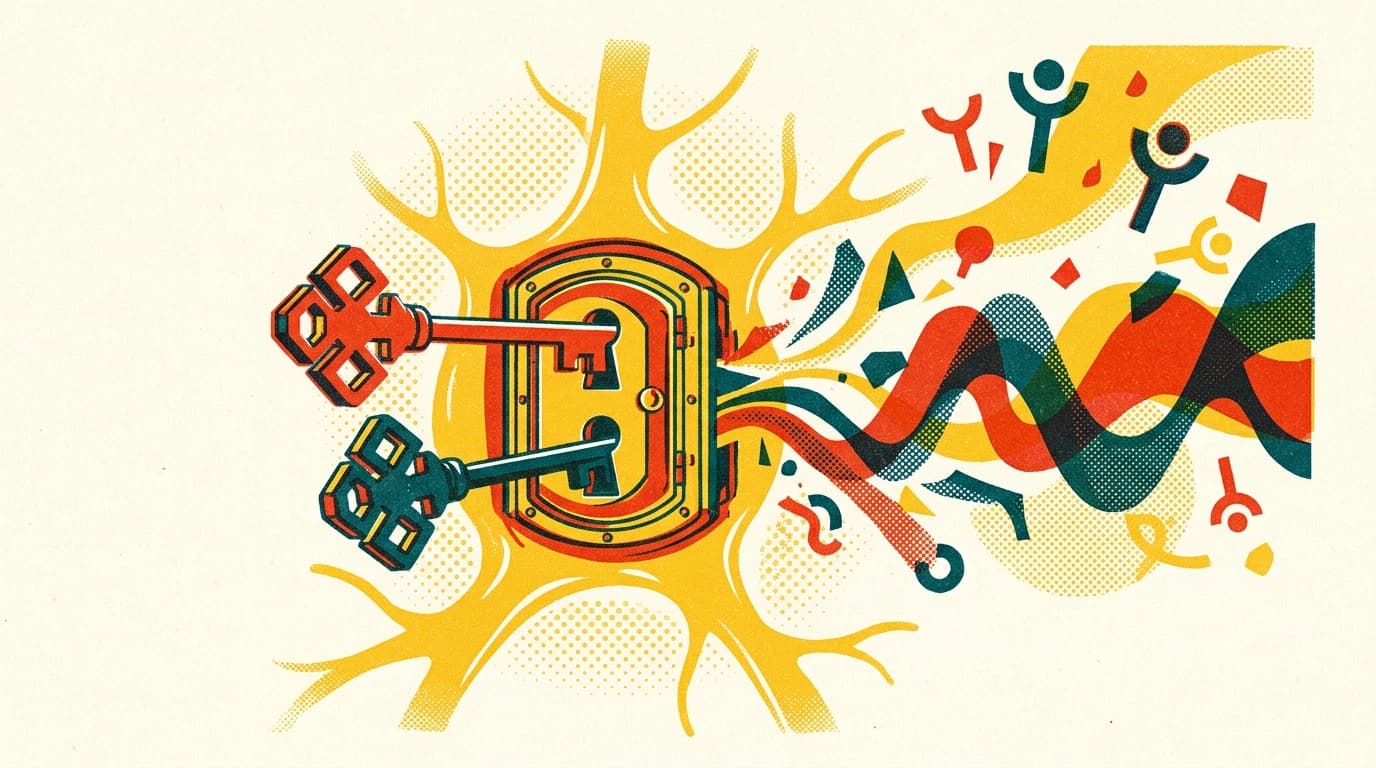
Instead, these visual cortex neurons demanded two keys turned at the exact same moment. LTD only occurred when mGluR5 was switched on alongside another G-protein coupled receptor (GPCR). This partner could be a muscarinic, noradrenergic, or serotonergic receptor. Once both receptors fired together, they drove local protein synthesis regulated by FMRP, an RNA-binding protein. This stringent double-lock mechanism may explain why sensory brain wiring resists sudden, accidental changes, supporting gradual learning instead.
What we still do not know
These experiments were carried out in brain slices rather than living animals navigating their environment. The original report did not detail exact statistical numbers or effect sizes. We also do not yet know which real-world visual cues or behavioural states switch on these specific receptor pairs in living brains, or whether other sensory regions share the exact same rules.
Science words
- LTD (Long-Term Depression)
- A lasting decrease in the signalling strength between two communicating neurons.
- mGluR5
- A receptor on the surface of neurons that triggers internal chemical cascades rather than opening an ion channel.
- GPCR
- G-protein coupled receptor; a major family of cell-surface sensors that detect chemical signals outside the cell.
- NMDAR
- A type of glutamate receptor channel commonly involved in synaptic changes.
- FMRP
- A specialised protein that controls the production of new proteins at synapses.
- CA1
- A specific subregion of the hippocampus frequently studied in learning research.
Check it yourself
This story is based on a real research paper in The Journal of Neuroscience by Severin, Moreno, Contreras et al. We write with AI help and check it against the paper, but the original is the final word.