Why split-second chemical pulses steer juvenile social play in young rats
During rough-and-tumble games, rat brains release rapid pulses of dopamine that reinforce individual physical moves. In rats lacking the autism-linked Shank3 gene, this split-second reward signal breaks down, but targeted flashes of light can restore normal play.
Reading level
The full story with proper science words explained.
Split-second moves
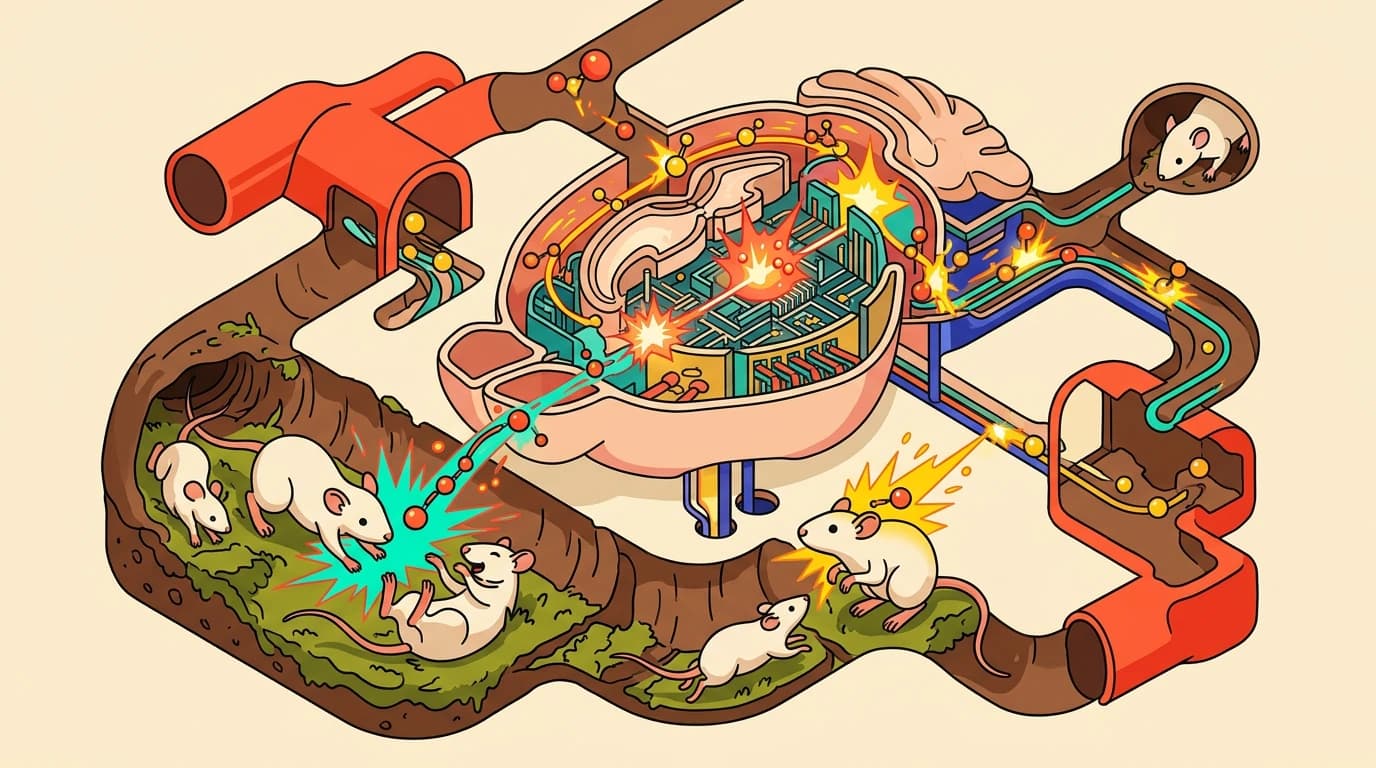
Watch two pups roll and scuffle, and the game looks wildly chaotic. Yet beneath the tumbling bodies, their brains follow a strict rhythm. A study in young rats shows that juvenile social play relies on rapid bursts of dopamine. This chemical acts as a reward signal to guide actions in real time.
To track these fast bouts, the team built a vision tool called Social-seq. By mapping 3D body poses, the tool split hectic games into tiny units called social syllables. These gestures last less than a second. At the same time, sensors measured brain signals in the nucleus accumbens, a key hub for reward learning.
The brain's real-time score
In typical rats, each bold move caused an immediate surge of dopamine. This quick burst reinforced the step right away. Typical males showed a sharp dopamine contrast between launching an attack and being held down. Young females also used dopamine during games, though their actions followed different patterns.
This reinforcement failed in rats missing Shank3, a gene linked to autism. In mutant males, proactive attacks triggered no dopamine at all. Instead, solitary actions produced strange spikes. In mutant females, the dopamine response flipped upside down. When math models ran these scrambled reward scores, virtual bots developed the exact play faults seen in real rats.
Rewiring the game
The team then tested if they could mend this broken loop. They turned to closed-loop optogenetics, which uses light to trigger altered brain cells in real time. They lit up a brain tract from the ventral tegmental area to the nucleus accumbens. When these light flashes fired only during proactive attacks, typical back-and-forth play returned.
What we still do not know
Importantly, the test does not show if reward signals can recover without sub-second light timed strictly to actions. Because tests used rats, we do not know if human brains work the same way. It also remains unknown how brain cells turn sex differences into physical moves, or if gentler therapies could match this split-second precision.
Science words
- Social syllables
- Brief, split-second movement patterns that make up the building blocks of an interaction.
- Social-seq
- A machine-vision tool that tracks 3D body positions to classify rapid behaviours.
- Nucleus accumbens
- A brain region essential for processing motivation, pleasure, and learned rewards.
- Shank3
- A gene that helps build connections between brain cells, often altered in autism.
- Closed-loop optogenetics
- A method using light to activate modified brain cells instantly when a specific action occurs.
- Ventral tegmental area
- A midbrain area containing dopamine-producing cells that connect to reward centres.
Check it yourself
This story is based on a real research paper in Cell by Chen, Tao, Zhong et al. We write with AI help and check it against the paper, but the original is the final word.