Why Solid-State Proton Batteries Could Soon Power Your Tech Without Lithium
Source PublicationAngewandte Chemie International Edition
Primary AuthorsHuang, Xiong, Liu et al.
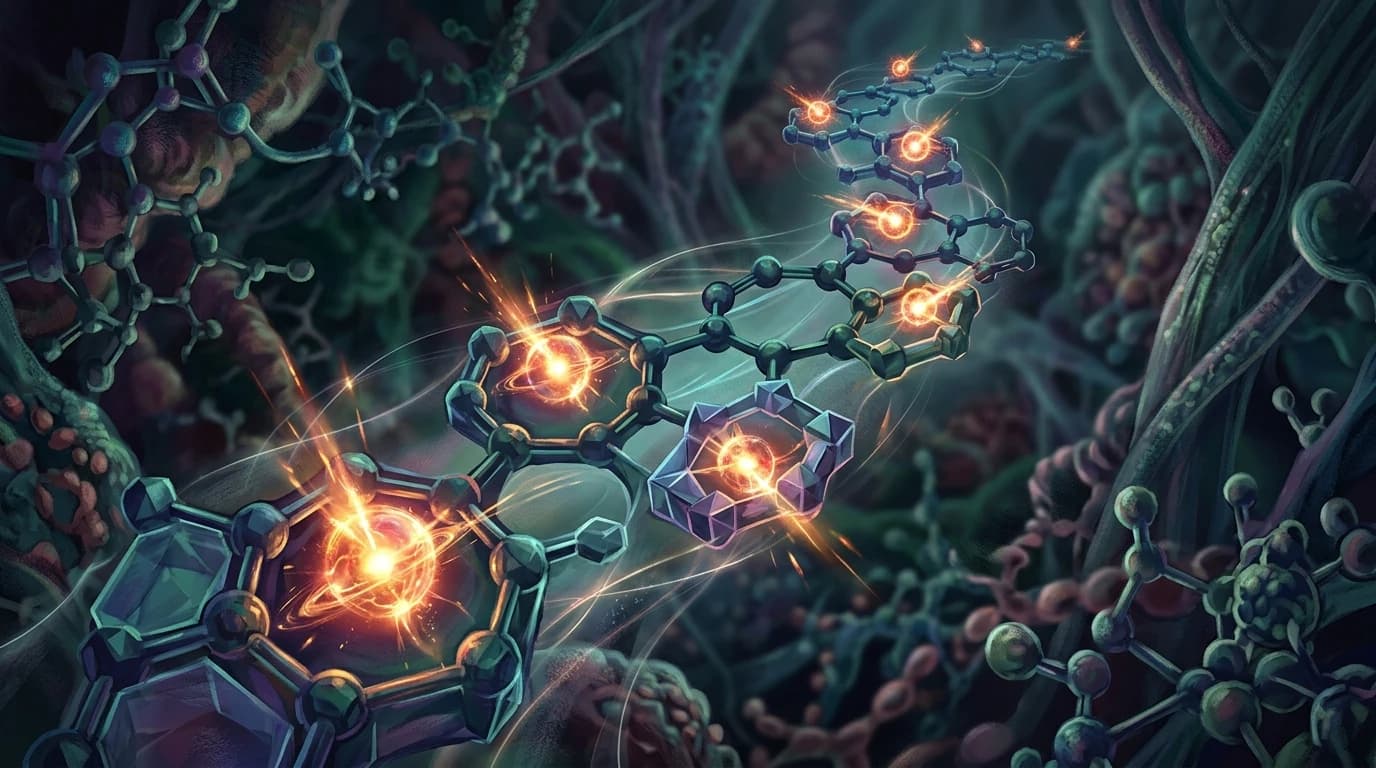
"Think of protons as runners in a relay race. Instead of swimming through liquid, they hop across a tightly linked grid of molecular stepping stones."
Did you know that the lithium inside your phone's battery isn't the only way to store energy? In fact, the simplest element in the universe—hydrogen—might actually hold the key to safer, faster charging.
The Rise of Solid-State Proton Batteries
Lithium-ion batteries can overheat and degrade over time. That is why scientists are looking at solid-state proton batteries as a stable alternative. But there is a catch: getting protons to move quickly through solid materials at room temperature is notoriously difficult.
How GDYO Speeds Up the Hop
Researchers recently solved this bottleneck by using a material called graphdiyne oxide (GDYO). By mixing GDYO with phosphoric acid, they created a three-dimensional molecular network. Spectroscopic measurements confirmed that protons hop rapidly along this network.
What This Means for Future Tech
What does this mean for future tech? The team built a full battery prototype that showed some serious stats:
- It retained 53.6% capacity at an ultrahigh charge rate of 50C.
- It kept 90.2% of its capacity after 4,500 charge cycles.
- It operates safely without flammable liquid electrolytes.
This design suggests GDYO could serve as a useful platform for building stable, high-performance energy storage.