Why solid state batteries need thin coats to stop needle-like shorts
A review reveals how thin coatings at internal borders help solid-state lithium batteries block destructive metal spikes during fast charging.
Reading level
The full story with proper science words explained.
The trouble with tight fits
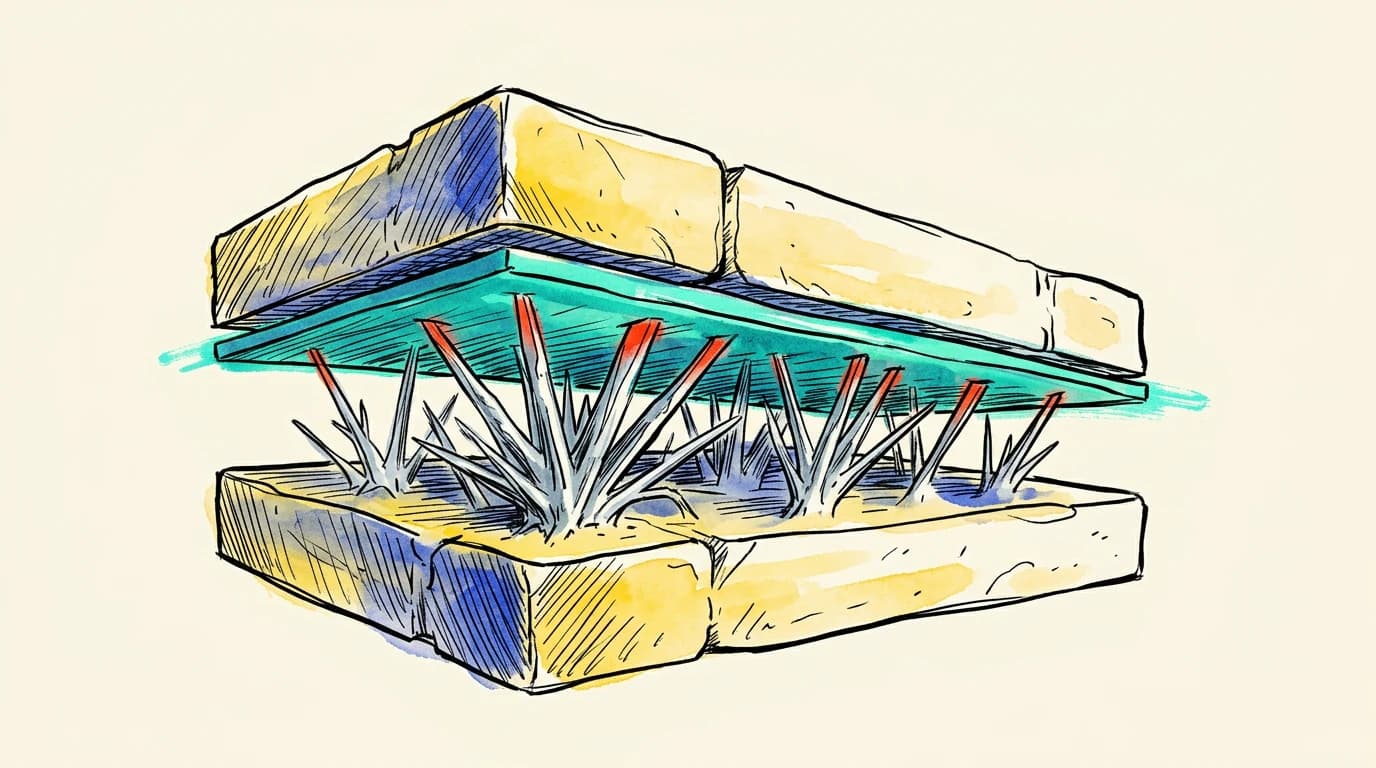
What happens when two solid parts touch inside a hard-working battery? Next-generation solid state batteries swap out runny liquids for a solid-state electrolyte, which is a firm solid that carries charged ions. A metal lithium anode must press right against this solid block.
Up close, both parts have rough faces. This leaves tiny gaps where electric power crowds together into small hot spots. When a cell runs under high current density, meaning heavy electric flow packed into a tight space, the metal builds up unevenly. It sprouts sharp needles called lithium dendrites. These spikes push straight through the solid core, causing short circuits that ruin the cell.
Thin primers and shield layers
A recent review tracks how interface engineering, or treating the contact zones between joined parts, fixes this rough fit. Think of it like putting a thin primer on a rough wall. The primer fills hidden cracks so paint sticks without peeling away. Here, an ultra-thin film spreads out the flow and keeps both sides firmly joined.
Teams use several methods to add these thin shields. One method is atomic layer deposition, which lays down films one single layer of atoms at a time. Other methods use pulsed lasers, vapour clouds, or wet chemical baths. Some designs use in situ interfacial formation, meaning the protective layer grows by itself right at the boundary as the cell runs.
These steps stop bad reactions across oxide, sulphide, halide, and polymer electrolytes. By smoothing the boundary, they stop dangerous metal spikes before they start.
What we still do not know
This review surveys known ideas rather than testing one new cell recipe. The authors do not claim that one shield design will fit every type of solid battery. Real results still vary by system. Factory teams still do not know which coating method will scale best for large plants. How many fast charge cycles these cells can endure also remains unknown.
Science words
- Solid-state electrolyte
- A solid material that conducts ions between battery electrodes instead of a liquid solution.
- High current density
- Operating a battery with a large flow of electric current packed into a small area.
- Lithium dendrite
- Microscopic, needle-like metal spikes that can pierce battery layers and cause short circuits.
- Interface engineering
- Modifying or treating the contact surface between two different battery materials.
- Atomic layer deposition
- A high-precision manufacturing method that deposits films one single atomic layer at a time.
- In situ interfacial formation
- Creating a protective layer directly at the contact zone during battery assembly or operation.
Check it yourself
This story is based on a real research paper in Materials Horizons by Saju, Ivers, Jose et al. We write with AI help and check it against the paper, but the original is the final word.