Why Severe Drought Puts Desert Cacti at Higher Risk
Computer models show that factoring in severe drought alongside warmer temperatures pushes the projected loss of suitable habitat to 69–72% across 993 assessed cactus species.
Reading level
The full story with proper science words explained.
Surviving the dry heat
Cacti are famous for surviving in bone-dry dirt. Yet rising temperatures and harsher dry spells are testing those limits, dramatically altering future cactus extinction risk.
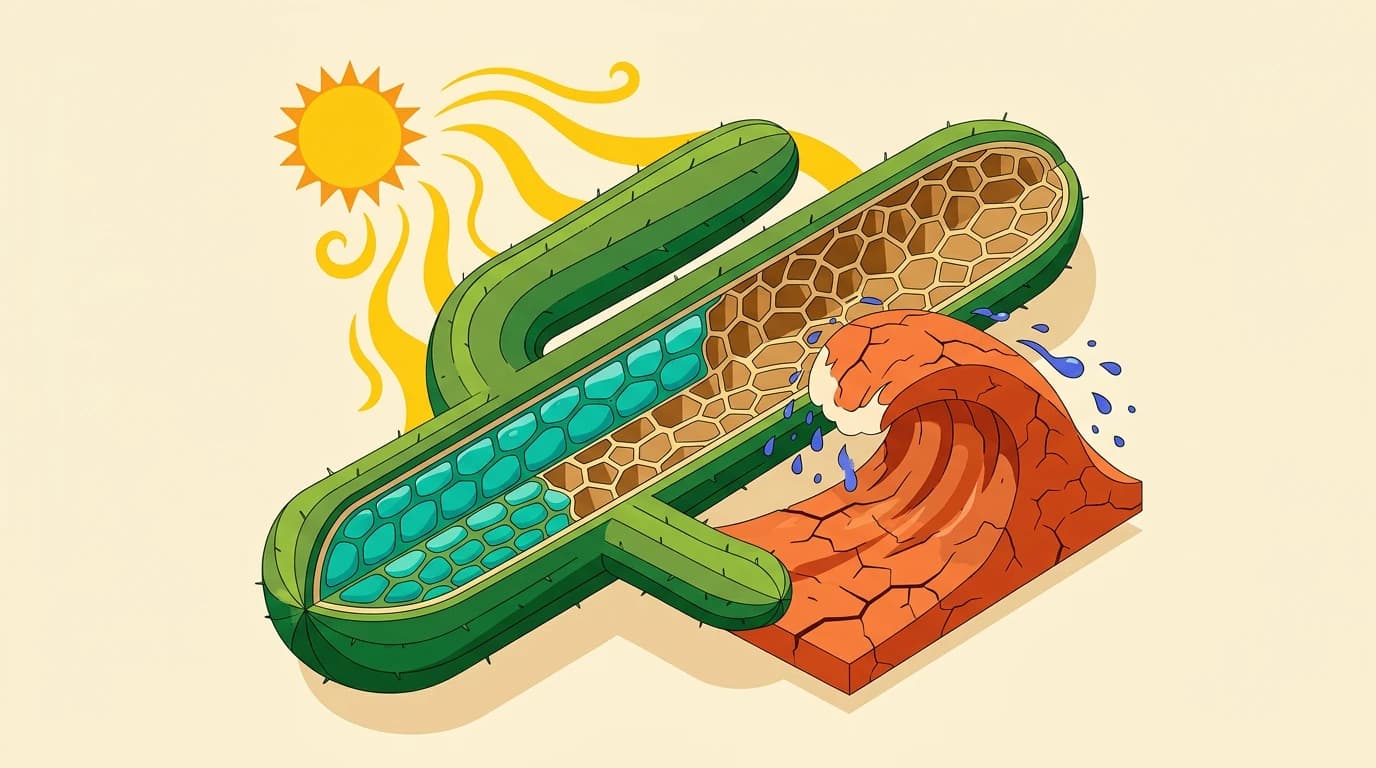
Ecologists usually predict where plants can survive by looking at average yearly rainfall and temperature. But judging climate threats only using mild seasonal averages is like judging a ship’s safety by calm seas while ignoring massive rogue waves.
Adding the spikes to the forecast
To see what happens when extremes hit, researchers examined 648,316 records covering 993 species in the Cactaceae family. They ran species distribution models across different future greenhouse gas scenarios, known as Shared Socioeconomic Pathways (SSPs), from low to high emissions.
Instead of relying on averages alone, the team integrated severe drought alongside hotter temperatures. In 91% of cases, models that included severe drought performed better than standard average-climate forecasts.
Losing suitable ground
The results suggest that many species may struggle to cope. Assuming plants can manage a 100-km dispersal to track good weather, severe drought raised the proportion of species losing suitable climatic area from 58–61% up to 69–72% across all emissions scenarios.
The share of species projected to lose over four-fifths of their habitat jumped from 1–15% in average models to 25–35% with extreme drought. If species cannot spread to new ground at all (0-km dispersal), habitat loss reaches 84–85%. Across five major bioregions, more than a quarter of resident cactus species could lose their homes.
What we still don't know
Importantly, this computer model evaluates potential changes in suitable climatic area rather than tracking real-time population collapses or direct extinctions happening on the ground today. The models also simplify seed dispersal to fixed distances of zero or 100 kilometres.
Scientists still do not know the precise biological limits that govern heat and drought tolerance in individual species. Whether other desert plants face an identical squeeze also remains to be tested.
Science words
- Species distribution models
- Computer simulations that predict where a species can survive based on environmental factors like temperature and rainfall.
- Shared Socioeconomic Pathways (SSPs)
- Standardised scenarios showing how future greenhouse gas emissions and societal developments might unfold.
- Dispersal
- The movement or spread of seeds and offspring from one location to another.
- Suitable climatic area
- The geographical range that has the right temperature and moisture conditions for a species to live.
- Bioregion
- A large ecological area defined by distinct natural boundaries and unique mixes of species.
Check it yourself
This story is based on a real research paper in Nature by Pillet, Maitner, Arakaki et al. We write with AI help and check it against the paper, but the original is the final word.