Why quantum entanglement resilience shields devices from errors
A modelling study shows that as quantum particles entangle, their shared connections naturally dilute hardware errors without needing complex correction codes.
Reading level
The full story with proper science words explained.
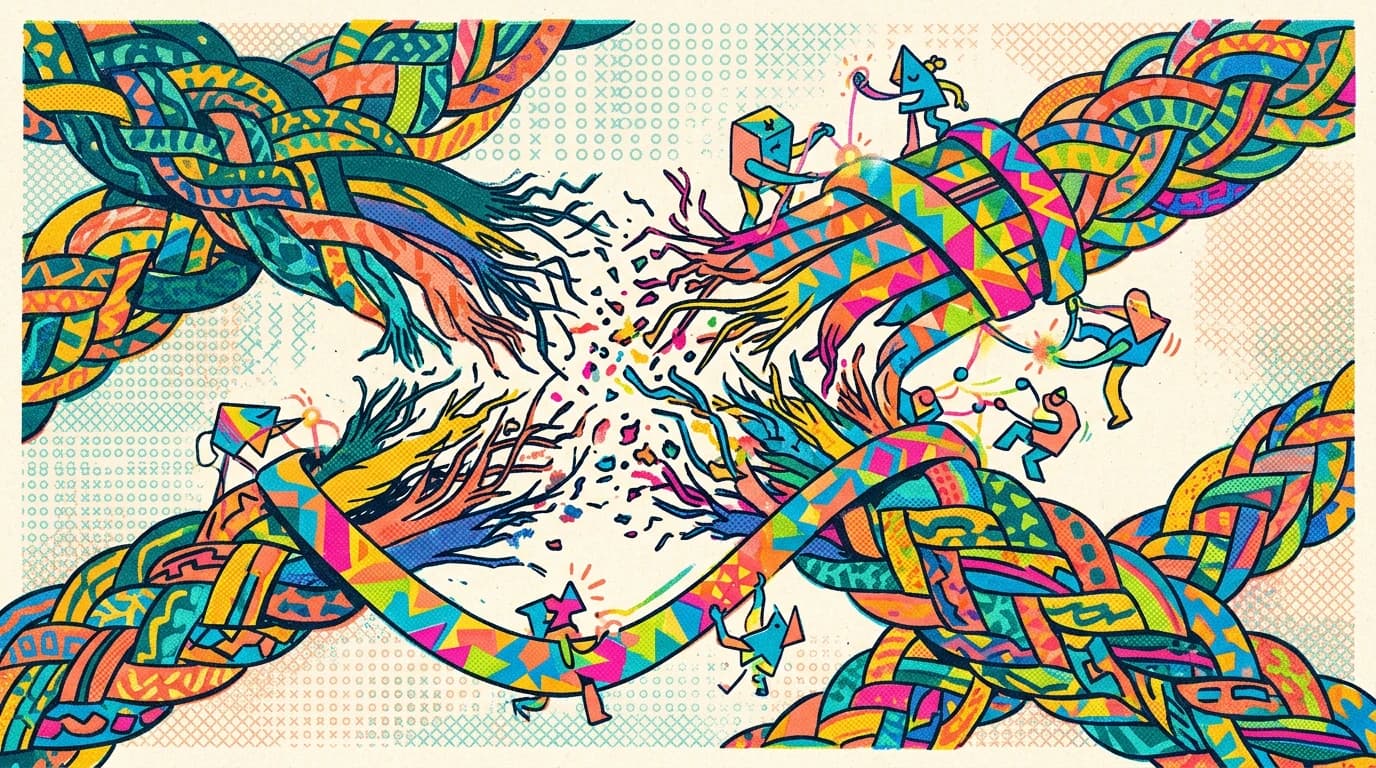
A sharp poke easily pierces a loose thread. In contrast, striking a woven fabric spreads the impact across thousands of fibres. In quantum devices, tiny hardware flaws often build up until calculations collapse. Now, a modelling study reveals an internal defence called quantum entanglement resilience. The work shows that strong connections between quantum objects can act like that tightly woven net.
The hidden flaw in quantum hardware
Quantum computers rely on fragile states that are easily spoiled by noise. A common problem is cross-talk, which refers to unwanted nudges between neighbouring qubits. Usually, scientists calculate these mistakes using a spectral norm. This mathematical tool captures the absolute worst-case damage an error can cause. Across many interacting objects, that worst-case damage adds up fast. It scales directly with the number of error terms. To fix this, builders often think they need complex, resource-heavy correction codes. But the study asked a different question: could the system naturally protect itself?
How shared ties dilute the damage
The team modelled how many-body quantum systems change over time. They tracked entanglement entropy, a measure of how strongly one part of a system connects to the rest. As parts interact, their shared links grow quickly. This growth pushes small local areas into a scrambled, mixed state. When that happens, local cross-talk nudges practically cancel out. Local mistakes stay trapped instead of spreading through the whole device. The error drops from the worst-case spectral norm to a Frobenius norm. This number reflects the much smaller, average-case damage across all states. If a system has bounded error terms, this effect shrinks the total damage. The build-up shifts from a large value linked to N down to the square root of N.
Testing the shields
The team tested this mechanism in several computer models. In a transverse-field Ising model, an analog simulation of interacting spins, errors dropped down to the lower Frobenius bound. This happened as soon as the shared ties levelled out. In an 8-site Fermi-Hubbard chain, errors spiked whenever links between pairs weakened. The errors then fell back to average levels as the entropy peaked at 4. Simulating a 3x4 quantum dot array running 180-nanosecond gates, they found a clear trend. Turning up initial entanglement drove gate errors straight toward the lower bound. In addition, scientists can check for this shield by measuring local cross-talk directly. This test avoids quantum state tomography, a slow process that requires measuring an entire quantum state completely.
What we still do not know
This natural shield has clear limits. Entanglement blunts systematic cross-talk, but it does not remove errors caused by random disorder. Unusual states that fail to build up enough links remain exposed to worst-case failures. It also remains unknown how well this effect works in open experiments that leak energy. Finally, we do not know if it can protect general digital circuits without hitting local snags.
Science words
- Cross-talk
- Unwanted, parasitic interactions between neighbouring qubits that create systematic errors.
- Spectral norm
- A mathematical measurement that captures the absolute worst-case impact an error can have on a quantum state.
- Entanglement entropy
- A metric quantifying how strongly a subregion of a system is quantum-mechanically linked to the remainder.
- Frobenius norm
- A mathematical measurement reflecting the typical, average-case magnitude of an error across states.
- Transverse-field Ising model
- A standard physics model of interacting quantum spins placed within an external magnetic field.
- Quantum state tomography
- A resource-heavy experimental process used to fully reconstruct an unknown quantum state using extensive measurements.
Check it yourself
This story is based on a real research paper in Science Advances by Feng, Cao, Yu et al. We write with AI help and check it against the paper, but the original is the final word.