Why planting native trees beside oil palms creates vital forest air conditioning
Planting native trees along rivers in oil palm plantations creates cooler, more stable microclimates that shield wildlife from heat. These restored strips could buffer animals against future climate extremes through 2085.
Reading level
The full story with proper science words explained.
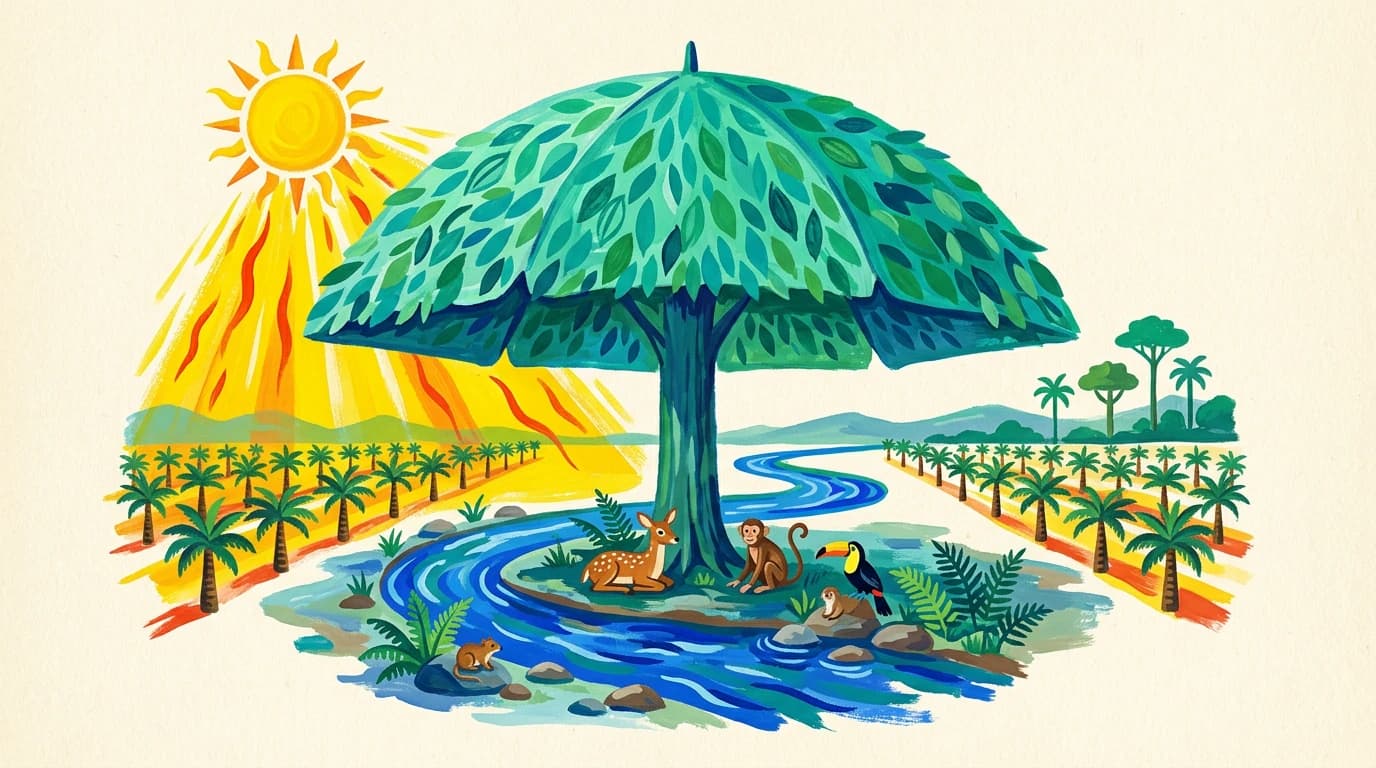
A baking plantation
Step onto an oil palm plantation at midday, and the heat feels relentless. Tropical agricultural land gets fiercely hot, leaving forest creatures with few places to hide from baking temperatures. But what happens if you bring native trees back to the water's edge?
Building a living parasol
To find out, researchers set up the Riparian Ecosystem Restoration in Tropical Agriculture project in Riau, Indonesia. They wanted to test oil palm restoration along streams, also known as a riparian margin. They compared three different strategies: replanting young palms right to the water, letting nature take its course under old palms through passive restoration, and active restoration by planting six native tree species.
Six years later, the team mapped the forest structure using terrestrial laser scanning, which fires laser pulses to build 3D maps of vegetation. They also measured surface heat with thermal cameras and temperature loggers. Finally, they combined their field readings with climate projections called Shared Socioeconomic Pathways to see how these sites would cope in 2045 and 2085.
Cool shade that lasts
The actively replanted riverbanks grew a thicker, more complex overhead canopy than the other plots. This living parasol produced far cooler, more stable microclimates. The thermal cameras revealed significantly more cool surface pockets, creating microclimatic refugia—small, cooler shelters where vulnerable animals can escape deadly heatwaves. The climate models confirmed that these restored banks will still reduce thermal extremes decades from now.
What we still don't know
This study comes from a preprint, meaning independent scientists have not fully peer-reviewed it yet. The field trials took place at a single site in Indonesia over six years and tested only six native tree species. We do not yet know how these riverbanks will perform as the trees fully mature, or exactly which animals will rely on them over time.
Science words
- Riparian margin
- The strip of vegetated land directly bordering a river or stream.
- Passive restoration
- Allowing an ecosystem to regenerate naturally without planting new trees.
- Active restoration
- Direct human help to restore an ecosystem, here by planting native tree species.
- Terrestrial laser scanning
- A ground-based tool that uses laser pulses to map vegetation structure in 3D.
- Microclimatic refugia
- Small, local areas that stay cooler and offer wildlife shelter from extreme heat.
- Shared Socioeconomic Pathways
- Standardised future scenarios showing how society and climate might change.
Check it yourself
This story is based on a real research paper in Preprint by Shin-Clayton, Aryawan, Senior et al.. We write with AI help and check it against the paper, but the original is the final word.