Why pairing up polymer photocatalysts helps turn sunlight into clean fuel
Joining two solar-active plastics helps rip trapped electrical charges apart to make clean fuel, but laboratory claims still need closer inspection.
Reading level
The full story with proper science words explained.
The problem with stubborn charges
Standard solar catalysts like titanium dioxide ignore over 95% of sunlight because they only absorb ultraviolet rays. Coloured plastics known as polymers offer a promising path forward because they soak up visible light. Yet they bring their own puzzle. When sunlight strikes a polymer, it kicks a negative electron free, leaving behind an empty positive space called a hole. Together, these two form a tightly bound pair called an exciton.
Think of an exciton as two dance partners clinging tightly to each other across a crowded hall. Because organic plastics have low dielectric screening between 2 and 4, they lack the strong electrical shielding found in mineral crystals. Their exciton binding energy sits between 0.2 and 0.7 electronvolts. This grip is over four times stronger than in mineral semiconductors, where binding energy stays below 0.05 electronvolts. The partners simply refuse to let go, which means they cannot easily drift to the surface to split water or clean up pollutants on their own.
Teaming up to split the pair
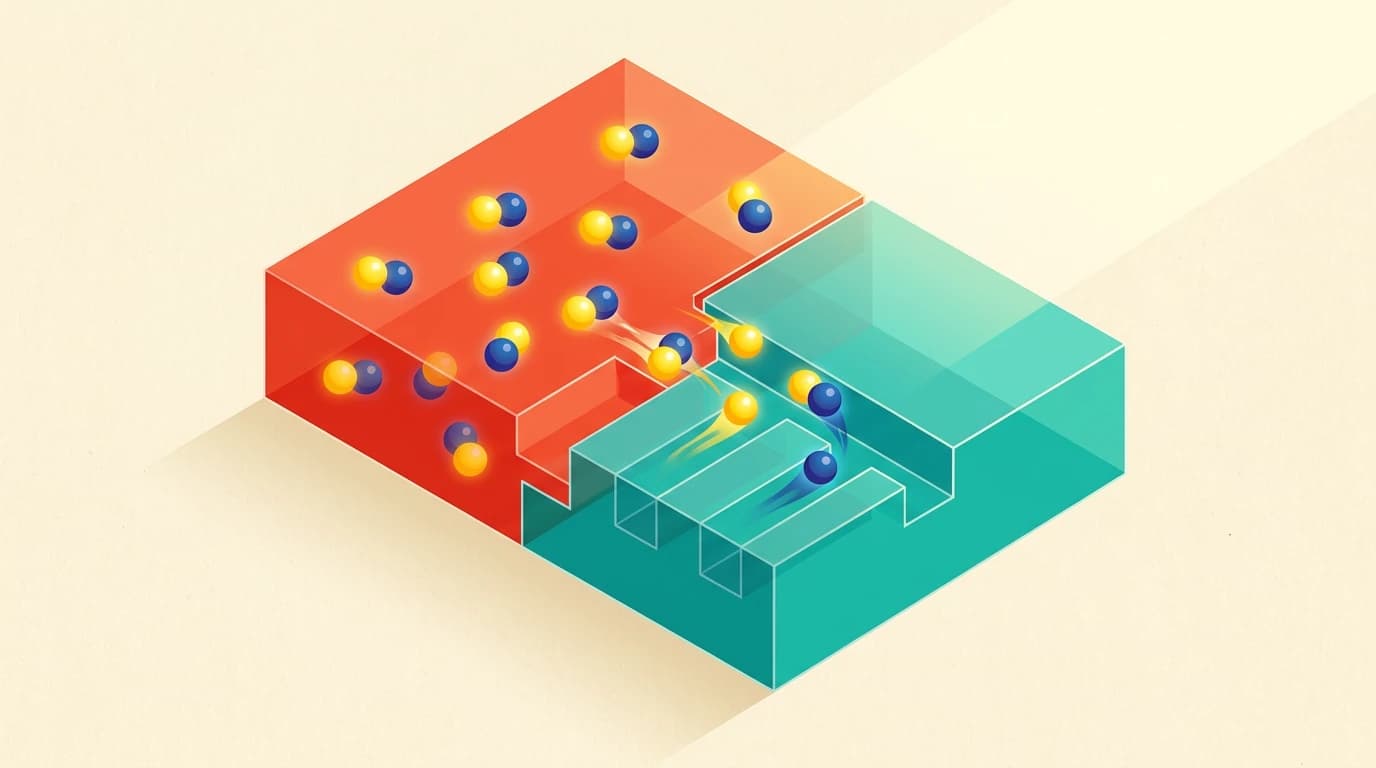
To pull these charges apart, scientists build a heterojunction, which is an intimate boundary joining two distinct semiconductors. When two different plastics meet, the steps between their internal energy levels pull the negative charge to one side and the positive hole to the other. This spatial split leaves both charges free to do chemical work.
For instance, pairing a benzothiadiazole-thiophene copolymer with graphitic carbon nitride produced 19.36 millimoles of hydrogen gas per gram each hour. That is over 13 times higher than using the carbon nitride alone, and seven times higher than using the copolymer by itself. Another clever design spins P3HT plastic and carbon nitride together into composite fibre membranes. This mixture reached an apparent quantum yield of 77.4% under 420 nanometre light, meaning more than three-quarters of incoming light particles sparked a reaction.
Tweaking the plastic chains from the inside also helps. Adding bromine atoms into polymeric carbon nitride twists its flat sheets out of shape. This structural shift moves its highest occupied and lowest unoccupied molecular orbitals (HOMO and LUMO) into separate zones. That tiny change more than doubled its uranium cleanup rate while keeping it stable across five test cycles.
What we still do not know
Impressive lab results can sometimes hide real weaknesses. A paper might boast a huge 50-fold jump in hydrogen output, but that big multiple is easy to reach when the starting plastic barely worked. Bragging about massive gains from a near-zero baseline tells us very little about practical real-world performance. In addition, simply making a powder with more surface area does not guarantee success if the surface repels water or contains destructive structural flaws. Almost all reported recipes remain stuck in tiny laboratory batches of under one gram.
Most importantly, seeing a drop in emitted light or showing that energy levels align on paper does not prove how charges actually move. Scientists still argue whether charges separate mainly through built-in electric fields or simple particle diffusion. Advanced tools like transient absorption spectroscopy are needed to confirm whether these systems follow stepped routes, such as an S-scheme mechanism, or other pathways.
Science words
- Exciton
- A bound pair made of an excited negative electron and the positive hole it left behind.
- Heterojunction
- A shared boundary between two different semiconductors that helps pull opposite electrical charges apart.
- Apparent Quantum Yield
- The percentage of incoming light particles that successfully trigger a chemical reaction.
- HOMO and LUMO
- The highest occupied and lowest unoccupied energy levels where electrons sit in a molecule.
- S-scheme mechanism
- A stepped pathway where weaker charges recombine at an interface to preserve the most reactive charges.
Check it yourself
This story is based on a real research paper in RSC Advances by Majid, Raza, Noureen et al. We write with AI help and check it against the paper, but the original is the final word.