Why obesity duration damages the heart across decades
Tracking thousands of people from childhood to age 62 revealed that carrying obesity for decades steadily increases blood markers of heart injury and stress.
Reading level
The full story with proper science words explained.
A lifelong clock
Does living with obesity for five years affect your heart the same way as carrying it for twenty-five? A study tracked 4,901 people born in 1958, measuring their body mass index from age 7 up to 62. The team wanted to know if obesity duration damages the heart independently of a person's current weight.
Tracking wear and tear
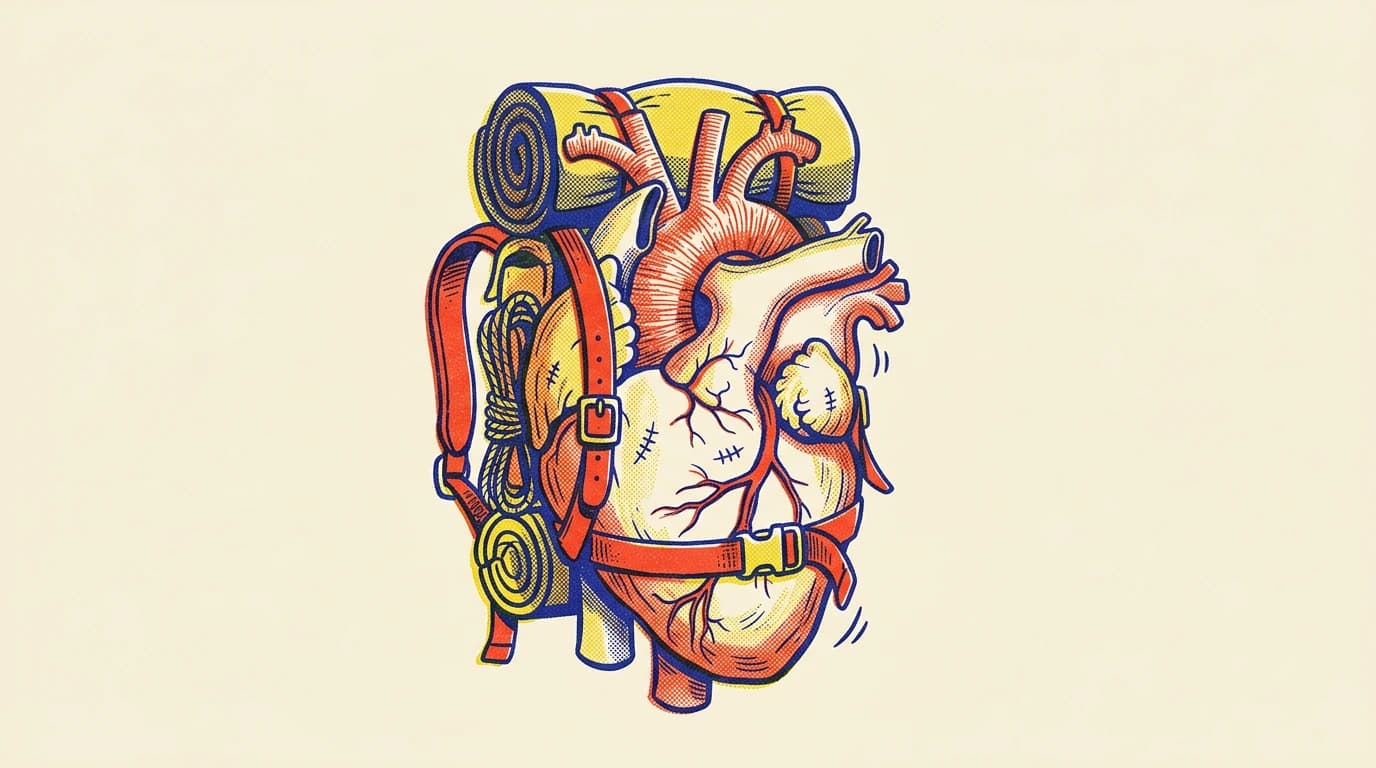
Think of carrying a heavy backpack. A quick walk with heavy straps might cause little trouble, but hiking with it for decades slowly wears out the frame. To test this, researchers checked three blood biomarkers at age 62. They measured hs-cTnI, a protein released when heart muscle cells suffer injury. They also measured NT-proBNP, which signals stretched heart walls, and GDF-15, a marker of cellular stress.
The results showed that time matters. Every extra year of living with obesity was linked to a 0.41% rise in hs-cTnI. In addition, ever having experienced obesity was tied to 11.00% higher hs-cTnI in men, though not in women. Meanwhile, each unit of mean excess BMI—the average amount weight stayed above the obesity cutoff—raised NT-proBNP by 4.02% and hs-cTnI by 2.00%.
The 25-year threshold
Stress markers showed a sharp turning point. Levels of NT-proBNP and GDF-15 stayed relatively steady until obesity lasted beyond roughly 25 years. After that point, each additional year was tied to a 1.80% rise in NT-proBNP and a 0.81% rise in GDF-15. The backpack straps finally begin to tear.
What we still don't know
This work comes from a preprint, meaning independent scientists have not fully peer-reviewed it yet. The study shows an association, not direct proof that time alone caused the changes. We still do not know the exact biological triggers behind the 25-year jump. It also remains unknown whether reversing obesity in later years can return these heart markers to normal levels.
Science words
- hs-cTnI
- A heart protein released into the bloodstream when cardiac muscle cells suffer injury.
- NT-proBNP
- A substance released into the blood when heart muscle walls are stretched or under strain.
- GDF-15
- A blood marker that rises in response to cellular stress and inflammation.
- Mean excess BMI
- The average amount a person's body mass index remained above the obesity cutoff during their time living with obesity.
Check it yourself
This story is based on a real research paper in Preprint by Johnson, Norris, Hughes et al.. We write with AI help and check it against the paper, but the original is the final word.