Why magnetic carbon capture makes methane when ordinary furnaces ruin the catalyst
Heating a carbon-trapping material with alternating magnetic fields turns dilute carbon dioxide into methane in minutes, whilst standard heating ruins the catalyst completely.
Reading level
The full story with proper science words explained.
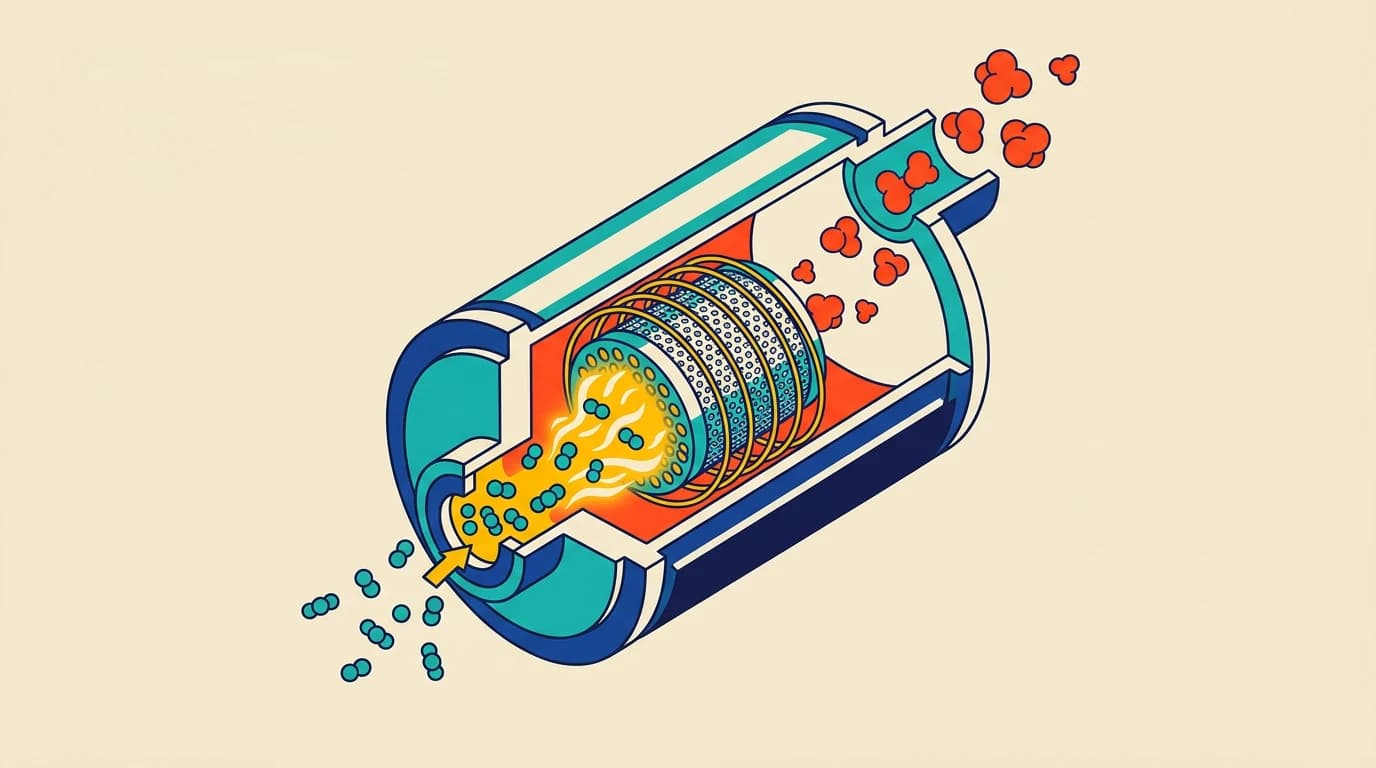
Think of warming a small pie by heating an entire kitchen. Standard chemical reactors often operate this way. They slowly warm large steel vessels from the outside just to trigger reactions within. This slow response time, known as thermal inertia, creates long delays whenever temperatures need to rise or fall.
Heating from the inside out
To speed up this cycle, researchers tested magnetic carbon capture. They used multi-function materials made from iron, nickel, and sodium. These single substances act as both a sponge to trap dilute carbon dioxide and a helper to transform it into fuel. Instead of using an external flame or hot wall, the team applied high-frequency alternating magnetic fields directly to the metal grains.
Because the material contains ferromagnetic elements that respond strongly to magnets, it heats up from the inside. Temperatures climbed at 200 to 400°C each minute. As a result, the reactor reached its target working temperature in minutes rather than hours.
Why standard heat failed
Speed was only part of the story. When the team tested the exact same recipe with standard contact heat, the entire process broke down. Normal furnace heat caused phase segregation, meaning the evenly mixed ingredients separated into clumped parts. It also caused sodium to wander away from its post. Once these alkaline sites moved, the material could no longer trap carbon dioxide gas from the air.
Localised magnetic heating produced the opposite outcome. It kept the sodium sites intact while building a pool of reactive hydrogen on the metal surface. That allowed the reactor to convert trapped waste gas directly into methane. Standard furnace heat simply destroyed the substance before it could complete this conversion.
Unanswered questions
This laboratory trial demonstrates an efficient path toward power-to-X technologies, which convert electricity into synthetic fuels. However, key limits remain. We do not know how well the substance will hold up after long cycles of repeated heating, or if it stays efficient at full factory scales. The tests also tracked only methane, so we do not yet know if it can produce other useful fuels.
Science words
- Thermal inertia
- The slow response of a bulky physical system to temperature changes, causing long heating and cooling delays.
- Multi-function materials
- Single engineered substances that both capture carbon dioxide and chemically transform it.
- Phase segregation
- The separation of a well-mixed material into distinct, unmixed chemical parts, often degrading performance.
- Power-to-X
- Processes converting surplus electrical power into alternative synthetic fuels or chemical products.
Check it yourself
This story is based on a real research paper in Angewandte Chemie International Edition by Lee, Wrasman, Hayden et al. We write with AI help and check it against the paper, but the original is the final word.