Why human noise pollution changes how four in five studied species live
A global analysis of 177 animal species reveals that human-made noise alters biological traits in four out of five tested creatures. This disruption reaches from individual behaviour to entire food chains across land and water.
Reading level
The full story with proper science words explained.
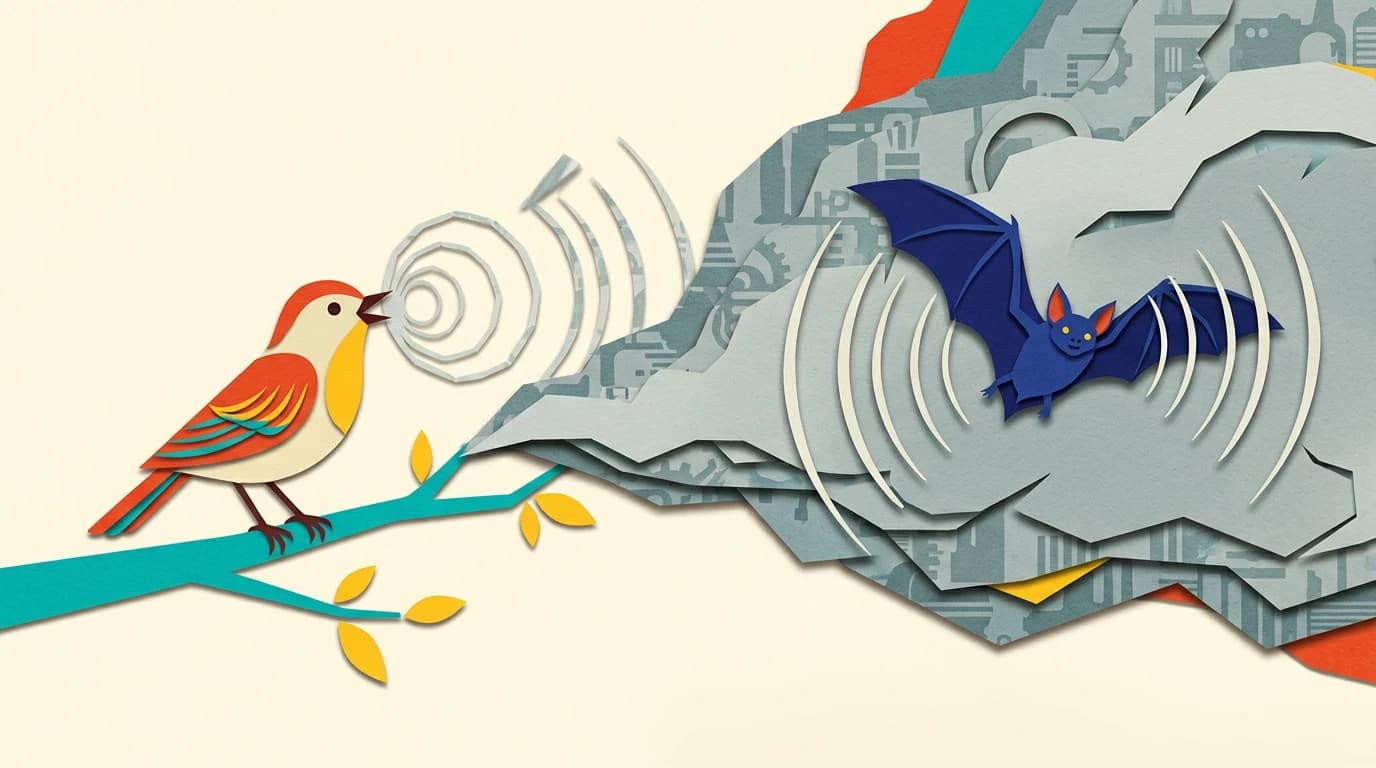
The volume is turned right up
Human noise stretches everywhere, but can sound alone change wild survival? To find out how noise pollution affects wildlife, researchers gathered data from 214 experimental studies across six continents. They examined 177 aquatic and terrestrial species, looking at everything from tiny body processes to overall population numbers.
To avoid false conclusions, they used a phylogenetically controlled meta-analysis. This statistical approach pools multiple investigations while accounting for the evolutionary family tree connecting different species. The question was whether human clatter truly rattles wildlife globally or just causes minor, isolated irritations.
Winners and losers in a loud world
The pattern was striking. Anthropogenic noise altered at least one measured physiological, developmental, or behavioural trait in 80% of the species studied. Noise was not just a passing nuisance. It caused measurable declines in animal fitness, which measures how well organisms survive and produce offspring. Across every examined habitat, human sound also reduced abundance and disrupted vital predator-prey interactions.
However, sound does not hit every creature the same way. The response mechanisms varied across specific traits and species, meaning that noise creates clear winners and losers. Some species manage or even benefit, whilst others struggle to feed, breed, or hide.
Why soundscapes matter
Because it reshapes who survives, human racket functions as a novel selection pressure. This external force actively drives evolutionary changes and remakes entire communities. Conservationists often focus on protecting physical land or clean water. These findings show that protecting the natural soundscape, the total acoustic environment of a habitat, is just as necessary for safeguarding wild populations.
What we still do not know
Scientists still do not know the full long-term, ecosystem-scale consequences across unstudied species. We also need to learn the exact physical mechanisms that decide why some species emerge as winners whilst others become losers.
Science words
- Anthropogenic noise
- Sound pollution created directly by human activity.
- Phylogenetically controlled meta-analysis
- A statistical method combining separate studies while correcting for evolutionary family relationships among species.
- Fitness
- An organism's ability to survive and successfully reproduce.
- Selection pressure
- An external factor that affects which organisms survive and reproduce.
- Soundscape
- The collection of natural and human-made sounds that make up an environment's acoustic profile.
Check it yourself
This story is based on a real research paper in Science by Kunc, Schmidt. We write with AI help and check it against the paper, but the original is the final word.