Why counting damaged coral reefs as protected misses real conservation goals
A modelling study of the Great Barrier Reef shows that tracking reef health, rather than just location, completely changes which areas need urgent protection.
Reading level
The full story with proper science words explained.
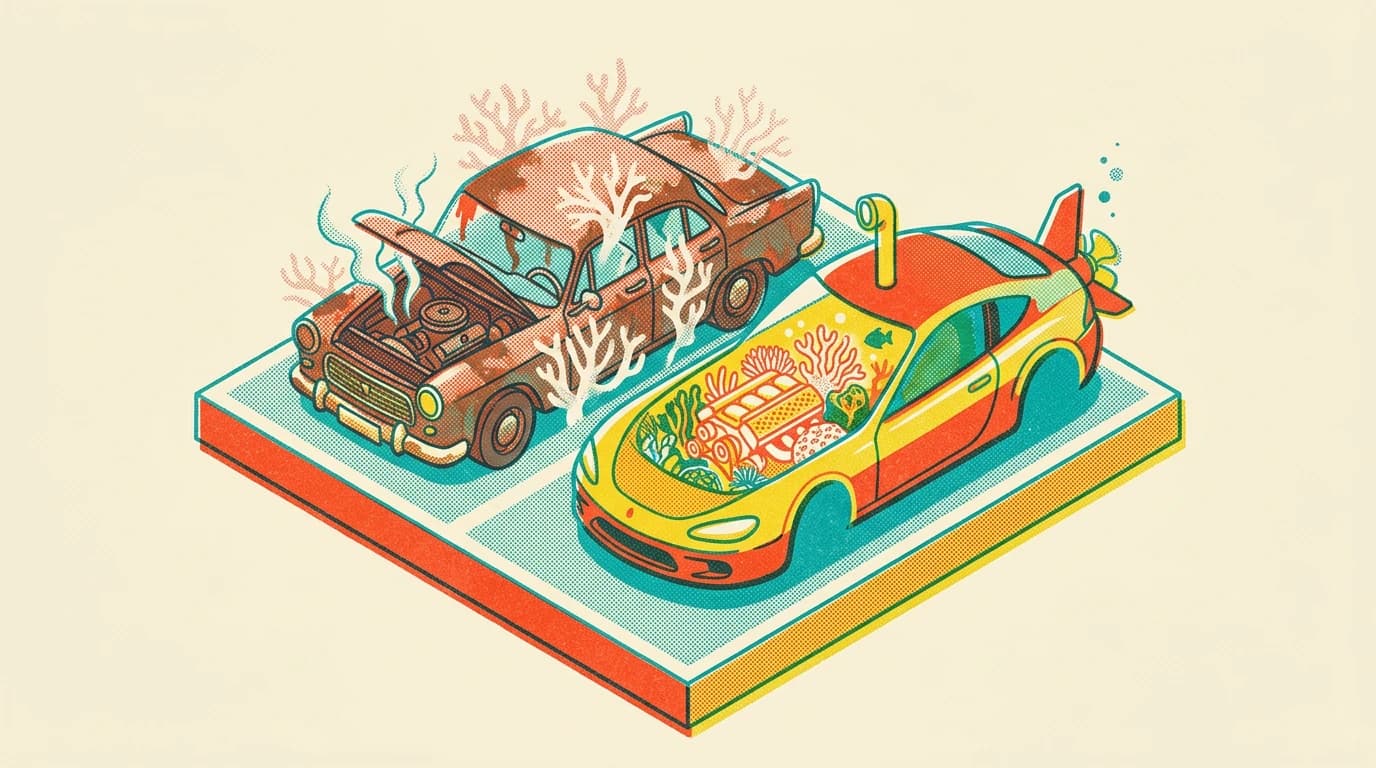
Counting car parks without checking the engines
Imagine filling a car park with vehicles to build a transport network, but never checking if their engines actually work. On paper, every space is full. In reality, half the fleet cannot move.
Marine planners face a similar puzzle with coral reef conservation. Under the Kunming-Montreal Global Biodiversity Framework, countries aim to protect 30% of marine areas by 2030 through GBF Target 3. Historically, plans often relied on presence-only approaches, mapping where reefs exist without checking their actual health.
Why ecosystem health shifts the map
Researchers tested this approach using computer models of Australia's Great Barrier Reef. They compared basic maps showing where coral sits against models incorporating static and modelled temporal condition datasets, which track ecosystem health over time.
The results shifted spatial planning priorities dramatically. Omitting reef health resulted in entirely different reefs being picked. Almost half of the priority reefs identified when condition was included became low priority when condition was ignored. Basic maps treat degraded reefs as equal to thriving ones, overestimating the true biodiversity gains. In fact, ignoring condition meant the models missed conservation targets for approximately 22% of reef habitats.
What we still do not know
This does not mean past work was useless, but it shows that counting area alone creates an illusion of success. Our car park analogy breaks down slightly here: broken cars can be quickly towed away, whereas degraded reefs remain complex living habitats that still interact with surrounding wildlife.
However, putting this idea into practice is not straightforward. Data describing coral reef condition are currently patchy and limited, creating uncertainty in informing conservation priorities globally. This modelling focused strictly on the Great Barrier Reef. Scientists still do not know which specific condition metrics are universally most effective across the globe, or how to make this complex information easily usable for local managers worldwide.
Science words
- Kunming-Montreal Global Biodiversity Framework (GBF)
- An international agreement setting worldwide biodiversity targets, such as protecting 30% of land and sea by 2030.
- GBF Target 3
- The specific global commitment to conserve at least 30% of coastal and marine areas by 2030.
- Presence-only approaches
- Mapping strategies that record only where an ecosystem exists, ignoring whether it is healthy or degraded.
- Spatial planning priorities
- Rankings that show which geographic areas are most urgent to protect first.
- Modelled temporal condition datasets
- Data that estimate how an ecosystem's health changes over time using computer calculations.
Check it yourself
This story is based on a real research paper in Conservation Biology by Davey, Kuempel, Klein et al. We write with AI help and check it against the paper, but the original is the final word.