Why an ocean heatwave triggered a massive hybrid crab surge in the Bering Sea
Seven years after an extreme Bering Sea marine heatwave wiped out snow crab stocks, researchers recorded an unprecedented surge in rare snow-Tanner hybrid crabs.
Reading level
The full story with proper science words explained.
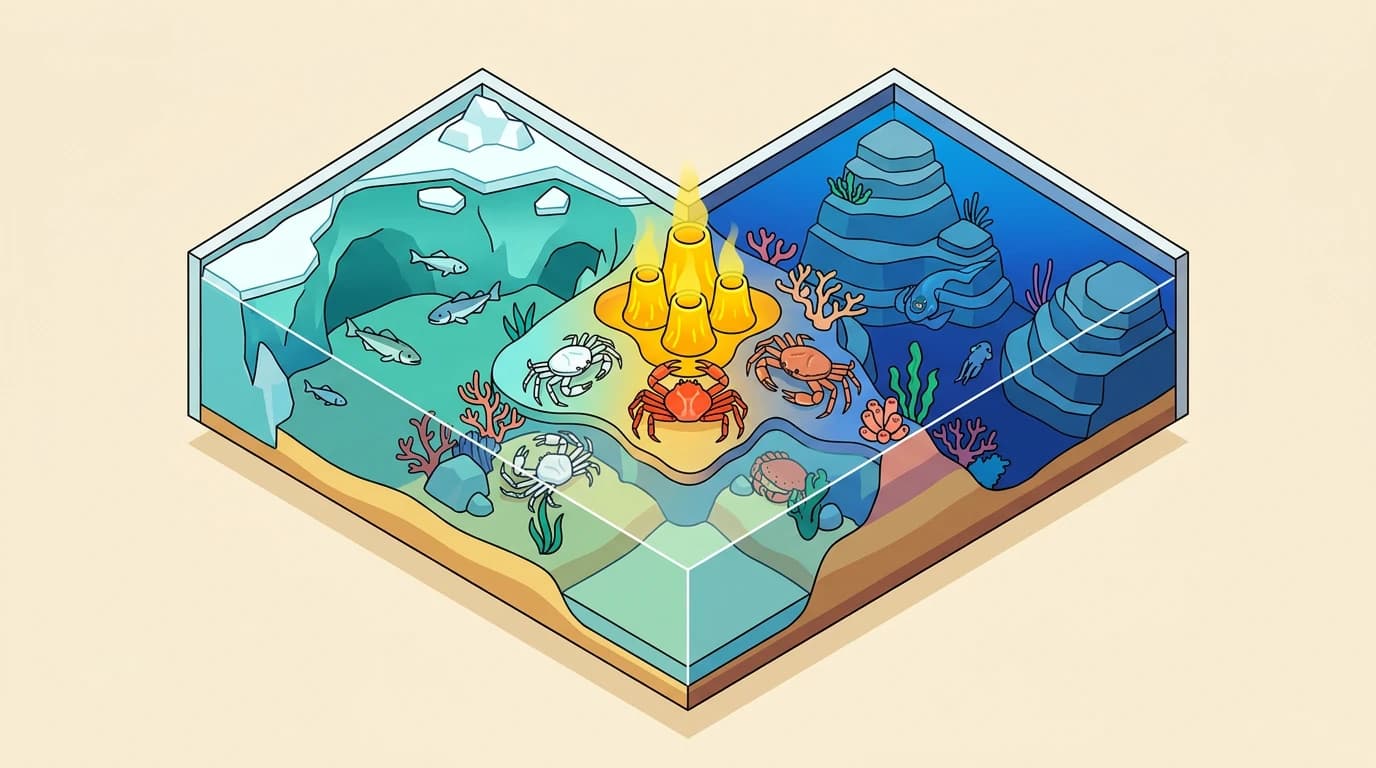
An unexpected sea floor takeover
What happens when intense ocean heat empties out an entire sea floor community? In the chilly Bering Sea, the aftermath looked nothing like scientists expected.
Seven years after a severe marine heatwave struck the region, researchers tracked a striking hybrid crab surge. Numbers of crossbred snow crab and Tanner crab climbed 13.4-fold compared to historical averages. At the same time, harvestable hybrid males increased 13.1-fold.
The mystery behind the mix
Normally, these two crab species rarely interbreed. To learn why crossbreeding suddenly exploded, researchers used causal modelling to test different explanations.
You might guess that warm water simply helped hybrid larvae survive, or pushed adult crabs into the same territory. Yet the models showed neither was true. The surge was not caused by direct thermal effects on hybrid survival, nor by increased spatial overlap between mature crabs.
Instead, the heatwave triggered a severe collapse in the snow crab population. With their normal mating partners largely gone, the surviving crabs began breeding across species lines. This ecological surprise was an indirect domino effect: the heatwave took out the snow crabs, and that absence created room for hybrids to take over.
Trouble for fishing rules
This biological twist creates real headaches for local fishing fleets. Commercial fishing rules set strict catch quotas for pure snow crabs and pure Tanner crabs, but harvestable hybrids sit completely outside current regulations.
Rigid rules struggle to handle rapid, indirect ecological shake-ups caused by extreme weather.
What we still do not know
The findings focus on a single marine heatwave event and rely on statistical models to untangle cause and effect. Scientists do not yet know the long-term genetic consequences for future crab generations, nor how fishing regulators will adapt to harvestable hybrids.
Science words
- Marine heatwave
- A prolonged period of unusually high ocean temperatures.
- Hybrid crab
- Offspring produced by the crossbreeding of two distinct species, here snow crab and Tanner crab.
- Causal modelling
- A statistical method used to test whether one event directly or indirectly caused another.
- Ecological surprise
- An unexpected, non-intuitive biological reaction to an environmental disturbance.
Check it yourself
This story is based on a real research paper in Proceedings of the National Academy of Sciences by Fedewa, Ryznar, Cleary et al. We write with AI help and check it against the paper, but the original is the final word.