Why AI healthcare guidelines are leaving blind spots in medical research
A review of 100 medical publications found that AI healthcare guidelines are split into competing checklists that focus on paperwork rather than clinical safety.
Reading level
The full story with proper science words explained.
A maze of checklists
Picture a health study where a smart tool helps spot a growth, but researchers clash on how to share results.
As fresh software joins patient care, doctors rely on AI healthcare guidelines so people can trust each test. Yet when a team combed through 30,276 records across PubMed and the EQUATOR Network site, they found a muddled field. The EQUATOR Network is a global group that lists standard tools to raise the bar for health research.
An automated text filter narrowed the pile down to 888 records for human screening. The team finally kept 100 papers from between early 2018 and mid-2026. These papers held 69 distinct frameworks and publisher policies. The trouble is that no single guide covers more than 60% of health AI project designs. Instead, teams must pick their way through 42 named frameworks, which sparks genuine confusion.
Authority is not spread evenly
To sort the clutter, the study grouped these tools into four evidence tiers. An evidence tier is a rank based on how mature a tool is and who backs it. Here is the key caveat: these tiers only describe maturity and official backing, rather than measuring study quality or real-world usefulness, and they cannot replace a formal quality test.
Tier 1 holds 20 formal guides listed by the EQUATOR Network. These often use a Delphi process, where specialists answer rounds of surveys to reach wide accord. Tier 2 holds 12 peer-reviewed shared frameworks, while Tier 3 has 12 early drafts. The biggest group was Tier 4, with 25 house rules written by individual journals.
Treating simple house rules like major consensus standards leads to epistemic conflation. This means mistaking a high pile of quick rules for deep scientific rigour. Furthermore, out of 100 papers, 99 were in English. Most Tier 1 guides came only from the UK and the US.
Looking at paperwork instead of safety
The rules also show strange priorities. Across the 69 instruments, most demands focused on who wrote the paper and naming any software used during submission. Meanwhile, post-deployment monitoring—tracking an algorithm for safety and accuracy once it runs in clinics—had primary coverage in only one group. Carbon costs and power draw barely got a mention.
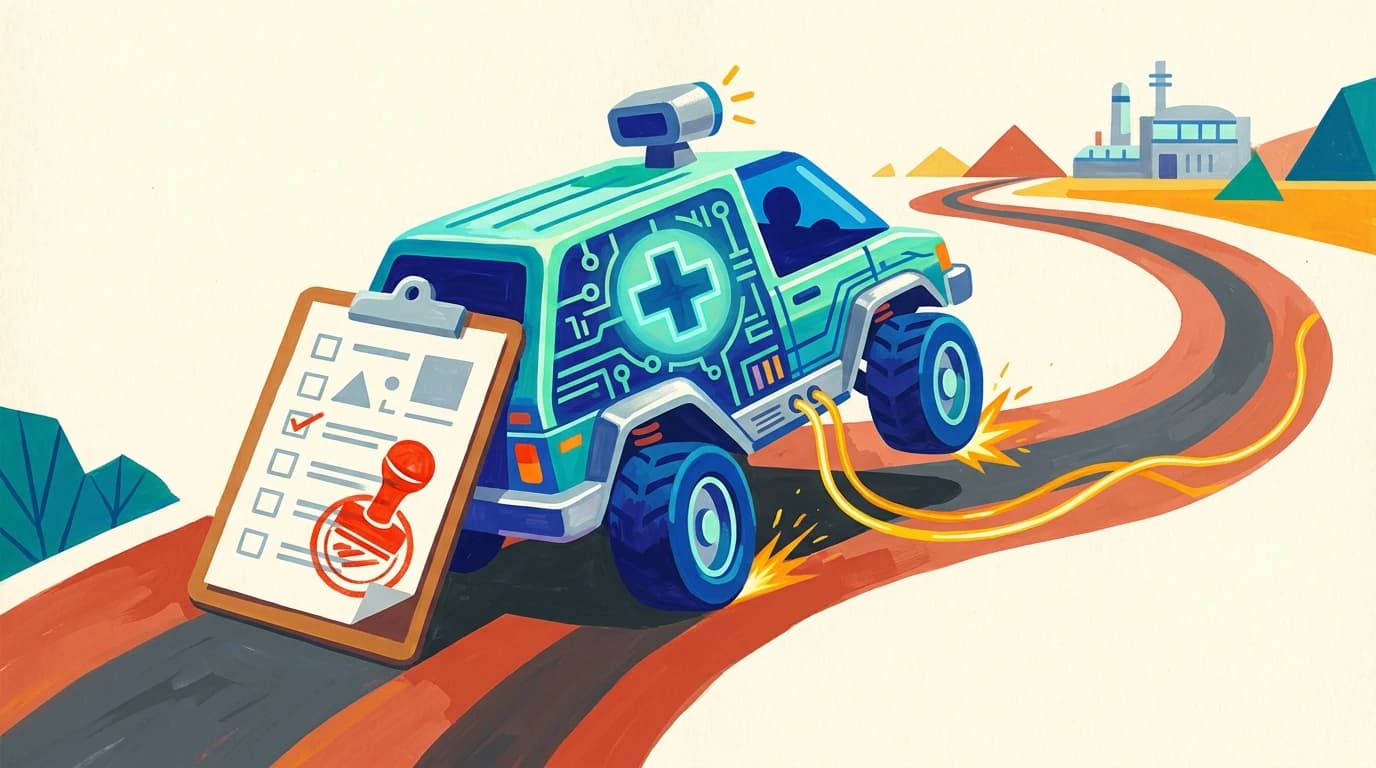
Current rules are like checking car registration papers at a shop while ignoring whether the brakes work on the road. This comparison breaks down because a broken car crashes loudly right away. By contrast, an unchecked clinic model can quietly output bad predictions over years without any warning sound.
What we still do not know
The review had clear limits. The team searched only two databases, missing other libraries and regional policies. Their software filter also cut out 29,388 records without a direct test to show how many useful papers it dropped.
We still lack a shared path to tell authors which checklist fits complex study designs. Clearing up duplicate names also remains an open problem. For instance, the labels CLEAR and METRICS belong to completely separate rules, leaving authors to guess which one to pick.
Science words
- EQUATOR Network
- An international group that catalogues research reporting guidelines to improve study quality.
- Evidence tier
- A rank reflecting a tool's development maturity and official backing, not a direct score of its quality.
- Delphi process
- A structured method where a panel of experts answers several rounds of questions to reach an agreement.
- Epistemic conflation
- Treating simple publisher checklists as having the same scientific authority as rigorous expert consensus.
- Post-deployment monitoring
- Tracking an algorithm's accuracy, performance, and safety after it is introduced into real-world clinical care.
Check it yourself
This story is based on a real research paper in PLOS Digital Health by Silva, Canever, Lino et al. We write with AI help and check it against the paper, but the original is the final word.