Why a tiny raincoat keeps next-generation batteries from breaking down in air
A microscopic siloxane coating protects sulfide-based solid battery electrolytes from moisture, halting toxic gas release while allowing lithium ions to pass.
Reading level
The full story with proper science words explained.
A fragile champion
What if the best battery for our future broke down the moment it touched normal air? That is the exact problem facing engineers working on the next solid-state battery electrolyte. Inside these energy devices, a solid crystal shuttles charged lithium ions back and forth instead of a liquid that can catch fire.
Sulfide-based crystals, such as an argyrodite structure known as LPSCBr, move these ions quickly. Sadly, they react violently with humidity in regular air. This reaction destroys the crystal and frees hydrogen sulfide, a toxic gas that smells like rotten eggs. Because of this hazard, battery plants must build expensive, dry rooms to assemble these parts safely.
A tiny waterproof shield
To fix this problem, the team tried a silicon-based chemical compound called MPTMS. They ground the dry powders in a ball mill to trigger a chemical reaction on the outside of the grains. One end of each chemical group hooks firmly onto sulfur atoms at the surface. Meanwhile, the other end bonds with its neighbors to weave a waterproof siloxane skin just 10 nanometres thick.
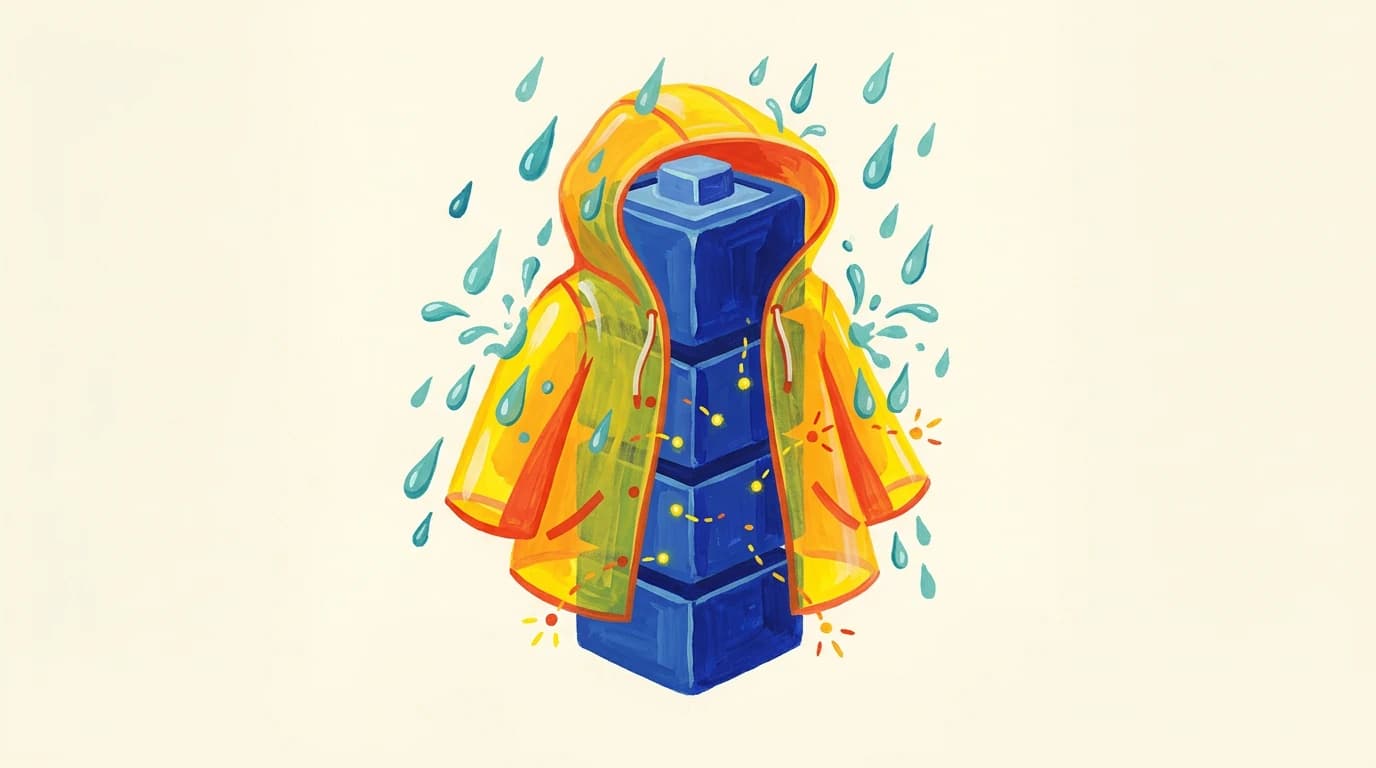
Think of it as a breathable raincoat for each grain. It locks out water droplets from moist air, but still lets tiny lithium ions glide smoothly through the solid beneath. When plain, unprotected LPSCBr met air with 30% relative humidity, it released 5 cubic centimetres of toxic gas per gram within 35 minutes. With the thin 10:1 ratio skin in place, that leak dropped down to 0.33 cubic centimetres per gram. That marks a 93.0% drop in toxic gas release.
Staying strong under pressure
Stopping dangerous fumes is only half the task, because battery parts must still move electric charge. Unprotected powder left in moist air for 10 hours saw its ionic conductivity collapse from 13 down to just 0.26 millisiemens per centimetre. In comparison, the shielded powder held strong at 5.7 millisiemens per centimetre, down from its fresh value of 10.8.
The thin skin also cuts down electronic conductivity, which helps stop stray electrons from causing internal short circuits. At the same time, it lifts the point where the crystal starts to break down from 2.58 volts up to 2.95 volts. When placed into full NCM83 battery cells, the difference was obvious. Unshielded parts left in humid air for two hours managed only 49.5% capacity after 200 cycles. By contrast, the shielded cells lasted 1,000 cycles while holding on to 84.6% of their original capacity.
What we still do not know
This thin shield removes a huge manufacturing headache, yet several open questions remain. Most lab tests used air at 30% relative humidity, so performance in swampy air above 70% is still unknown. The outer coating also burns off at elevated temperatures, leading to weight loss that pure mineral crystals do not show. Putting on too thick of a coat hurts performance too, dragging ion speed down to 7.24 millisiemens per centimetre at a 5:1 ratio. Finally, scientists must check whether this surface holds up across thousands of deep charges under heavy pressure, and whether factory ball mills can produce it in huge batches.
Science words
- Solid-state battery electrolyte
- A solid material that conducts ions between battery electrodes instead of a liquid solution.
- Argyrodite
- A specific crystalline structure of sulfide electrolytes known for extremely fast lithium-ion transport.
- MPTMS
- An organic silicon-based molecule used to build a protective, water-repelling surface network.
- Ionic conductivity
- A measure of how quickly charged atoms, such as lithium ions, move through a substance.
- Electronic conductivity
- The ability of a material to allow electrons to flow directly through it, which can cause internal battery leaks.
Check it yourself
This story is based on a real research paper in Nano-Micro Letters by Li, Xu, Cao et al.. We write with AI help and check it against the paper, but the original is the final word.