What mysterious marine Hikarchaeia microbes do in ocean depths
A five-year study reveals how rare, uncultivated Hikarchaeia microbes divide the ocean by depth and geography, peaking regularly with the seasons.
Reading level
The full story with proper science words explained.
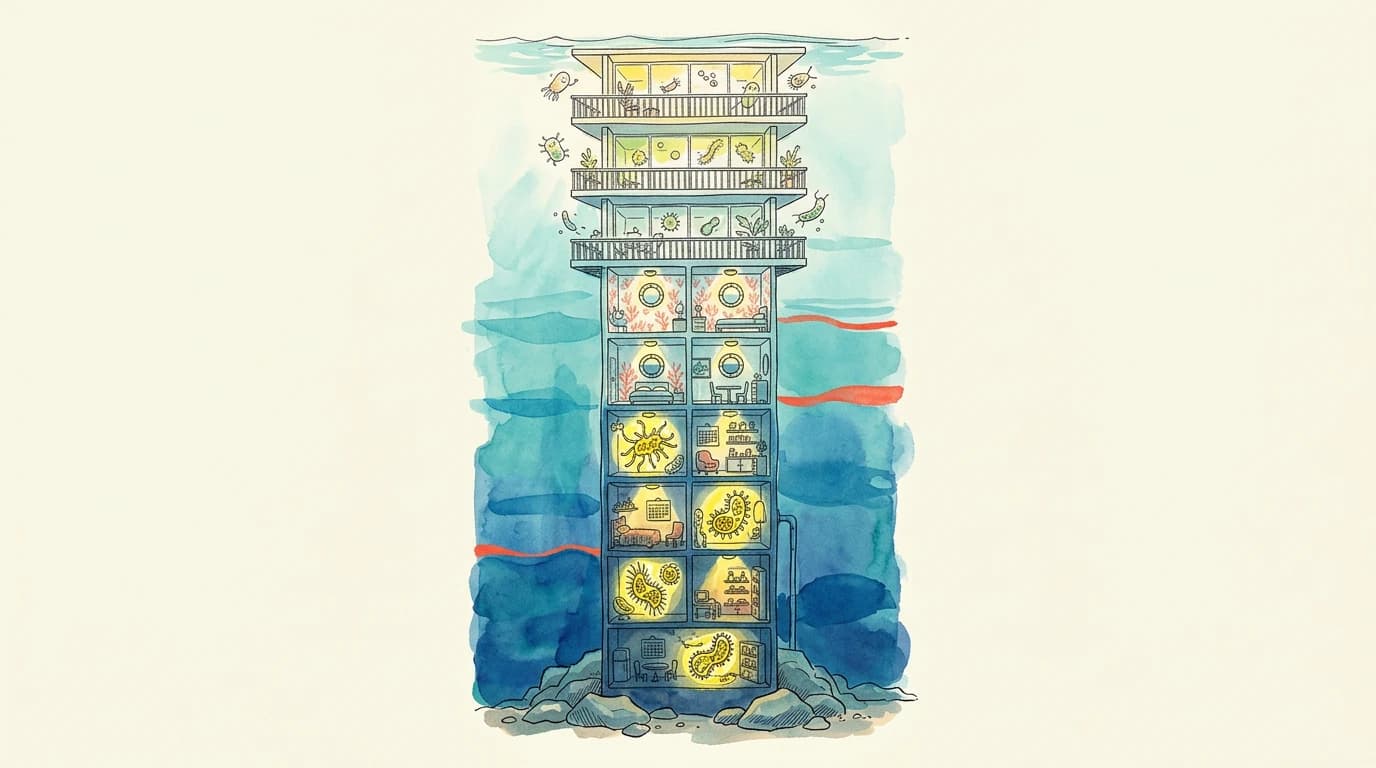
Climbing the ocean floors
Imagine the open ocean as an enormous high-rise tower block where different residents occupy strictly divided levels. Some flourish near the sunlit roof, while others dwell in the cold, pitch-black basement.
For decades, marine microbes called Hikarchaeia remained mysterious phantoms of this aquatic tower. They belong to the rare biosphere, microbial groups that survive at tiny relative numbers. Because no one has ever grown them in a laboratory, their lifestyles stayed completely hidden.
Tracking a five-year schedule
To uncover their secrets, researchers collected water every month across five years in the North Atlantic Subtropical Gyre. They tracked microbial DNA by vertical depth and reconstructed a diminutive complete genome measuring 1.17 million base pairs from day-and-night samples at 200 metres.
The survey showed these microbes are not random wanderers. Their numbers peaked every year at about 1% of prokaryotic amplicons. This surge happened just after deep winter mixing, when thermal stratification—water separating into warm and cold horizontal layers—trapped dissolved organic matter in the twilight zone.
Separated by depth and latitude
The genetic evidence revealed five distinct evolutionary branches sorted by geography and depth. Clade I lived in subtropical and tropical twilight zones, whereas Clade III drifted deeper into the lower mesopelagic and dark bathypelagic layers. Clade V specialised in cold polar waters.
Genomes showed they are free-living oxygen-breathers carrying tools to process carbon monoxide and synthesise bacterioruberin, a protective pigment absent only in deep Clade III. These details establish a vital baseline to help model marine nutrient cycles as oceans warm.
What we still do not know
These organisms remain entirely uncultivated in any lab, so our understanding comes strictly from their environmental DNA. Furthermore, data sparsity means the ecological homes of Clade II and Clade IV remain unknown, and the real-world speeds of their predicted chemical reactions are still unmeasured.
Science words
- Hikarchaeia
- A group of uncultivated marine archaea that exist in the ocean.
- Rare biosphere
- Microbial groups that exist at very low numbers within a natural environment.
- Thermal stratification
- The natural separation of ocean water into distinct horizontal layers based on temperature differences.
- Twilight zone
- The dim ocean layer sitting between the sunlit surface and the totally dark deep sea.
- Bacterioruberin
- A protective carotenoid pigment produced by certain archaea.
Check it yourself
This story is based on a real research paper in mBio by Wittmers, Dames, Michelsen et al. We write with AI help and check it against the paper, but the original is the final word.