What microplastics in mussels do to their guts and cells
A lab study shows that the size and polymer of plastic fragments change how quickly blue mussels ingest and clear them. Larger polystyrene shards linger for days, sparking cellular stress, shifting digestive enzymes, and wiping out gut bacterial diversity.
Reading level
The full story with proper science words explained.
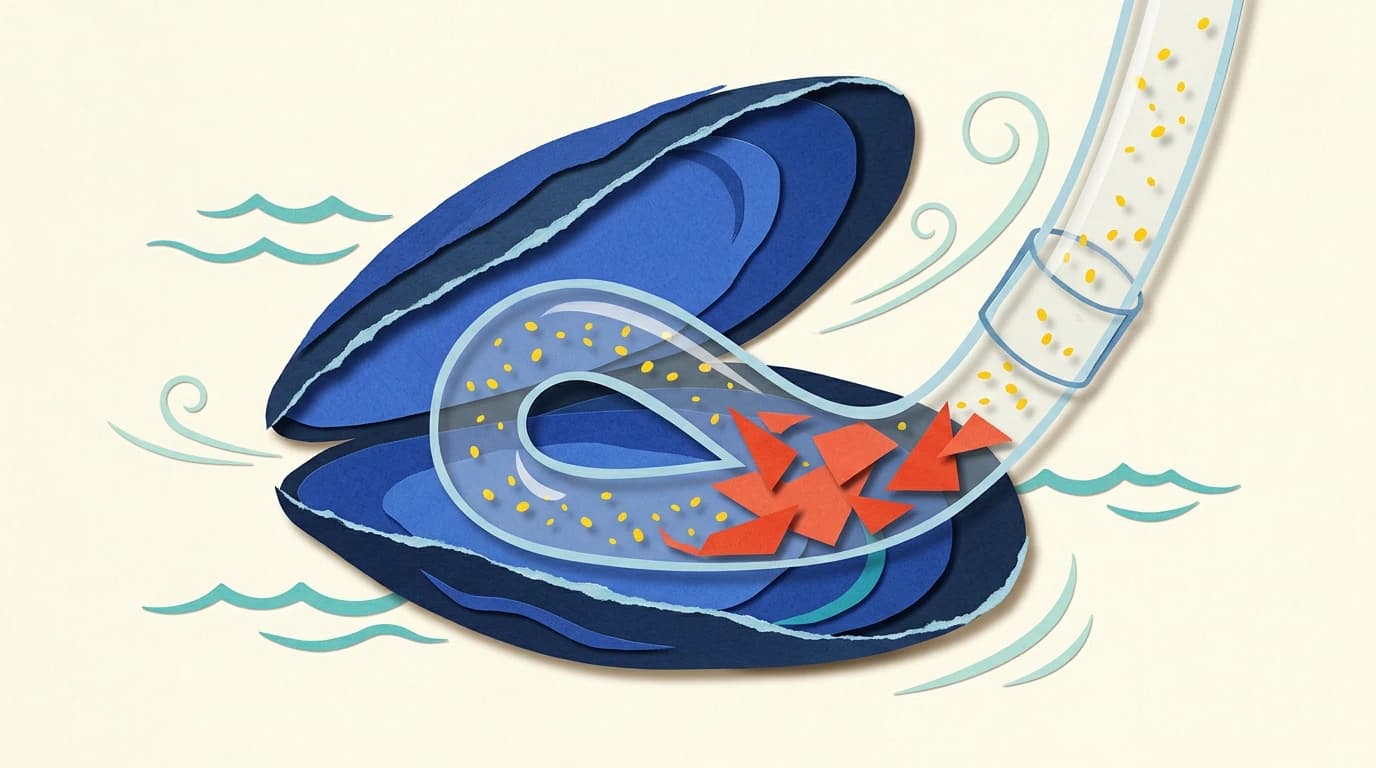
A vacuum filter under the sea
Mussels feed by pumping litres of seawater through their bodies every single day. Along with food, this habit pulls in jagged bits of pollution. Testing how microplastics in mussels behave, scientists placed blue mussels (Mytilus edulis) in tanks with fragments made of PET, PVC, and polystyrene (PS).
Think of a vacuum cleaner tackling household dirt. Fine dust sweeps right through the nozzle and clears quickly, but bigger crumbs get wedged inside the pipe. The mussels ingested small fragments of 100 to 200 micrometres easily and flushed them out. Larger bits measuring 300 to 500 micrometres, roughly the width of a grain of coarse salt, stayed trapped far longer. The vacuum comparison breaks down when chemistry enters the story, because plastic does not simply sit there like inert dust.
The chemistry inside
The type of plastic shifted the timeline. PET and PVC reached peak levels in the animals within two hours, measuring up to 1.87 and 1.5 items per gram. Polystyrene built up far more slowly, peaking after four to five days at up to 6.63 items per gram.
The team tracked the biological damage caused by those lingering 300 to 500 micrometre polystyrene shards. The animals went into cell-level panic. Defensive enzymes climbed to tackle chemical damage, with superoxide dismutase (SOD) and catalase (CAT) peaking on day seven, while reduced glutathione (GSH) stores fell to 3.2 micromoles per gram. Their digestive machinery shifted too. Amylase rose, but the protein-chopping enzymes trypsin and pepsin dropped. Inside the gut, scores on the Shannon index and Chao1 index plummeted, showing that common marine bacteria had crashed.
What we still don't know
This research is currently a preprint and has not yet undergone formal peer review. Scientists only measured the cellular and gut effects for one size of polystyrene, so PET and PVC might act differently. We also do not know whether wild populations can survive this long-term digestive chaos.
Science words
- Superoxide dismutase (SOD)
- An antioxidant enzyme that helps cells break down harmful reactive oxygen molecules.
- Catalase (CAT)
- An enzyme that protects cells from damage by converting toxic hydrogen peroxide into water and oxygen.
- Reduced glutathione (GSH)
- A key protective molecule that absorbs damaging reactive oxygen species inside cells.
- Chao1 index
- A statistical score used to estimate the total number of different species in a community.
- Shannon index
- A measure that tracks both how many species exist in a community and how evenly they are spread.
Check it yourself
This story is based on a real research paper in Preprint by Li, Wang, Wang. We write with AI help and check it against the paper, but the original is the final word.