What happens when marine heatwaves become the ocean's new normal?
Computer simulations show that under high greenhouse gas emissions, marine heatwaves could become almost permanent across most oceans by 2070. These extreme thermal spikes speed up energy loss and amplify the damage of steady ocean warming on marine food webs.
Reading level
The full story with proper science words explained.
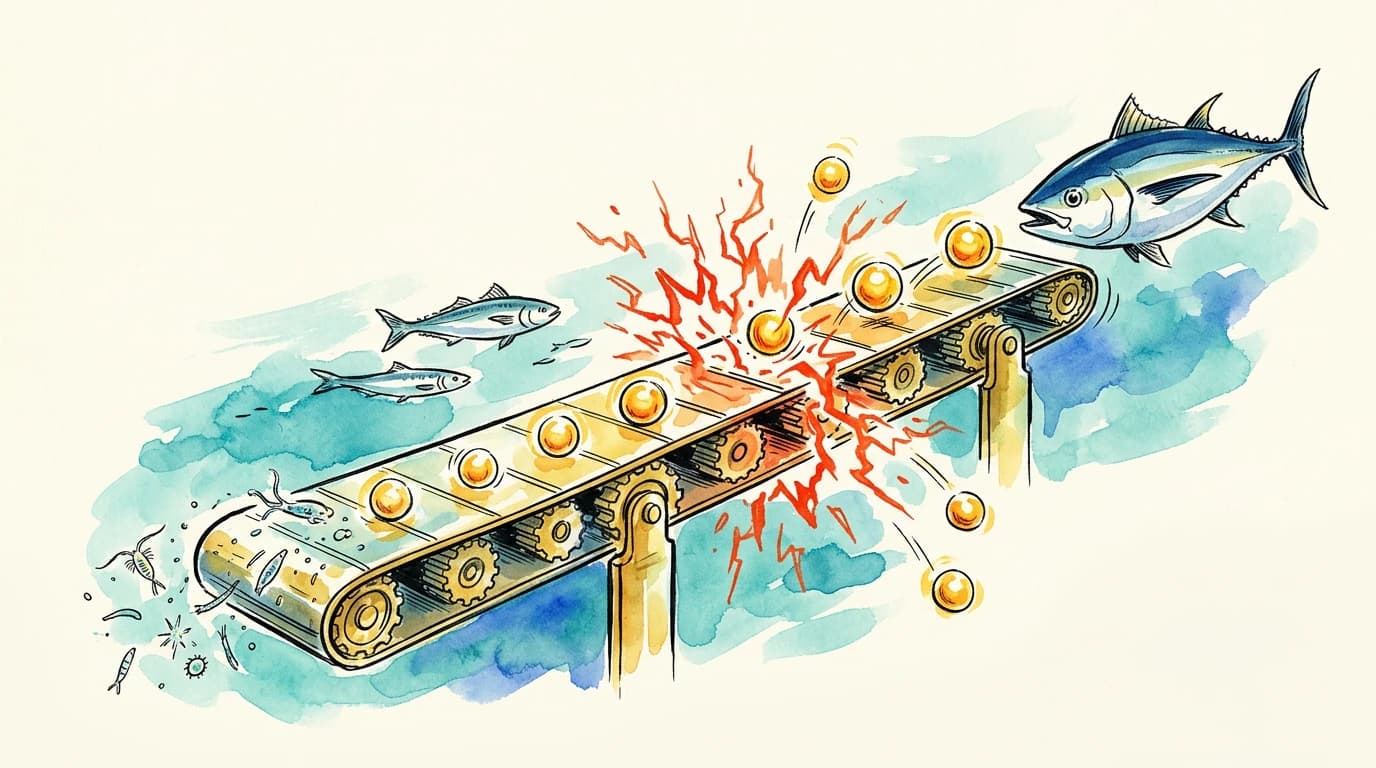
Surging heat on the ocean conveyor
Imagine a factory conveyor belt moving food from primary producers up to top predators. Gradual ocean warming slowly speeds up the motor, forcing the system to work faster. Marine heatwaves act like sudden power surges, rattling the belt and throwing off biomass before higher levels can use it.
A marine heatwave is a period of unusually high sea surface temperatures lasting days or months. Chronic warming is already driving long-term shifts in seawater. Scientists wanted to find out how sudden thermal spikes compound that damage across entire food webs.
Tracking the flow of marine life
To investigate this, researchers linked two Earth System Models, GFDL-ESM4 and IPSL-CM6A-LR, with an ecosystem simulator called EcoTroph-Dyn. The model split the global ocean into a grid of one-degree squares and ran on fifteen-day intervals. It tracked living tissue across trophic levels, which measure an organism's position on the food ladder from tiny plankton up to large predators.
The team analysed the flow kinetic, which is the speed at which biomass and energy transfer up the chain. Using a statistical method called Census X-11 decomposition, they separated background temperature trends from sudden extremes. Simulations showed the system took ten to twelve years of run time to reach a steady equilibrium.
When heat spikes never end
The models revealed alarming trends under the high emissions scenario known as SSP5-8.5. In this pathway, global warming crosses the critical two-degree threshold relative to pre-industrial times between 2043 and 2051. By 2070, heatwaves measured against a fixed baseline become nearly permanent across most of the ocean.
A fixed baseline compares future temperatures to a constant historical average. Under lower emissions scenarios like SSP2-4.5 and SSP1-2.6, the rise in heatwave days drops by one-third and two-thirds respectively. The story changes, however, if researchers use a moving baseline, which shifts the reference window forward as waters warm. Under a moving baseline, projected heatwave frequency and duration show only minor changes over the century.
Why assumptions matter
This difference highlights a vital ecological puzzle: can marine species adapt? If wildlife cannot adapt, the fixed baseline shows that heat spikes will relentlessly pummel ecosystems. If species adjust to chronic warmth, the moving baseline suggests extremes might feel less severe to them.
The analogy of the surging conveyor belt works well for energy loss, but it stops working when animals adjust their habits. Animals are living organisms that can alter how they feed, not rigid plastic parts bolted to a track.
What we still don't know
The framework has clear limits. Because EcoTroph-Dyn cannot start with zero primary production, the authors had to exclude 8,214 high-latitude grid cells. That leaves out about 4.7 per cent of the ocean surface where polar night or sea ice cuts off light.
The model also left out detritus, meaning dead organic matter was not tracked. Scientists still do not know how individual animals might react by migrating deeper to escape the heat. Exactly how much consumer biomass falls under lower greenhouse gas pathways remains an open question for future simulations.
Science words
- Marine heatwave
- A period of unusually warm ocean surface temperatures lasting from days to months.
- Trophic level
- The rank an organism holds in a food chain, starting with primary producers at the bottom.
- Flow kinetic
- The speed at which living biomass and energy travel upwards through a food web.
- Census X-11 decomposition
- A statistical technique used to separate long-term trends, regular seasons, and irregular anomalies in data.
- Fixed baseline
- A constant historical temperature average used to detect heat spikes without assuming species can adapt.
- Moving baseline
- A shifting reference window that moves forward in time, treating steady background warming as normal.
Check it yourself
This story is based on a real research paper in Global Change Biology by Guibourd de Luzinais, Cheung, Frölicher et al.. We write with AI help and check it against the paper, but the original is the final word.