What happens to your brain activity walking outdoors?
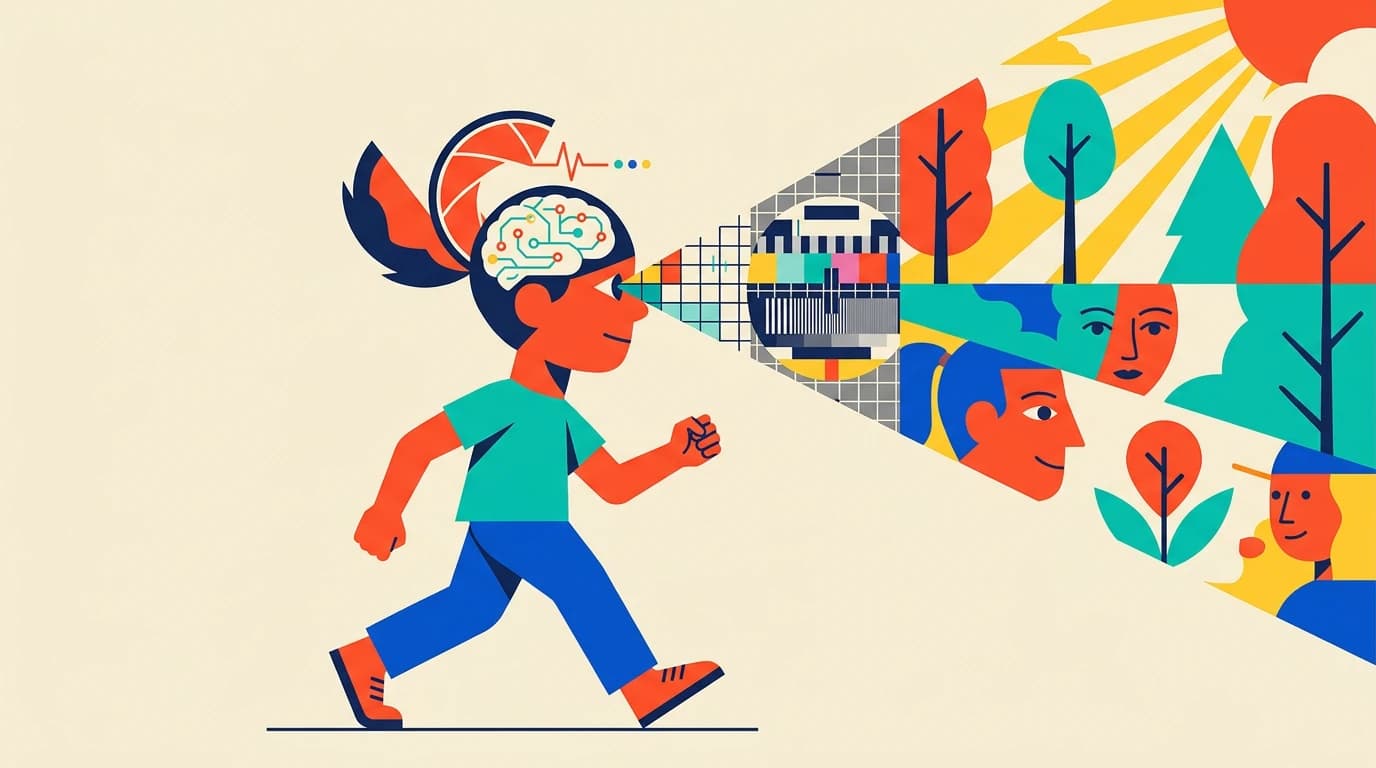
Researchers used wearable head caps to track and predict how our brains handle sights and sounds during free outdoor walks.
Reading level
The full story with proper science words explained.
Heads up: this study is a preprint, which means other scientists haven’t finished checking it yet.
Stepping out of the lab
What does your brain do when you walk down a busy street? For decades, brain scans forced people to stay frozen inside quiet rooms. Real life, though, is full of body steps and shifting sights and sounds.
Brain scanning on the move
To track natural brain activity walking outside, researchers fitted volunteers with whole-head high-density fNIRS caps. This gear shines safe beams of light into the scalp to track blood oxygen levels across the cortex, which is the brain's wrinkly outer layer. Volunteers also wore gear that recorded outside sound, nearby human faces, and luminance, which means brightness. They took part in two tests: watching movies indoors and walking freely outside without any set path or task.
By matching first-person video to blood signals, the team built a cortical map for each person. These spatial maps show which areas on the outer brain layer react to specific sights and sounds. The setup works like testing a camera on still cards before filming out in the wild. Simple sensory patterns held steady, even when the open air changed quickly.
What the signals revealed
Maps for basic traits like sound volume and brightness matched well between indoor screens and outdoor strolls. These brain patterns also stayed steady across repeated outdoor strolls by the same person. The team then used incoming sensory logs to run out-of-sample encoding. This statistical method uses a model trained on one time block to predict brain responses during held-out, unseen walking times.
However, social signals did not match as cleanly. Cortical maps for spotting human faces showed weaker links between indoor movies and outdoor walks.
What we still do not know
These prediction results came from an exploratory analysis, so key questions remain. Researchers do not yet know why face signals matched less closely outside than basic sensory signals. They also do not know how well this method will hold up during other real-world actions, such as social conversation or complex navigation.
Science words
- High-density fNIRS
- A wearable brain imaging setup using many closely spaced light sensors to measure blood oxygen levels across the cortex.
- Luminance
- The perceived brightness or intensity of light coming from the surroundings.
- Cortical map
- A spatial map showing which areas on the brain's outer surface react to specific sensory signals.
- Out-of-sample encoding
- A statistical method where a computer model trained on one dataset accurately predicts brain responses in a separate, previously unseen set of data.
Check it yourself
This story is based on a real research paper in Scientific Publication by Altınkaynak, Carlton, Topkoç et al.. We write with AI help and check it against the paper, but the original is the final word.