What happens to tropical bee pollination as you climb a mountain?
A study across Costa Rican mountain gardens shows bee diversity peaks halfway up the slopes, while high-altitude bees form tighter, more shared plant networks.
Reading level
The full story with proper science words explained.
A climb up the slopes
If you hike up a green mountain, the air turns cold, clouds sweep in, and the rules of life begin to shift.
Scientists wanted to know how tropical bee pollination changes as the ground rises into the sky. Do chilly mountain heights leave flowers empty, or do insects find fresh ways to share food and pollen?
To find out, a team spent 35 days netting insects across 28 home gardens in Costa Rica’s Tilarán Mountain Range. They set up small plots spread across five height bands, climbing from 200 to 1,500 metres above the sea. During 560 observation hours, observers watched open blossoms for 15 minutes per plant, catching every bee that landed on plant parts. In total, they logged 5,242 flower visits across 157 bee types.
Cliques down low, crowds up high
The team found that bee variety peaked halfway up the slopes, between 800 and 900 metres. Yet plant variety stayed steady across the entire climb, with 6 to 26 plant types per garden plot.
Even stranger was how the insect-flower links changed. Down in the warm lowlands, networks showed high modularity, an ecological setup where insects split into distinct, tight clusters that feed on their own plant groups. These lowland webs also showed high specialisation, meaning insects were picky about which blossoms they visited.
Higher up the slopes, however, those exclusive groups faded away. Modularity and specialisation fell in a steady straight line. Instead, the webs showed higher connectance, meaning a larger share of all possible plant-pollinator links actually took place. They also showed higher nestedness, where picky visitors shared blossoms with broad generalists that visit almost anything. To be sure these network shifts were real rather than random flukes caused by network size, the team checked their raw counts against a null model, a statistical baseline that shuffles real records 1,000 times by chance.
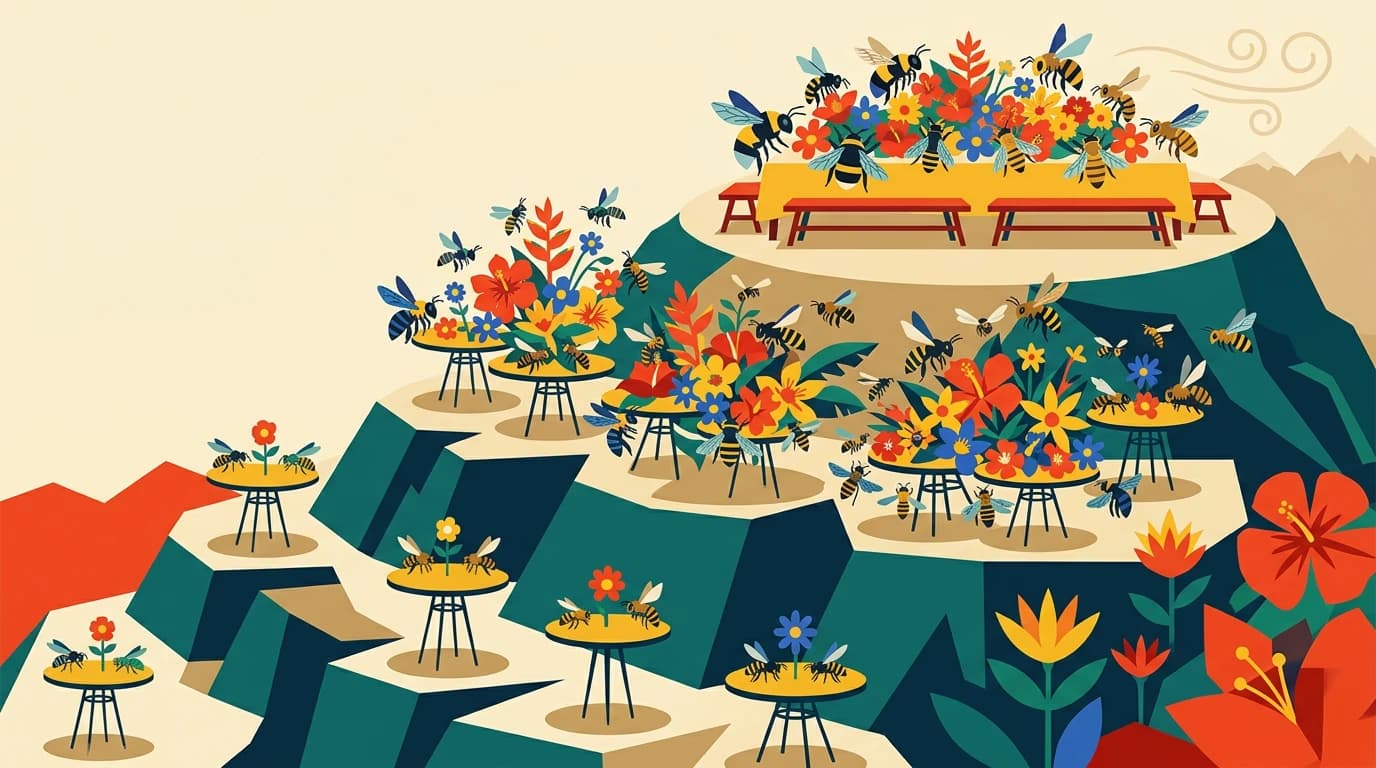
Think of it like a school hall: down low, pupils sit in strict, closed cliques, but near the windy peak, everyone mingles together at one big table.
New neighbours on the peaks
You might guess that bees simply dropped away in the mountain chill, leaving behind only tough lowland survivors. But 93 per cent of the shift between bands came from species replacement, the turnover where one insect type is replaced by an entirely new kind of neighbour.
Remarkably, the coldest band near the summit hosted nine indicator species uniquely tied to those heights. That was more than any other height zone along the slope.
There are limits to keep in mind. This work took place inside countryside garden mosaics. It does not show what happens deep inside continuous, uncut forest interiors. A severe drought caused by delayed rains in 2023 may also have lowered solitary bee numbers during field counts.
What we still do not know
Because these peaks top out around 1,800 metres, mountaintop bees have nowhere higher to escape if temperatures rise. What we still do not know is whether summit bees will be crowded out by lowland rivals pushing uphill. Scientists also want to learn if shifting rain patterns will knock bee hatching out of step with flower blooming, or whether physical body traits match these high-altitude webs.
Science words
- Modularity
- The extent to which an ecological community divides into distinct clusters of species that interact primarily with each other.
- Specialisation
- A mathematical index measuring the degree of selective flower choice across a whole interaction network.
- Connectance
- The proportion of all possible species interactions within a network that actually occur.
- Nestedness
- A pattern where interactions of specialist species are subsets of the interactions of generalist species.
- Null model
- A statistical baseline generated through random permutations used to determine if an observed ecological pattern exceeds chance.
- Species replacement
- The turnover of biodiversity where species at one site are replaced by entirely different species at another site.
Check it yourself
This story is based on a real research paper in Ecology and Evolution by Peters, Hsu. We write with AI help and check it against the paper, but the original is the final word.