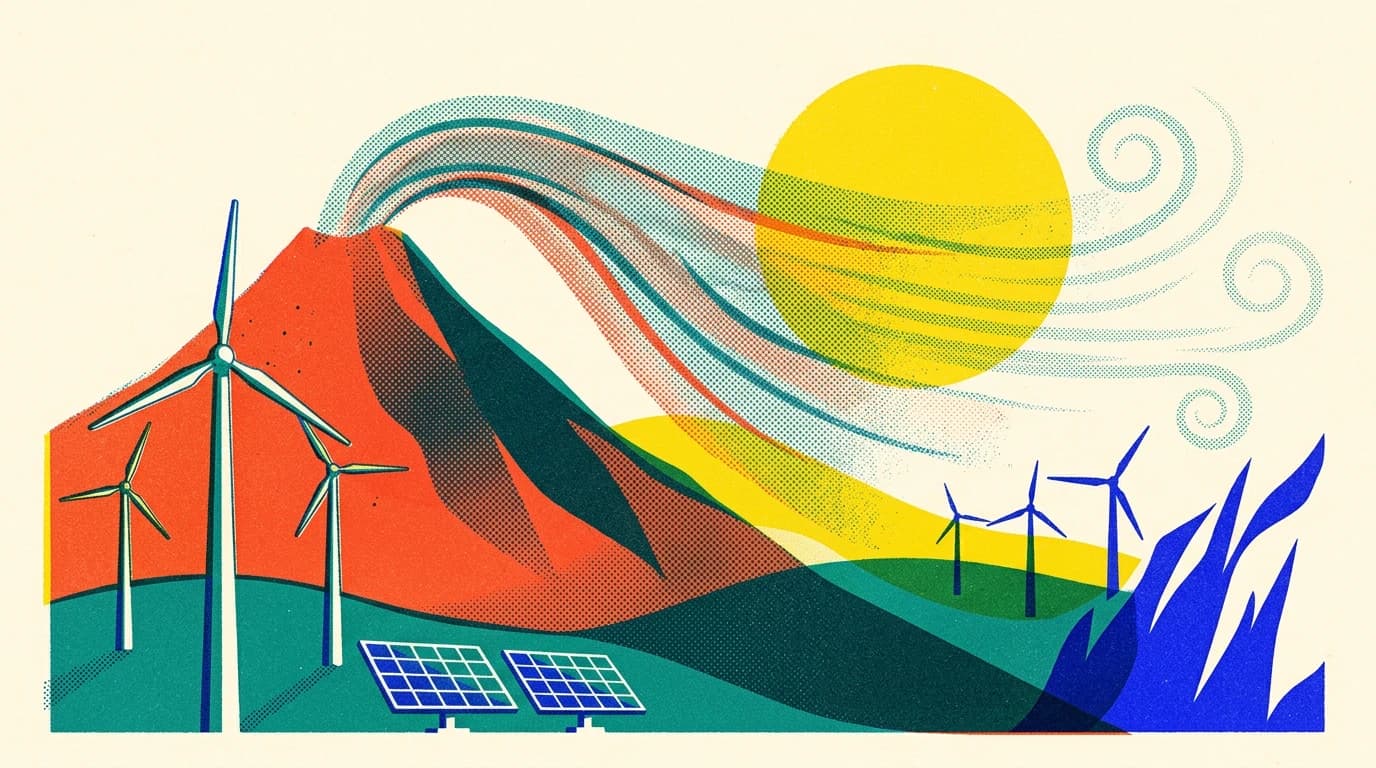
What happens to green power when a giant volcano erupts?
A major volcanic eruption could reduce global wind and sunlight for up to 20 months, wiping out massive amounts of renewable electricity and costing billions.
Reading level
The full story with proper science words explained.
Heads up: this study is a preprint, which means other scientists haven’t finished checking it yet.
A sudden veil in the sky
Imagine the entire planet dimming under a gigantic, hazy filter. When huge volcanoes blow their tops, they blast out stratospheric aerosols, which are tiny particles suspended high above Earth that reflect sunlight back into space. Scientists asked a pressing question about volcanoes and renewable energy: what would happen to our wind turbines and solar panels if an immense eruption went off tomorrow?
To find out, researchers created a computer simulation modelled on the 1815 blast of Mount Tambora. They tracked how the volcanic haze would spread, altering wind patterns and cutting down sunshine across the globe. Then, they mapped those climate shifts directly onto today's power grids to measure the real-world fallout.
When the breeze and sunlight fade
The results showed an unexpected double blow. The simulation revealed a mean 3.6% dip in global wind and solar potential that lingered for up to 20 months. That long slump acts like a massive atmospheric sunshade, muting wind and daylight worldwide. In our world, that sheer curtain would cause a resource reduction—a measurable drop in the raw sunshine and wind available to turn into clean power.
That 3.6% drop sounds tiny, but on a planetary scale it hits hard. It would wipe out an estimated 213.5 terawatt-hours of electricity. That is roughly equal to California's entire electricity use in 2024. Financially, it translates to 9.0 billion US dollars in losses.
Where the blow lands hardest
Curiously, the regions hit by the worst physical climate shock did not suffer the biggest power crashes. South America and Africa faced the largest drops in natural wind and sunshine. Yet Asia suffered the steepest generation losses simply because it has built so many wind farms and solar parks.
What we still don't know
This study only tested one historical event on today's energy grid, so we cannot know how larger or smaller blasts might act. We also do not know how future expansions of renewable networks will alter our vulnerability, nor how intentional aerosol-based climate intervention technologies might reproduce these power drops.
Science words
- Stratospheric aerosols
- Tiny particles suspended high up in the second layer of Earth's atmosphere that reflect sunlight.
- Resource reduction
- A decrease in the natural availability of sunlight or wind required to generate electricity.
- Aerosol-based climate intervention
- Geoengineering methods that intentionally inject particles into the atmosphere to block sunlight and cool the planet.
Check it yourself
This story is based on a real research paper in Scientific Publication by Liu, Yang, Gao et al.. We write with AI help and check it against the paper, but the original is the final word.