What AI can see hidden inside eye reflections
A systematic review examined how machine learning can recover scenes and identify people from tiny reflections on the surface of human eyes.
Reading level
The full story with proper science words explained.
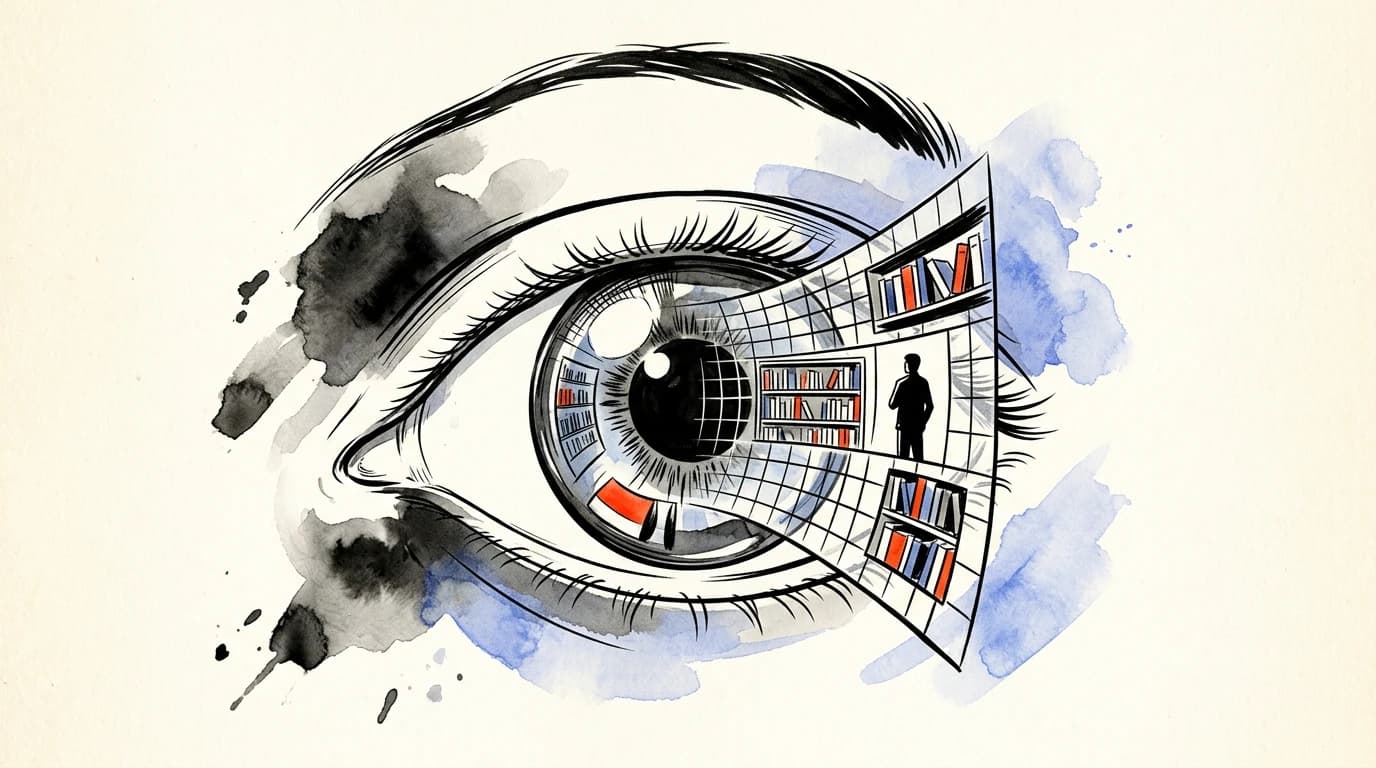
Clues hidden on a eyeball
Zoom into a high-detail portrait, and you might spot a warped version of the room gleaming on the pupil. This shiny curved surface acts like a miniature security mirror. It catches whatever stands in front of the viewer, even things outside the camera frame.
Now, artificial intelligence is turning these faint glints into useful evidence. A systematic review gathered published research on eye reflection analysis to see how computers handle this visual data.
Smoothing the curved mirror
Using eye reflections is far from simple. Because the eye is round, it introduces optical distortions that stretch and bend shapes. The reflection also has a tiny spatial extent, meaning it covers very few pixels in a snapshot. It frequently suffers from motion blur and uneven lighting.
To fix this, scientists build software pipelines that isolate the reflection, flatten out the bends, and sharpen grainy details. Machine learning models then scan the cleaned picture to recognise faces or map the surrounding room. This helps when direct views of a scene are missing, offering aid in forensic investigation, biometric identification, and surveillance.
Mapping a scattered field
The review combed through studies published between January 2006 and August 2026. Strikingly, only 12 primary studies met the criteria across top journals. The authors found that work in this field was badly fragmented, with teams using entirely different tasks, models, and image datasets without a common plan. To fix this, they created a structured system classifying datasets, tasks, and machine learning architectures.
What we still do not know
This paper is a preprint that has not yet undergone peer review. While the concept sounds like science fiction, the small evidence base means major gaps remain. Researchers still do not know the best ways to overcome optical distortions or tiny resolutions in everyday, messy environments.
Science words
- Eye reflection analysis
- The process of extracting and studying images mirrored on the surface of an eye.
- Optical distortions
- Deformations in an image caused by the curved, imperfect shape of a reflective surface.
- Spatial extent
- The physical area or number of pixels an object occupies within an image.
Check it yourself
This story is based on a real research paper in Preprint by Azad, Alaei, Chakraborty et al.. We write with AI help and check it against the paper, but the original is the final word.