The Universal Rotation Curve: How Invisible Matter Keeps Galaxies Spinning
Source PublicationSpringer Science and Business Media LLC
Primary AuthorsBhatia, Salucci, Schiavone et al.
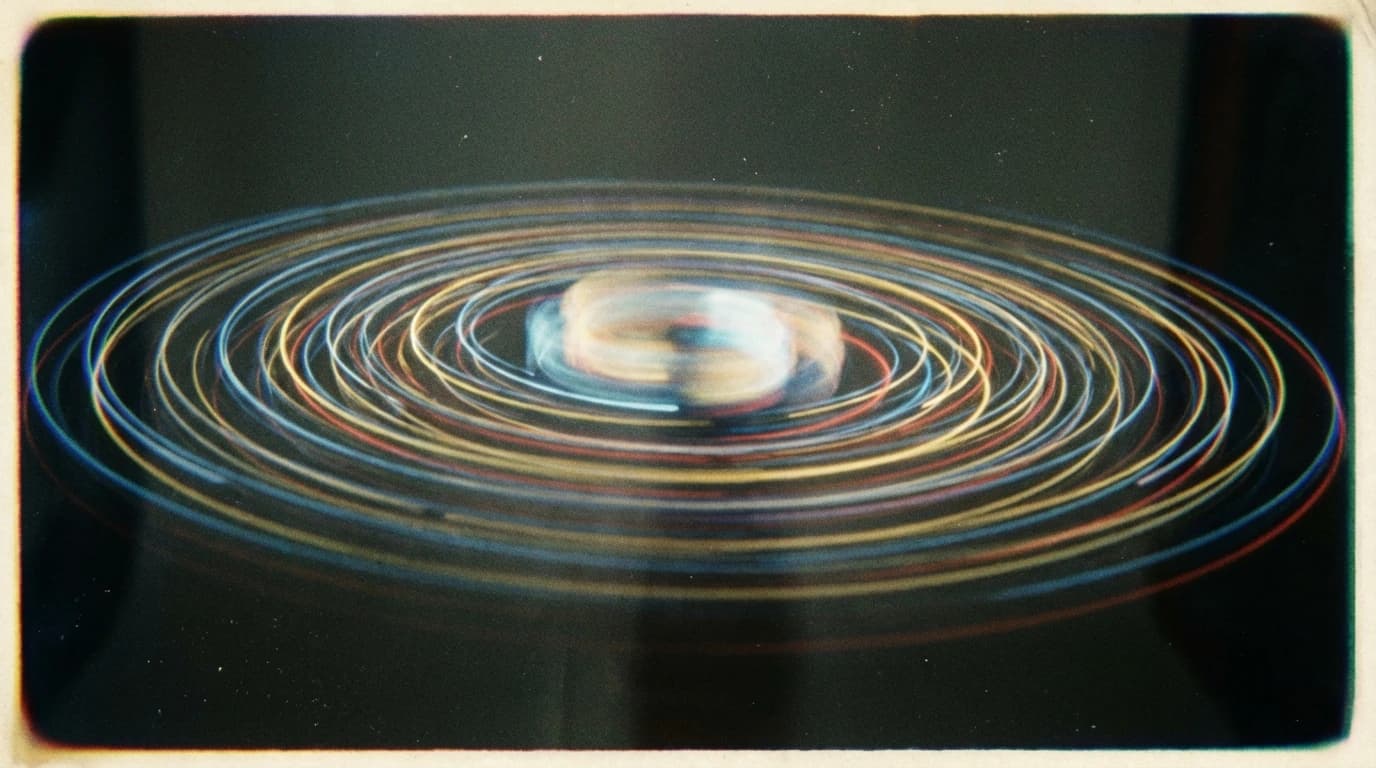
Imagine a galaxy is a massive, glowing merry-go-round spinning in the dark. You can easily measure the speed of the brightly lit wooden horses near the centre.
Note: This article is based on a preprint. The research has not yet been peer-reviewed and results should be interpreted as preliminary.
But what if the ride extended twice as far into the pitch black? And what if those invisible outer horses were moving in a highly predictable pattern, held on by an unseen force?
This is the exact cosmic puzzle astrophysicists are trying to solve. To understand it, they rely on a mathematical tool called the Universal Rotation Curve.
The Context: A Dark Mystery
For decades, scientists have known that spiral galaxies spin far too fast at their outer edges. If they only contained visible matter like stars and gas, they would simply fly apart.
Without this invisible mass, the outer stars would be flung into deep space. But measuring something you cannot see is notoriously difficult.
The extra gravitational glue holding them together is dark matter. Researchers map this unseen mass using a model known as the Universal Rotation Curve, which standardises how galaxies spin based on their size and brightness.
Previously, scientists could only reliably trace this curve using optical light. Because telescopes could only see the starlight, the vast, dark outer edges of these galaxies remained a mathematical mystery.
The Discovery: Extending the Universal Rotation Curve
A new early-stage study takes this model much further into the dark. Researchers used data from cold, neutral hydrogen gas to measure galactic spin far beyond the visible starlight.
By tracking this gas within a specific collection known as the SPARC sample of galaxies, the team extended their measurements out to twice the optical radius. This is a quiet, empty zone where dark matter almost completely dominates the environment.
The team measured the rotation speeds of these outer regions across this large sample of spiral galaxies. They found that even in the pitch-black outer edges, the galaxies follow a single, predictable mathematical profile.
When the researchers plotted the data, the spin rates collapsed perfectly onto one uniform graph. The mathematical rules governing the bright centre apply just as strictly to the dark edges.
The Impact: Redrawing the Galactic Map
These early results suggest that the relationship between normal baryonic matter and dark matter is highly organised. It is not just random noise; there is a structural rhythm to how these galaxies form.
By confirming that this mathematical rule holds true so far out, the study provides an essential new tool for physicists. It helps them build more accurate models of how mass is distributed across the universe.
Here is what this research could mean for astrophysics:
- More accurate maps of mass distribution across spiral galaxies.
- Tighter constraints on what dark matter particles might actually look like.
- New insights into the interplay between baryonic matter and dark matter.
These findings refine our understanding of galactic anatomy. Knowing exactly how fast the outer edges spin gives theorists strict boundaries when guessing the weight and behaviour of dark matter particles.
We still cannot directly see dark matter. But by watching the invisible edges of the merry-go-round, scientists are finally learning how to trace its machinery.