The Twisted Light Problem: Solving the Paradox of Circularly polarized luminescence
Source PublicationAngewandte Chemie International Edition
Primary AuthorsQin, Li, Li et al.
For decades, materials scientists have been trapped in a frustrating optical compromise. Imagine trying to build a lighthouse beam that must spin in a precise, mathematical spiral, only to find that the faster it spins, the dimmer the bulb becomes. If you want to twist light into a perfect, corkscrew-like structure, you must sacrifice its raw brightness. Conversely, if you want a blindingly bright emission, that elegant helical twist instantly falls apart. This bitter physical trade-off has stalled the progress of advanced optical engineering, leaving designers with materials that are either brilliant but chaotic, or perfectly structured but hopelessly dim.
These results were observed under controlled laboratory conditions, so real-world performance may differ.
The Trade-off in Circularly polarized luminescence
This specific type of emission, known as Circularly polarized luminescence, is highly sought after in modern physics. It involves light waves that rotate clockwise or anticlockwise as they travel, forming a three-dimensional spiral through space.
Such twisted light holds immense potential for advanced chiroptical technologies and secure communication. Yet, the chemical materials required to generate this light suffer from an inherent, frustrating flaw.
When scientists measure the twist—a metric called the luminescence dissymmetry factor—alongside the overall brightness, or quantum yield, the two numbers stubbornly refuse to peak together. The molecules either crowd together and extinguish their own glow in a process known as quenching, or they scatter and lose their precise rotation.
A Helical Nanoconfinement Solution
Recently, researchers found an elegant physical workaround to this chemical limitation. They turned to environmentally friendly carbon quantum dots, which are tiny, highly fluorescent nanoparticles derived from simple carbon structures.
By themselves, these carbon dots are completely achiral; they lack any inherent ability to twist light. To solve this, the team constructed a microscopic, spiral-shaped mould called a chiral soft photonic crystal.
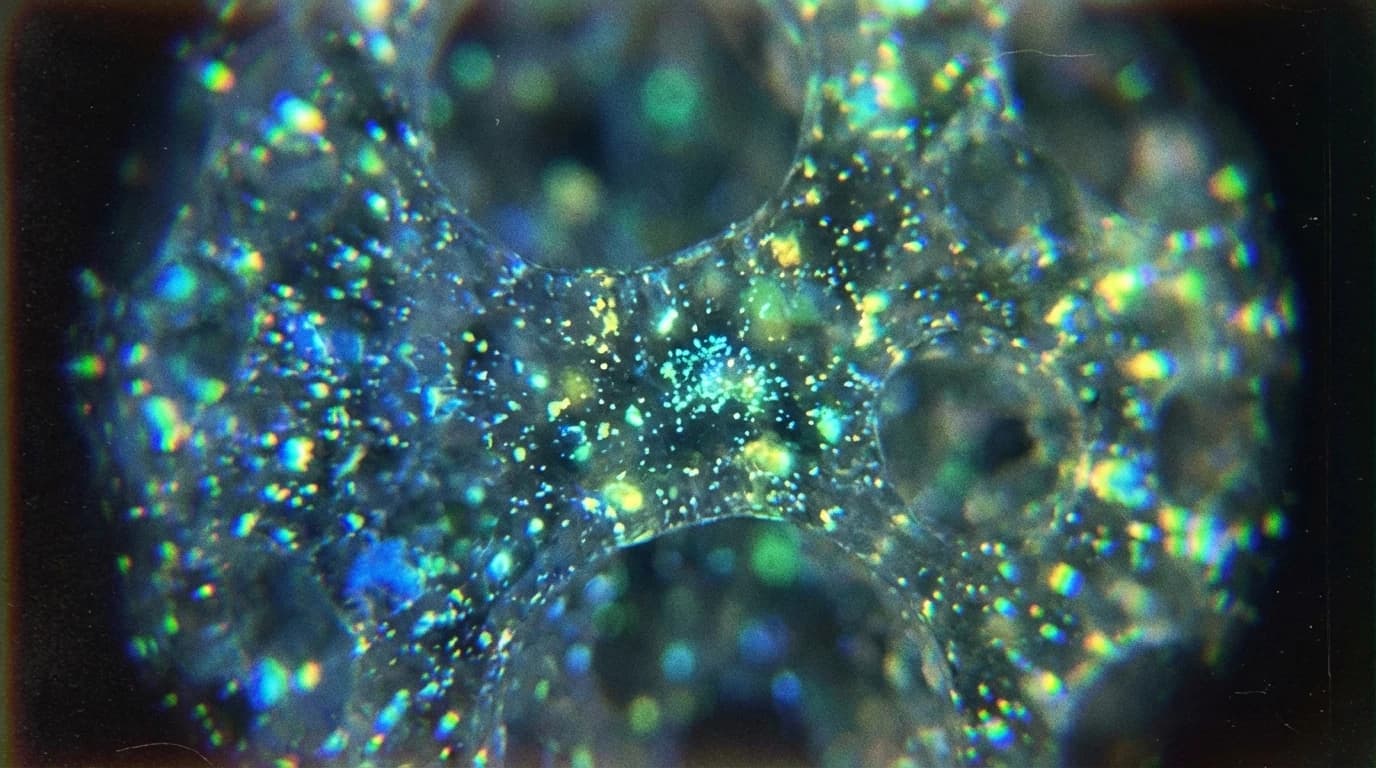
This crystal features a vast, three-dimensional network of helical nanopores. When the carbon quantum dots are introduced into this structure, they are physically forced into a spiralling arrangement.
This architectural restriction, termed helical nanoconfinement, keeps the dots perfectly spaced. It prevents them from clumping together and dimming, whilst simultaneously forcing their emitted light to twist. In laboratory testing, the researchers measured exceptional brightness—up to 92 percent efficiency across the visible spectrum—while maintaining a highly structured, twisted emission.
A Greener, Brighter Future
The study also demonstrated that mixing blue-, green-, and red-emitting carbon dots within the crystal produces pure white twisted light. This white light achieved a record-setting structural precision, proving the versatility of the crystal matrix.
Furthermore, the crystal host is entirely recyclable. It maintains its delicate chiral nanostructure and optical performance even after multiple cycles of loading and washing away the carbon dots.
This structural approach suggests a new direction for sustainable optical engineering. By relying on physical confinement rather than complex, toxic chemical alterations, engineers could develop highly efficient materials with minimal environmental impact.
The findings indicate that this method may soon advance several practical applications:
- Secure optical encryption systems that use twisted light to hide multilevel data.
- Advanced chiroptical technologies that rely on precisely structured solid-state light emission.
- Sustainable optical engineering platforms driven by environmentally friendly, recyclable components.
The stubborn compromise between brightness and structure appears to be resolved. Twisted light can finally shine at its full, uncompromised intensity.