The Spy Safehouse: How Frustration Creates a Quantum Spin Liquid
Source PublicationScientific Publication
Primary AuthorsMudring, Siebeneichler, Dorn et al.
"Three paranoid spies sitting at a circular table who refuse to look in the same direction, representing magnetic frustration."
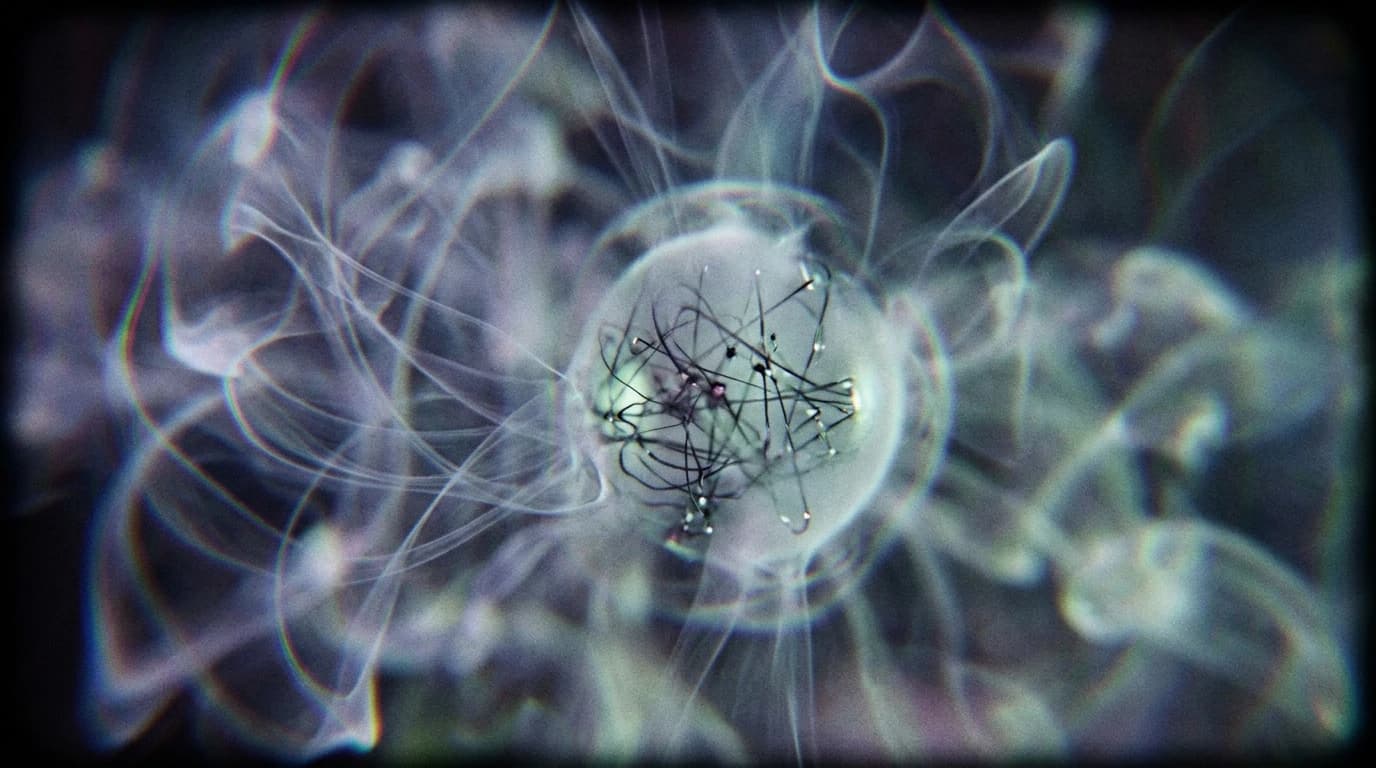
The Spy Safehouse and the Quantum Spin Liquid
Imagine a safehouse packed with paranoid spies. They have one strict rule for survival. If one spy looks left, the adjacent spy must look right. They absolutely refuse to face the same direction. In a straight line, this is easy. Left, right, left, right. But what happens if you seat three spies at a small circular table?
Spy A looks left. Spy B looks right. What does Spy C do? If Spy C looks left, they copy Spy A. If Spy C looks right, they copy Spy B. The rule is broken. They can never settle. They constantly shift, fidget, and change focus. This is frustration. It never stops.
This endless fidgeting is the perfect analogue for a quantum spin liquid. Instead of spies, we have electrons in a magnetic material. Instead of looking left or right, these electrons possess a magnetic property called spin.
How Frustration Prevents Freezing
When researchers cool a standard magnetic material down towards absolute zero, the electron spins typically lock together. They freeze into a rigid, highly predictable pattern. Order takes over.
However, in a frustrated magnet, the atoms sit in specific geometric arrangements that force the spins into a bind, much like the three spies at the table. Step by step, the process looks like this. First, the temperature drops, removing thermal energy. Second, the spins try to align according to their magnetic rules. Third, the triangular geometry of the atoms ensures that competing magnetic interactions simply cannot be satisfied all at once. Because they cannot agree on a stable pattern, the spins never freeze. They keep fluctuating and swirling, remaining in a fluid-like state even at the coldest possible temperatures.
Pushing the Boundaries of a Quantum Spin Liquid
Until recently, physicists thought this bizarre liquid state only occurred in materials with the lowest possible spin value, known as spin-1/2. Higher spin values were thought to behave differently. But this new study suggests otherwise.
Researchers created a series of layered, iron-based compounds. These materials feature a flat, two-dimensional atomic layout known as a kagomé arrangement. The iron atoms sit in a pattern of corner-sharing triangles, which is the perfect geometry to induce magnetic frustration. To keep the layers isolated, organic spacer layers sit between them, stopping the magnetic behaviour from spreading into the third dimension.
The team then cooled the material down to temperatures approaching absolute zero. They measured the magnetic susceptibility and used implanted muons to track the magnetic behaviour inside the crystal. The measurements showed a complete absence of long-range magnetic order. The spins kept moving.
This data suggests that a quantum spin liquid state can exist in high-spin systems. It proves that quantum fluctuations are strong enough to prevent freezing even when the magnetic moments are much larger than previously tested. If this holds true across other materials, then iron-based compounds could provide a completely new platform for studying quantum magnetism. We may soon see a massive expansion in how we understand these highly frustrated systems.