The Sprinkle Problem: Why Marine Microplastics Monitoring Needs a Standard Recipe
Source PublicationThe Journal of Physical Chemistry B
Primary AuthorsZhu, Xiong, Dai et al.
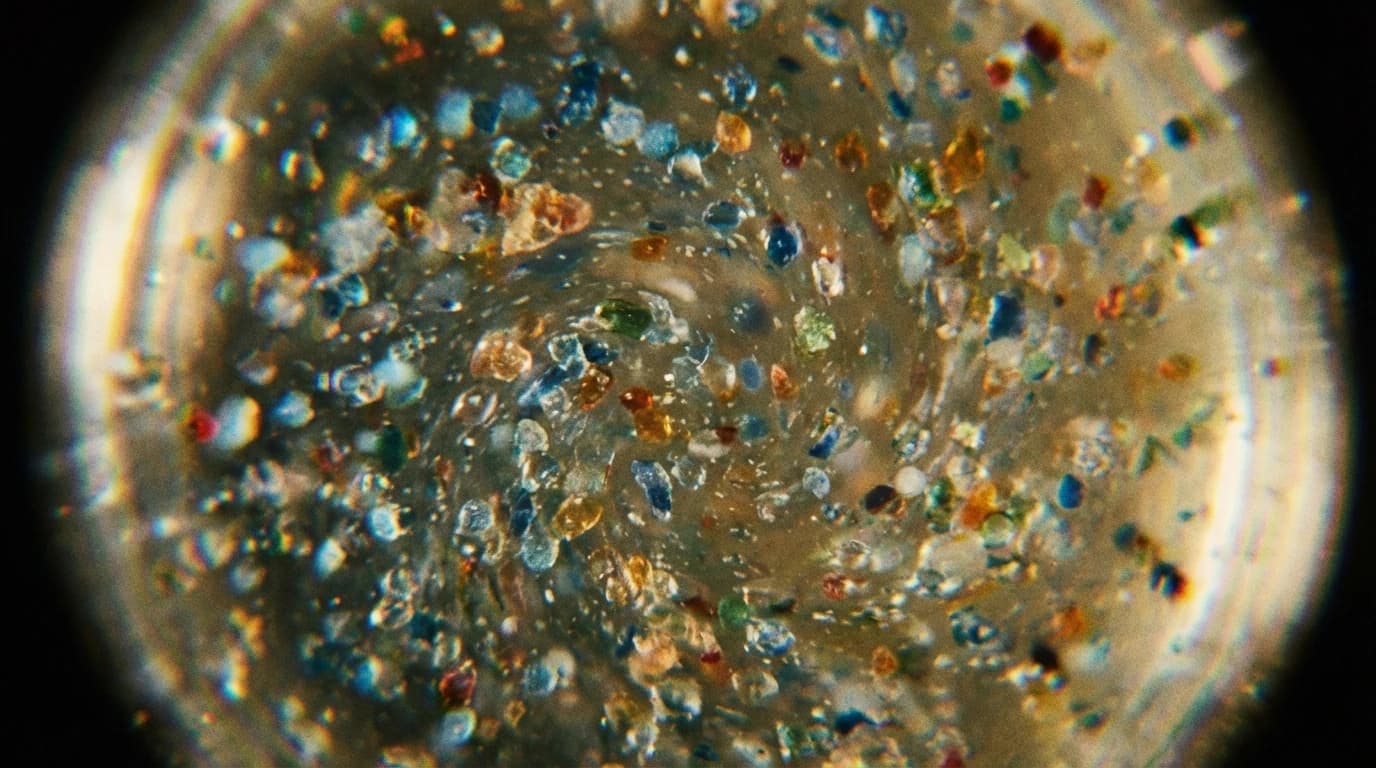
Imagine trying to count the exact number of hundreds and thousands on a massive, stadium-sized birthday cake. Now imagine everyone attempting this task is using a completely different tool. One person uses a soup spoon, another uses a tiny pair of tweezers, and a third just takes a quick photograph from a balcony.
When they compare their totals, the numbers will be completely different. No one will actually know how many sugary pieces are on the cake.
This is the exact problem scientists face with marine microplastics monitoring. Researchers know the ocean is full of tiny plastic fragments, but everyone uses slightly different methods to scoop them up.
The Messy Reality of Marine Microplastics Monitoring
We need to track plastic pollution to understand its threat to marine ecosystems. But right now, the data is incredibly noisy.
If one team samples a beach using a handful of sand, and another team uses an industrial bucket, their results will clash. The same issue happens when dragging nets through the water or pumping it through filters.
Without a standard set of rules, it is nearly impossible to compare data across different oceans or coastlines. To fix this, researchers decided to test the 'spoons' themselves to see which ones work best.
Finding the Perfect Scoop
The scientists went to the beach and out to sea to measure exactly how different sample sizes and methods changed their results. They analysed both coastal sediment and ocean seawater.
For beach sand and mud, they found a clear baseline. Researchers need to collect at least 30 grammes of sediment to get an accurate read.
They also noted that scientists cannot just check the dry sand. Teams must sample across the entire beach, from the dry high-tide mark straight down into the underwater zones.
When it came to ocean water, the team tested three main collection methods. They dragged a trawl net, used a water collector, and pumped water directly through a system.
The Rules for Better Data
The team discovered that for seawater, the best results require specific minimums. Based on their tests, researchers should always:
- Drag a trawl net for a minimum of 10 minutes.
- Collect at least 10 litres of water when using a water collector.
- Check multiple depths, as polymer types change depending on the water layer.
Interestingly, the size of the holes in the filter did not significantly change the total number of plastics caught. A 48-micrometre filter and a 330-micrometre filter caught roughly the same total amount of plastic.
However, the filter size completely changed the physical shape and size of the fragments trapped inside. The team also measured plastic levels across different water depths in Leizhou Bay. While the total volume remained similar, the chemical make-up of the plastics shifted the deeper they went.
A Clearer Picture of the Ocean
This research suggests a clear, standardised recipe for counting ocean plastics. By following these minimum requirements, scientists worldwide could finally compare their notes accurately.
If everyone uses the same standard tools, we can build a much sharper picture of global pollution. This standardisation may help us finally track whether our efforts to clean the oceans are actually working.