Chemistry & Material Science29 April 2026
The Spontaneous Order of the Polar Hedgehog Lattice
Source PublicationScientific Publication
Primary AuthorsXu C, Luo N, Yue J, Chen C, Bian T, Zhang C, Che X, Liang J, Li MM, Yin J, Chen Z, Zhang S, Pan X, Zhu Y.
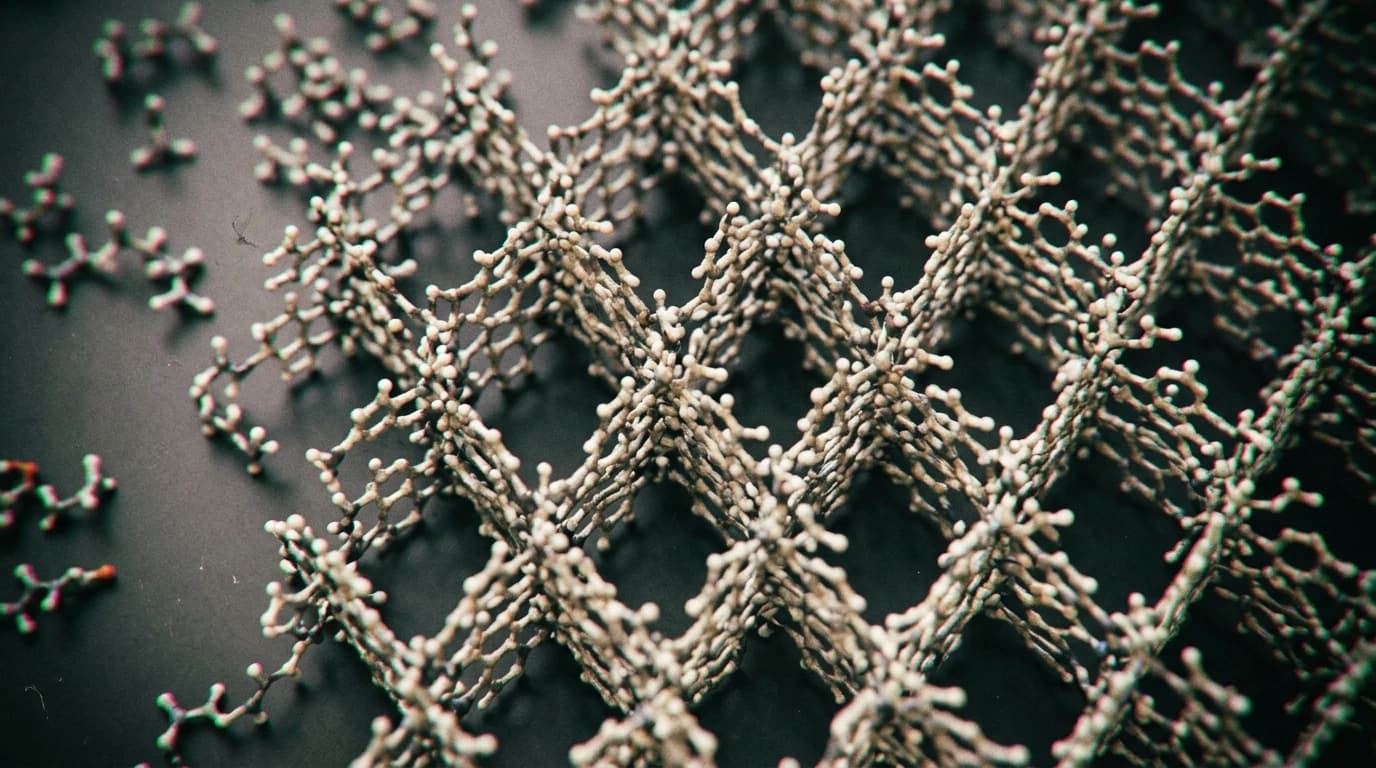
At the atomic scale, electricity is a restless force, usually fleeing toward the edges of a crystal or collapsing into messy static. Scientists have long struggled to trap these electrical dipoles into stable, swirling knots to store data, but the effort typically requires massive external voltages to maintain order.
The Spontaneous Polar Hedgehog Lattice
In a study of layered perovskites, physicists discovered that certain materials possess an innate drive for symmetry. They observed a **Polar hedgehog lattice**—a self-organised grid of electrical spikes—forming entirely on its own. This 4-nanometre pattern emerges without any mechanical or electrical constraints, appearing as a natural state of the crystal's geometry. Using scanning transmission electron microscopy, the team mapped these structures in real space. The measurements suggest the lattice arises from the coordinated movement of oxygen atoms rotating in and out of phase. This 'cooperative assembly' of atomic cages creates a stable environment for the dipoles to whirl.Impact on Artificial Intelligence
This discovery implies that we do not need to micromanage materials to achieve complex data structures. By selecting the correct atomic ingredients, the internal physics of the crystal handles the organisation.- Natural stability: These lattices exist in bulk form without needing artificial 'cages'.
- Density: A 4-nanometre period allows for incredibly compact information storage.
- Efficiency: Spontaneous formation could reduce the energy required to manufacture next-generation chips.
Cite this Article (Harvard Style)
Xu C, Luo N, Yue J, Chen C, Bian T, Zhang C, Che X, Liang J, Li MM, Yin J, Chen Z, Zhang S, Pan X, Zhu Y. (2026). 'Intrinsic polar vortex crystals in A-site layer-ordered perovskites. '. Scientific Publication. Available at: https://doi.org/10.1038/s41586-026-10470-2