The Silent Ocean and its Secret: What Marine plankton Tell Us About Hidden Order
Source PublicationScientific Publication
Primary AuthorsMa, Ser-Giacomi, Raut et al.
"Imagine trying to guess the layout of a vast, uncharted city hidden in the fog. Instead of wandering blindly through every street, you discover a master blueprint that dictates how all neighbourhoods are organised. Because the city follows strict rules for roads and districts, the blueprint helps you map the unseen areas. Similarly, the mathematical rules of Species Abundance Distributions help scientists understand the hidden structure of marine ecosystems."
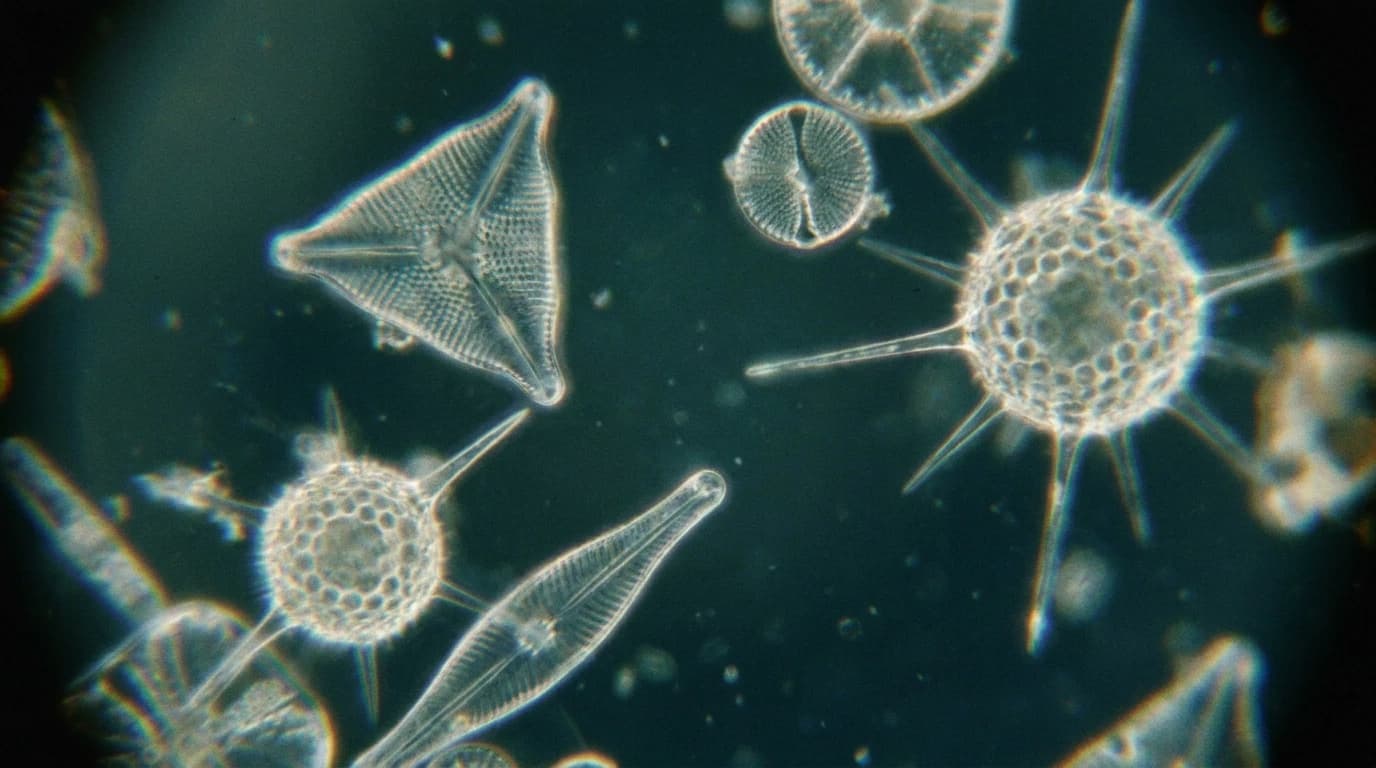
The ocean is a vast, churning wilderness. For centuries, scientists have stared into its depths, overwhelmed by its chaotic, shifting nature. Beneath the waves, microscopic life drives the biological cycles of our planet. These organisms dictate the health of the seas, yet their sheer diversity has long made mapping their ecosystems feel like an impossible human endeavour.
The stakes of understanding these ocean drifters are incredibly high, as they govern the global biogeochemical cycles that sustain life. For decades, researchers assumed these microscopic communities simply drifted randomly, shaped entirely by the turbulent whims of the sea. The plot twist? The discovery of a hidden mathematical order. Rather than a chaotic jumble, these microscopic populations actively assemble into highly structured, predictable ecosystems.
But how do scientists measure a global community they cannot easily see? To find order in such a vast, seemingly disorganised system, researchers needed a powerful mathematical tool. The heroes in this story are the scientists who turned to global data to decode the secrets of Marine plankton.
The Mathematical Rules of Marine plankton
The ocean is teeming with microscopic life. These tiny organisms span over five orders of magnitude in diameter, varying wildly in shape and function. Some are plant-like, others are animal-like, and together they form the invisible engine of the sea. For a long time, the massive diversity of these ocean drifters made it difficult to map their ecosystems.
However, a recent study measured the populations of these ocean dwellers. Based on current large-scale surveys and global, mechanistic computer simulations, the researchers diagnosed something called Species Abundance Distributions (SADs). In simple terms, this is a mathematical way to count how many rare species exist compared to common ones.
The ocean is not as chaotic as it seems. The study revealed a remarkably consistent structure. Whether looking at different latitudes, changing seasons, or entirely different biomes, the mathematical shape of these communities varied by less than ten per cent. Despite harsh environmental changes and taxonomic turnover, the overall structure of the community remained stable.
What This Suggests for Marine Ecosystems
This discovery suggests that nature follows strict rules when building communities, even microscopic ones. The researchers found that the shape of these populations reflects fundamental limits on how groups of organisms assemble.
By mapping the invariant structure of ocean life, scientists now have a compact, quantitative diagnostic tool. It allows them to predict the behaviour of complex biological networks. If we can understand the strict mathematical rules that govern wild, shifting ocean ecosystems, we can better safeguard the biogeochemical cycles they support. Nature, even in the depths of the sea, harbours a hidden order.