The Silent Dance of Extreme Mass Ratio Inspirals
Source PublicationSpringer Science and Business Media LLC
Primary AuthorsWu, Luo, Shi
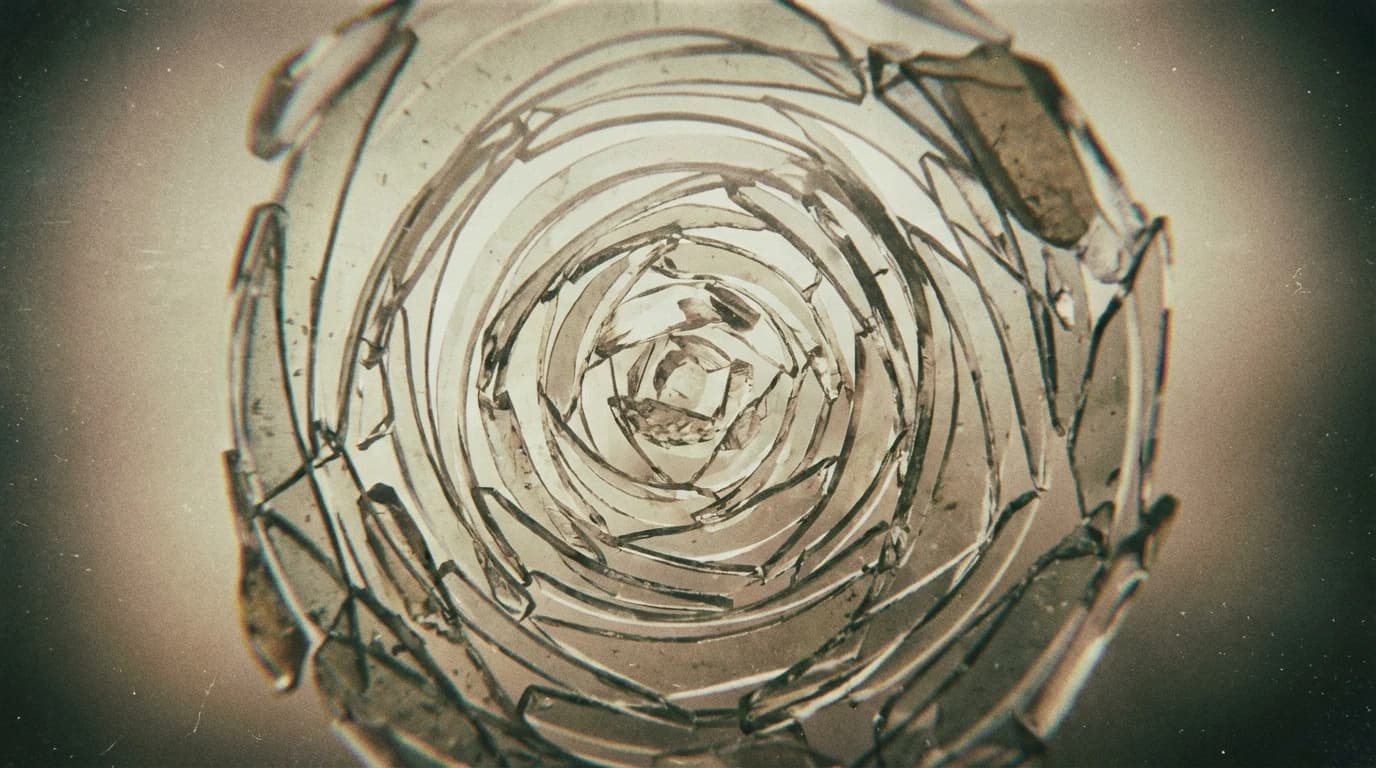
Deep in the quiet dark of the cosmos, a slow, violent execution is taking place. A dead star, incredibly heavy and dense, circles a supermassive black hole millions of times its size.
For millennia, the smaller object traces an ever-tightening spiral, trapped in a gravitational grip so absolute it warps the very fabric of space and time. No optical telescope captures this invisible struggle, as the black hole consumes all surrounding light.
The only evidence ripples outward as faint, ghostly vibrations, carrying the secrets of matter pushed to the absolute limit. Until recently, the final moments of this cosmic dance remained entirely hidden from human observation.
Extreme Mass Ratio Inspirals
These vastly lopsided cosmic pairings are known as Extreme Mass Ratio Inspirals. They represent one of the most anticipated targets for future space-based observatories, which will listen for the subtle tremors of gravity itself rather than looking for light.
As the smaller object—often a neutron star—plunges toward the dark centre, the extreme gravity crushes it mercilessly. Physicists have long wondered what happens to the ultradense matter inside the star just before the black hole swallows it whole. The internal pressure must reach levels that defy our current understanding of physics, compressing atomic structures into entirely new forms.
A Sudden Internal Shift
Now, a preliminary study awaiting peer review offers a mathematical blueprint to decode these final moments. The researchers modelled a sudden, violent change within the doomed neutron star.
Under the immense pressure of the black hole's gravity, the star's internal matter might undergo a sudden phase transition. This is not a gentle process, but a radical restructuring of the star's fundamental particles.
This shift forces the star to collapse from ordinary nuclear material into a strange, dense soup of free quarks. The research team calculated how this internal shift alters the star's shape, specifically changing its tidal deformability.
As the star becomes suddenly more compressible, it squishes, creating a tiny stutter in its orbital path around the black hole. According to their early-stage analytical models, this stutter shifts the timing of the gravitational waves rippling outwards.
Reading the Ripples
The researchers derived a strict scaling law to measure this accumulated phase shift, known as dephasing. Their calculations indicate that the spin of the supermassive black hole, along with the star's orbital speed, significantly amplifies the effect. The black hole's rotation essentially drags the surrounding space, making the stutter more pronounced.
By measuring this slight shift in the wave's rhythm, scientists could effectively peer inside the neutron star from billions of light-years away. The preprint suggests that researchers will be able to track several specific phenomena:
- The exact moment the star's core transitions into a quark state.
- How the supermassive black hole's rotation magnifies the gravitational wave distortion.
- The fundamental behaviour of matter at densities impossible to recreate in terrestrial laboratories.
If confirmed, this theoretical framework provides a robust new tool for future detectors like the Laser Interferometer Space Antenna (LISA) mission. Astronomers may soon read these gravitational ripples to understand the deep physical laws governing the universe. The silent death of a star could finally speak, transmitting its final physical state across the void.