The Quiet Brilliance of On-chip frequency combs
Source PublicationNature
Primary AuthorsEnglebert, Gray, Ledezma et al.
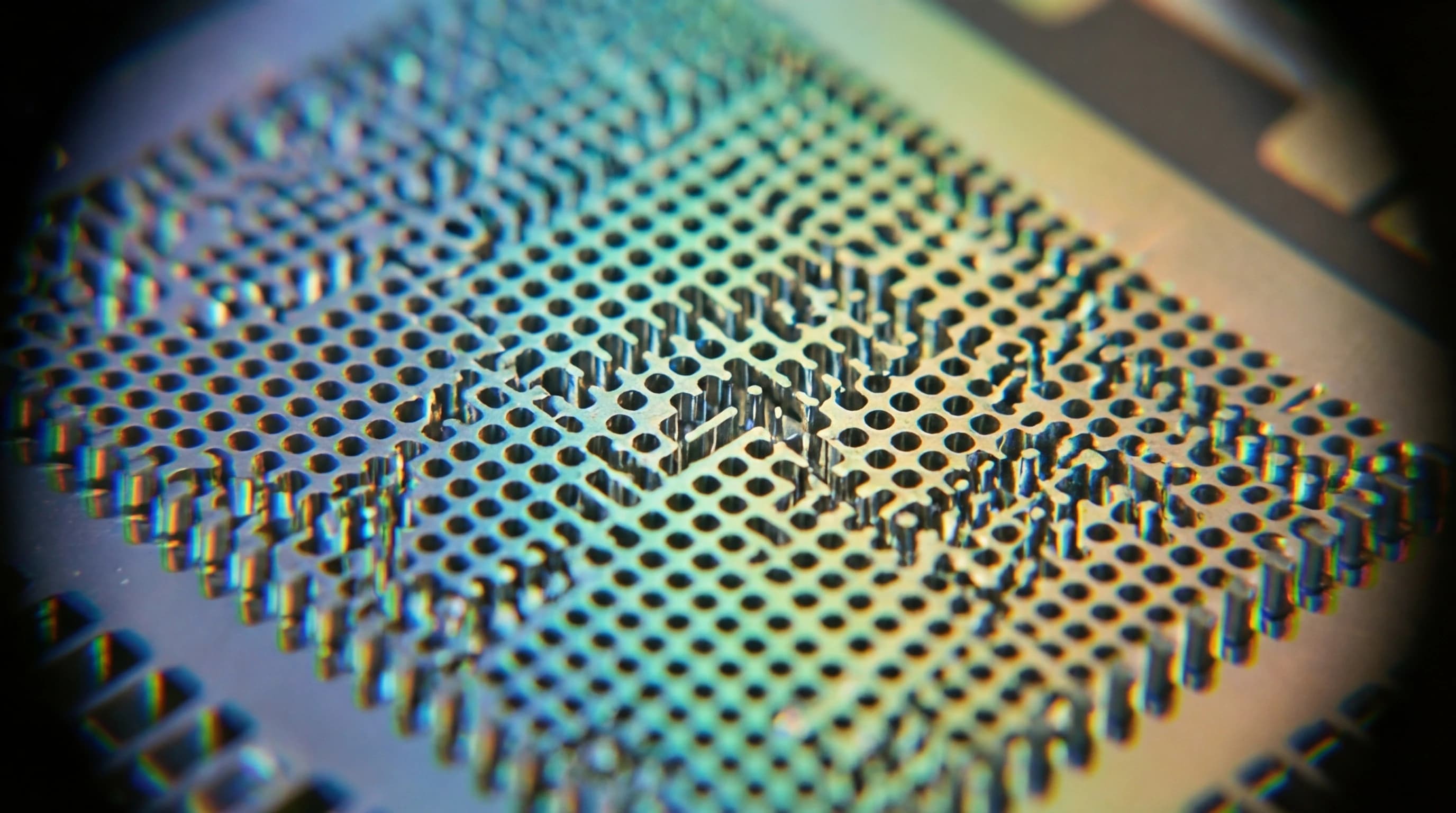
Deep inside the most advanced laboratories on Earth, physicists wage a quiet war against chaos. They seek to measure the universe with absolute perfection, slicing time and light into impossibly thin, exact fractions. To do this, they rely on massive, delicate laser systems that fill entire rooms with mirrors, lenses, and complex stabilisation equipment.
These results were observed under controlled laboratory conditions, so real-world performance may differ.
For decades, the dream has been to shrink these sprawling optical tables down to a flat sliver of metal and glass. But the physics of light is notoriously stubborn, and miniaturisation usually comes with an unbearable cost.
The prize at the centre of this struggle is the optical frequency comb. These devices act as literal rulers made of light, emitting millions of laser pulses in perfectly spaced intervals. They allow scientists to track time with atomic precision, measure vast distances through advanced ranging, or build ultra-accurate optical clocks.
Yet, shrinking them into practical, portable devices has proved maddeningly difficult. Existing miniature versions are notoriously finicky. They require external radiofrequency generators or incredibly fragile, high-quality resonators to keep the light bouncing correctly.
Furthermore, they demand complex stabilisation schemes just to function. These heavy requirements keep them trapped inside the laboratory, rather than deployed in the real world where they are needed most.
Now, researchers have demonstrated a new method that sidesteps these strict physical requirements entirely. Writing in a recent study, the team built a hybrid device that marries a standard semiconductor laser with a tiny lithium niobate nanophotonic circuit.
The elegance of On-chip frequency combs
This specific architecture allows the team to generate what physicists call temporal topological solitons. These are incredibly robust pulses of light, measuring as short as 60 femtoseconds, that form naturally within the circuit. To understand their brevity, a femtosecond is to a second what a second is to about 31.7 million years.
Unlike previous attempts, this oscillator operates with low finesse. It does not demand a flawless, high-quality resonator to maintain its rhythm. Instead, the solitons act as phase defects. They separate continuous waves of light without requiring perfect dispersion conditions.
The system effectively stabilises itself. By relying on quadratic nonlinearity, the light waves organise into a steady, reliable pulse train at exactly half the frequency of the input laser.
The researchers measured these microscopic pulses using on-chip cross-correlation. Their readings confirmed that the system operates exactly as theoretical physics suggests, matching the established Ginzburg-Landau theory.
To prove its practical viability, the team even demonstrated a proof-of-concept turn-key version of the device in a laboratory setting. You simply turn it on, and it works. It bypasses the endless manual calibration that plagues traditional experimental setups.
This specific design could free precision optics from the strict confines of the laboratory environment. It suggests a much simpler path forward for mass production because the system offers three distinct advantages:
- It is entirely agnostic to the sign of dispersion.
- It ignores the need for flawless, high-quality resonators.
- It eliminates the need for external high-speed modulators.
Future iterations may grant us unprecedented access to hard-to-reach spectral regions, such as the mid-infrared. If successful, this laboratory breakthrough could eventually pave the way for widespread deployment of portable optical clocks and advanced ranging technologies, bringing the uncompromising precision of the physics lab out into the wider world.