The Molecular Anchor Stabilising Perovskite Solar Cells
Source PublicationSmall
Primary AuthorsSun, Zhang, Zhu et al.
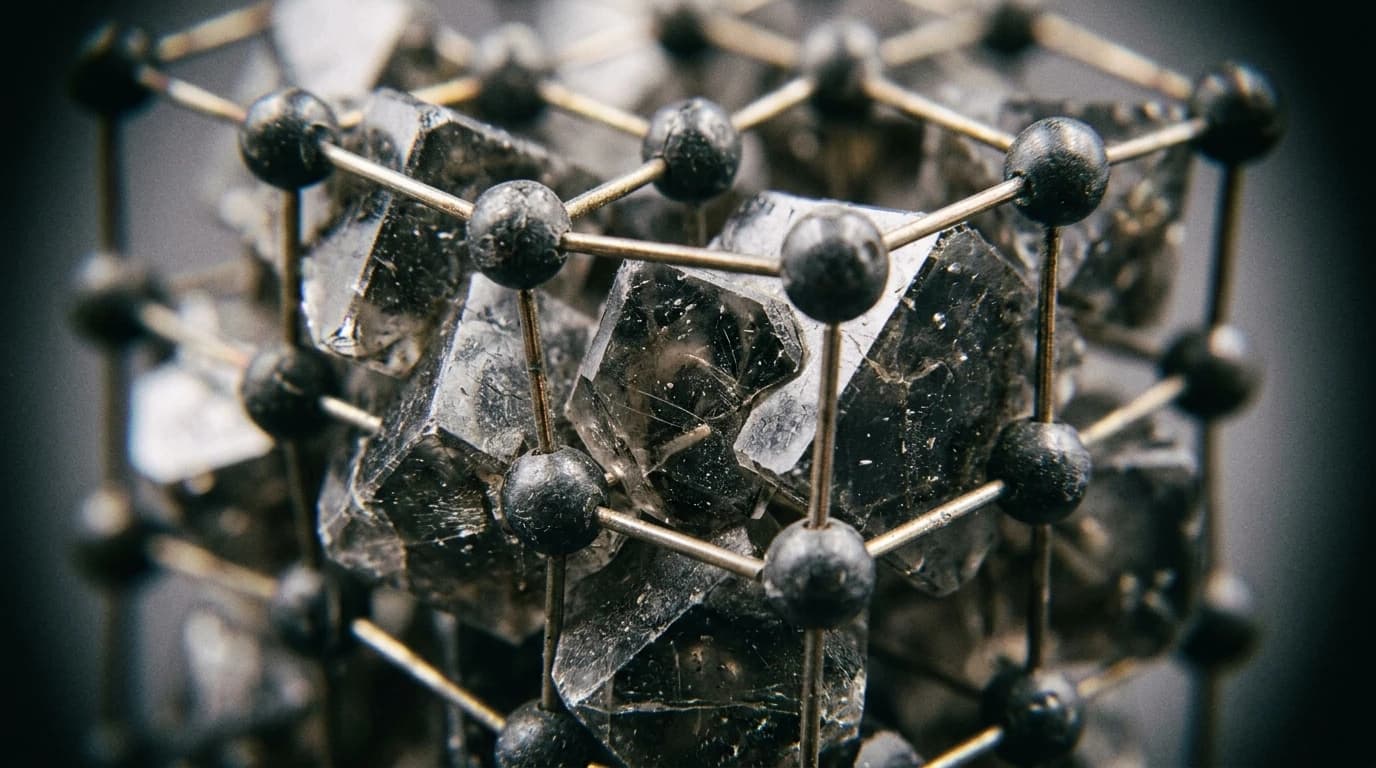
The sun is a harsh master for the very materials meant to capture it. While traditional silicon panels endure for decades, their successors—perovskite solar cells—often degrade before they even leave the laboratory. The problem is a form of chemical suicide: a vital component called formamidine slowly decays in the liquid precursor, leaving the final film riddled with microscopic tension and structural flaws.
Reinforcing Perovskite Solar Cells from Within
Researchers have now identified a molecular stabiliser, 4-amino-2,3,5,6-tetrafluorobenzamide (4-ATB), that prevents this internal collapse. By introducing this additive, the team created a dense network of hydrogen bonds that shields the delicate chemistry of the solution. This intervention stops the premature generation of iodine and preserves the chemical integrity of the mixture before it ever hardens into a solid.
During the crystallisation process, the 4-ATB molecules act as rigid anchors. They alter the internal physics of the film in several ways:
- The material shifts from a fragile tensile-stress state to a robust compressive state.
- The rigid aromatic backbone prevents the film from expanding and cracking under intense heat.
- Dual-site anchoring ensures the lattice structure remains aligned even under environmental pressure.
The resulting devices achieved a power conversion efficiency exceeding 26 per cent. More significantly, they retained over 97 per cent of that performance after 1,200 hours of continuous, simulated sunlight. This suggests that the fragility of these cells is not an inherent flaw, but a mechanical hurdle that precise molecular engineering can overcome. If these results scale, the cost of solar energy could drop as the durability of these flexible films rises.