The Ghosts of Ancient Forests Hold a Blue Carbon Secret
Source PublicationSpringer Science and Business Media LLC
Primary AuthorsLebrato, Shannon, Russell et al.
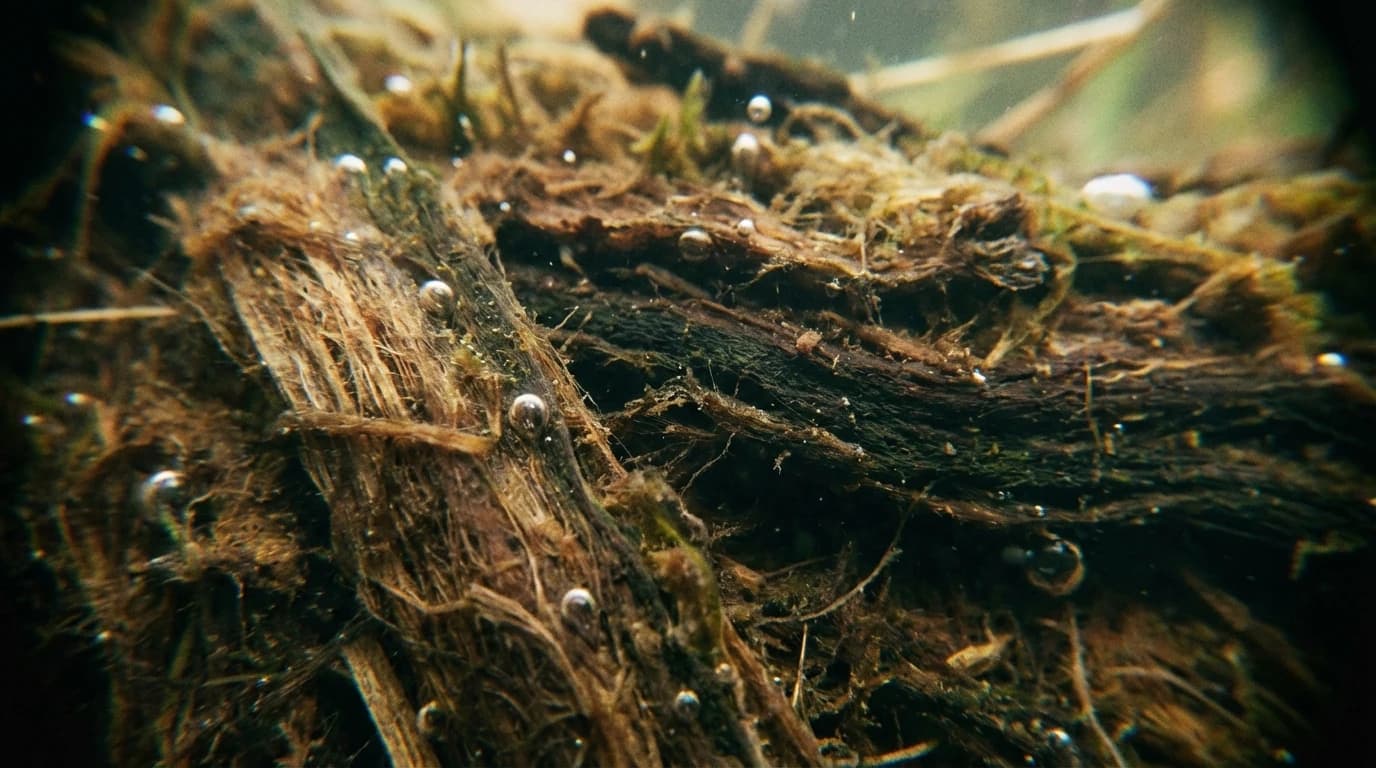
For millennia, the ocean has been quietly swallowing the edges of the continents. As ancient ice melted and tides crept higher, dense coastal forests slipped beneath the waves.
Note: This article is based on a preprint. The research has not yet been peer-reviewed and results should be interpreted as preliminary.
The trees drowned, their roots entombed in dark, cold sediment, hidden from the sun and forgotten by the world above. We tend to view sea-level rise purely as a destroyer of habitats, erasing the familiar green fringes of our coastlines.
Yet beneath the surf, the remnants of these ancient swamps have quietly endured. They sit in the shallows, battered by currents, holding onto carbon that the atmosphere has not seen for thousands of years.
The Hidden Vaults of Blue Carbon
When scientists talk about blue carbon, they usually point to living things. Mangrove thickets, salt marshes, and swaying seagrass meadows are famous for pulling carbon dioxide from the atmosphere and burying it in the mud. They are the visible lungs of the coast.
But what happens to the carbon locked inside a forest when the sea claims it entirely? Until recently, the fate of these drowned ecosystems remained a stubborn mystery.
Researchers suspected that submerged terrestrial deposits might hold vast stores of organic matter. Finding and studying them, however, proved exceptionally difficult. The ocean obscures its history well, burying old shorelines under layers of sand and water.
A Ghost Forest in Mozambique
Now, a recent study offers a rare glimpse into these submerged worlds. Researchers report discovering ancient, submerged peat reefs in the shallow waters of the Bazaruto Archipelago in Mozambique.
Radiocarbon dating suggests these reefs are the remains of coastal peat swamps that existed between 300 and 5,000 years ago. As the sea level rose during the mid- to late-Holocene, the water simply drowned the swamps intact. Today, the resulting peat contains up to 40 per cent organic carbon by weight.
These drowned forests are far from dead. While they lack the hard, reef-building corals found nearby, the data shows they support a highly distinct marine community. The researchers observed:
- Dense patches of seagrass and macroalgae clinging to the ancient peat substrate.
- Sponges and diverse invertebrates that form a complex physical structure.
- Rich nursery habitats for small fish, which frequently travel between the peat and nearby coral reefs.
Redrawing the Map
These findings suggest a remarkable ecological reinvention. A habitat that once hosted terrestrial plants has adapted to support a thriving, detritus-based marine food web. The peat reefs face wilder swings in temperature, salinity, and oxygen than adjacent coral reefs, yet they teem with life.
While the exact scale of these submerged carbon vaults worldwide remains an open question, the findings from this specific archipelago point toward a massive, overlooked climate resource. They are not merely dead relics, but active participants in the modern ocean ecosystem.
Recognising these reefs changes how we calculate the ocean's carbon inventory. It demands that conservation strategies expand to include these strange, hybrid habitats.
If we want to protect the sea's ability to store carbon, we must look beyond the living coastal fringes. We must also map, study, and protect the drowned forests of the past. Their preservation could be essential to keeping ancient carbon safely locked away beneath the waves.