The Ghostly Architecture of Bubbles: New Interfacial Phenomena in Polymeric Liquids
Source PublicationSpringer Science and Business Media LLC
Primary AuthorsOhta, Yamamoto, Fujimoto et al.
The Mystery of Interfacial Phenomena in Polymeric Liquids
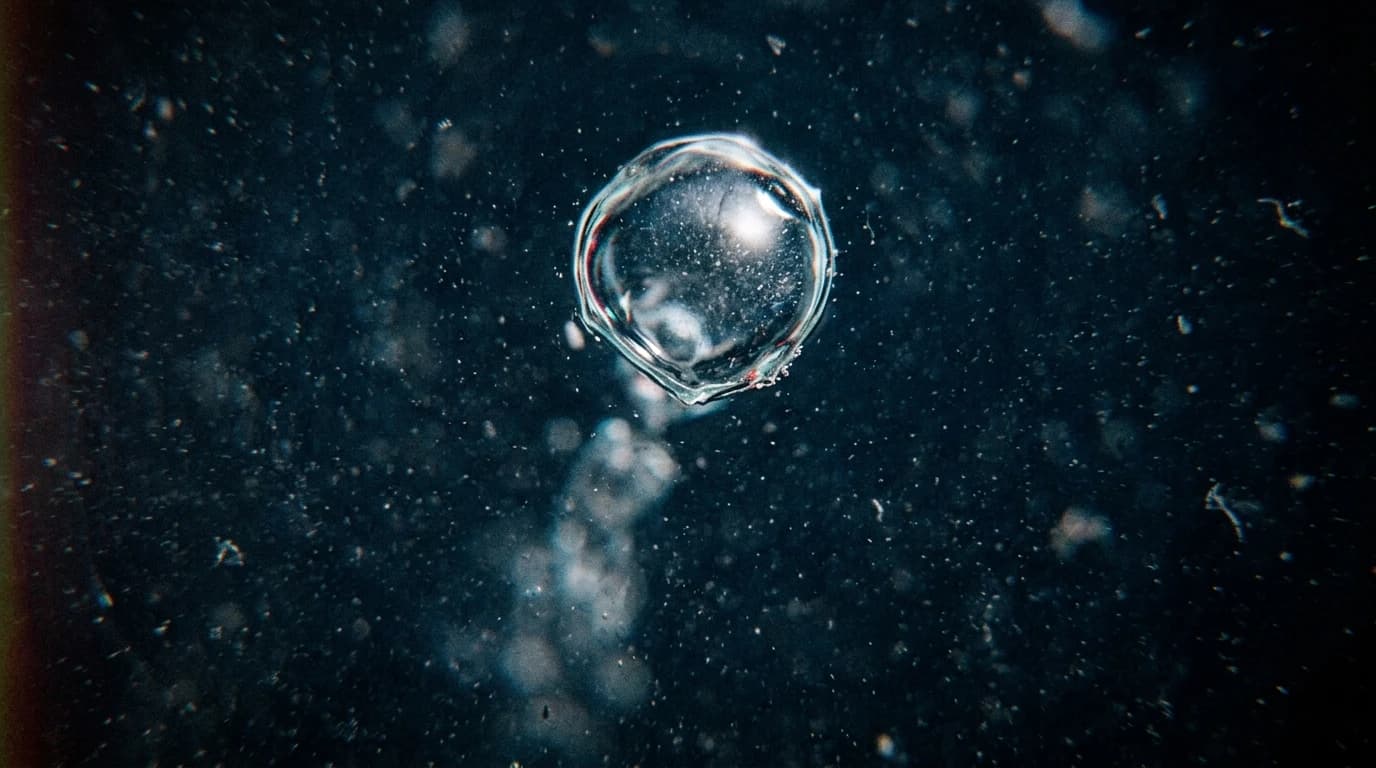
Imagine a bubble rising through a thick, clear syrup. Standard physics dictates it should remain a smooth sphere, minimising its surface area to conserve energy. Yet, in recent laboratory observations, scientists noticed something inexplicable: 'exotic microstructures' blooming from the base of these rising voids like trailing silk threads.
Note: This article is based on a preprint. The research has not yet been peer-reviewed and results should be interpreted as preliminary.
In a new study currently awaiting peer review, researchers investigated these interfacial phenomena in polymeric liquids by tracking bubbles through various viscoelastic fluids. They discovered that the shape and complexity of these structures depend on both the size of the bubble and the specific elasticity of the liquid. These formations appear to defy classical physics, which usually forces interfaces to be as small and simple as possible.
The data suggests that the local molecular friction between the gas and the polymer chains may be more influential than the thickness of the liquid itself. This microscale coupling indicates that the boundary where gas meets liquid is far more active than previously thought. While these results remain early-stage, they could change how engineers organise the production of advanced materials, from medical gels to industrial polymers, by focusing on the molecular friction at the bubble’s edge.