The elegant asymmetry of the Central amygdala: How the brain wires defence
Source PublicationJournal of Neuroscience
Primary AuthorsWang, Song, Chen et al.
"Think of the brain's defence system like a national emergency response network. Some operators only call the local fire brigade, while others have a red phone that simultaneously alerts the military, the hospitals, and the government."
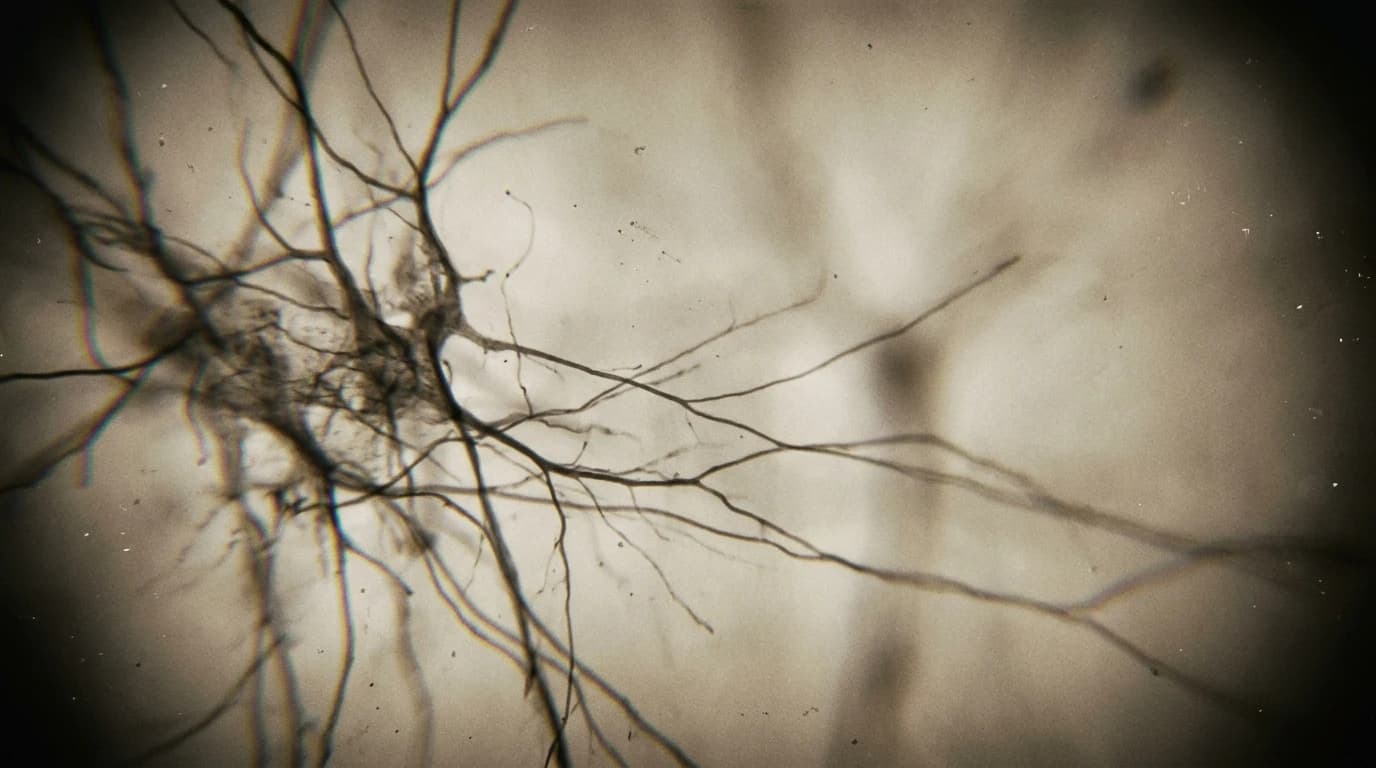
Is there a hidden elegance lurking within what appears to be biological chaos? Look closely at the mammalian brain, and you will find a dizzying tangle of wet wiring. To the untrained eye, it looks like a complete mess. It is a dense thicket of cells, dendrites, and axons firing in the dark. Yet, evolution rarely wastes energy on true disorganisation.
These results were observed under controlled laboratory conditions, so real-world performance may differ.
A recent laboratory study mapped the input and output architecture of three specific neuronal subtypes in male mice. The researchers measured the exact physical pathways these cells take, tracing them at single-cell resolution. What they found suggests a highly structured, almost ruthlessly efficient system for managing threat and stress.
The Central amygdala and its asymmetrical wiring
The primary focus of this research is the Central amygdala. Biologists have long known this region helps manage pain, stress, and defensive behaviours. But how do its specific molecular components actually plug into the wider brain? To answer this, researchers reconstructed the physical projections of three specific neuron types: Sst, Pkc-δ, and Crh.
The measurements revealed a fascinating physical reality. Some of these neurons are absolute homebodies. They restrict their connections to immediate, local circuits. Others are broad broadcasters. They send long-range signals out to the hypothalamus, the midbrain, and the brainstem simultaneously.
Why might nature organise a biological system this way? It is worth pausing to consider the evolutionary logic of such architecture. Evolution is an aggressive editor. It strips away the inefficient. If a brain region simply mashed all its signals together, a threat would trigger a massive, chaotic panic. Every alarm bell would ring at once. Instead, we see highly specific, segregated pathways alongside convergent ones. This dual approach allows an organism to fine-tune its response. A rustling bush might require quiet freezing. A snapping twig might demand immediate flight. By splitting the labour between local managers and global broadcasters, the brain ensures both speed and specific scale. Furthermore, the structural asymmetry—the fact that the left and right sides do not perfectly mirror each other—hints at an even deeper efficiency. Perhaps dividing tasks across hemispheres saves precious milliseconds. It is a brilliant, ruthless division of labour.
The study measured a distinct left-right asymmetry in these outputs. This structural lateralisation suggests that the left and right halves of this brain region could handle entirely different aspects of a threat response. The team also looked backwards. They mapped the upstream networks feeding into these neurons. They measured signals arriving from cortical projection neurons, particularly those originating in the insular cortex. These incoming signals were not randomly distributed. They were spatially organised, sending lateralised projections to distinct subregions.
Ultimately, this structural map does not tell us exactly what an animal feels in a moment of terror. It does, however, provide a physical blueprint. It suggests how a molecular identity translates into a brain-wide network, allowing an organism to select the exact right defensive behaviour when danger strikes.