The 100,000-Year Seal: How Granite Heals in a Deep Geological Repository
Source PublicationMDPI AG
Primary AuthorsTian, Wang, Wang et al.
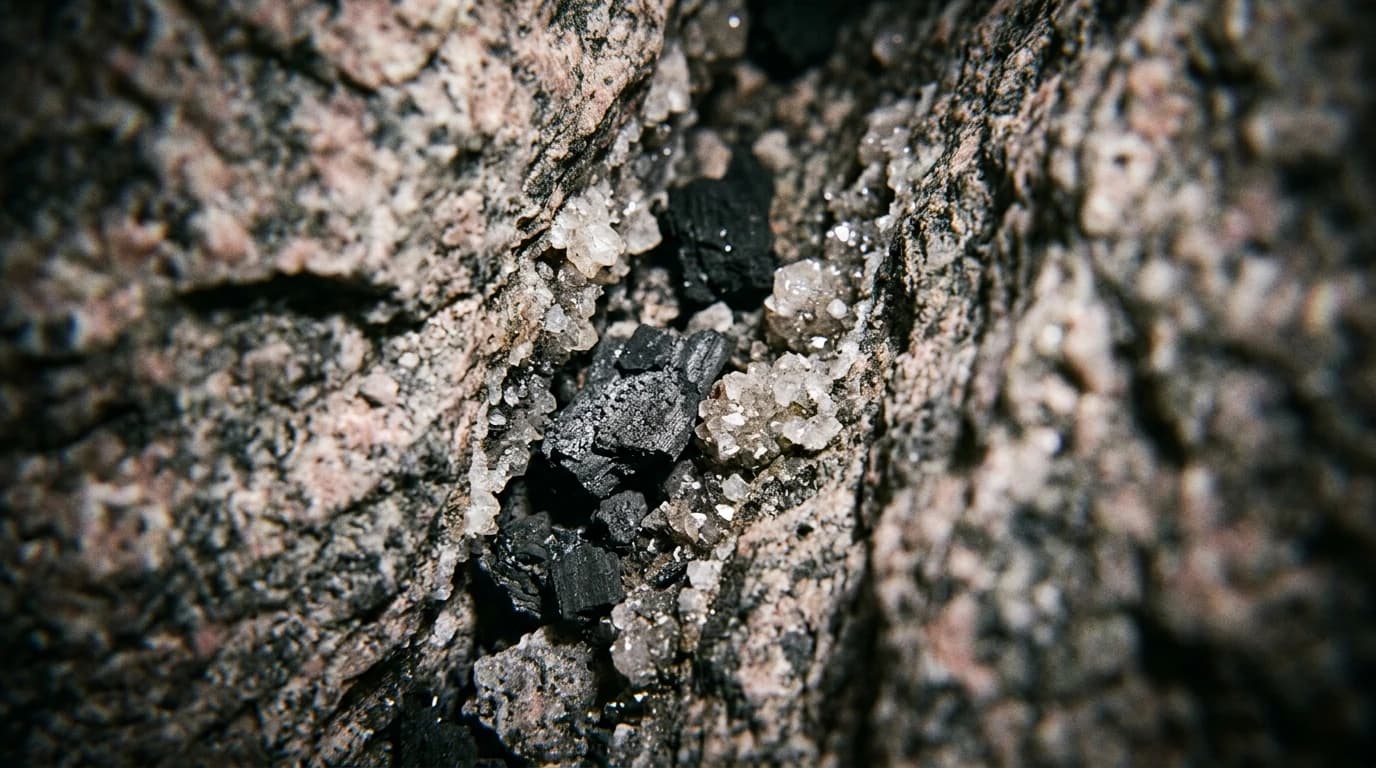
Deep beneath the Beishan granite, time moves at a glacial pace, yet the stakes are immediate. Here, high-level radioactive waste must remain undisturbed for a hundred millennia, isolated from the air we breathe and the water we drink. The primary threat to this isolation is the network of microscopic fractures within the rock—potential highways for toxic leakage.
Sealing the Deep Geological Repository
Engineers have long searched for a way to ensure these cracks remain shut under extreme subterranean stress. Researchers recently simulated these conditions, subjecting granite and its mineral fillers to 90°C and 15 MPa of effective pressure. They found that the earth possesses its own internal repair mechanism through a specific chemical handshake between minerals.
The study measured how calcite, quartz, and clay collaborate to plug gaps. In a saturated solution, calcite undergoes "pressure solution-precipitation," where the mineral dissolves at high-stress contacts and recrystallises in open voids. Fine-grained calcite proved most effective, reaching a porosity as low as 4.8% on its own.
This process, when combined with the lubrication of clay and the stress concentration of quartz, reduced the final porosity to a mere 2.1%. This suggests that natural mineral assemblages are significantly more effective at self-sealing than previous monomineralic models indicated.
By quantifying these interactions, scientists can better predict the long-term integrity of a deep geological repository. The findings provide a rigorous physical basis for safety assessments, ensuring that what is buried remains silent and secure. This natural alchemy turns a structural weakness into a permanent, stony seal.