Temperature-Controlled Chiral cocrystals Show Asymmetric Quantum Spin Behaviour
Source PublicationNano Letters
Primary AuthorsChen, Liu, Sun et al.
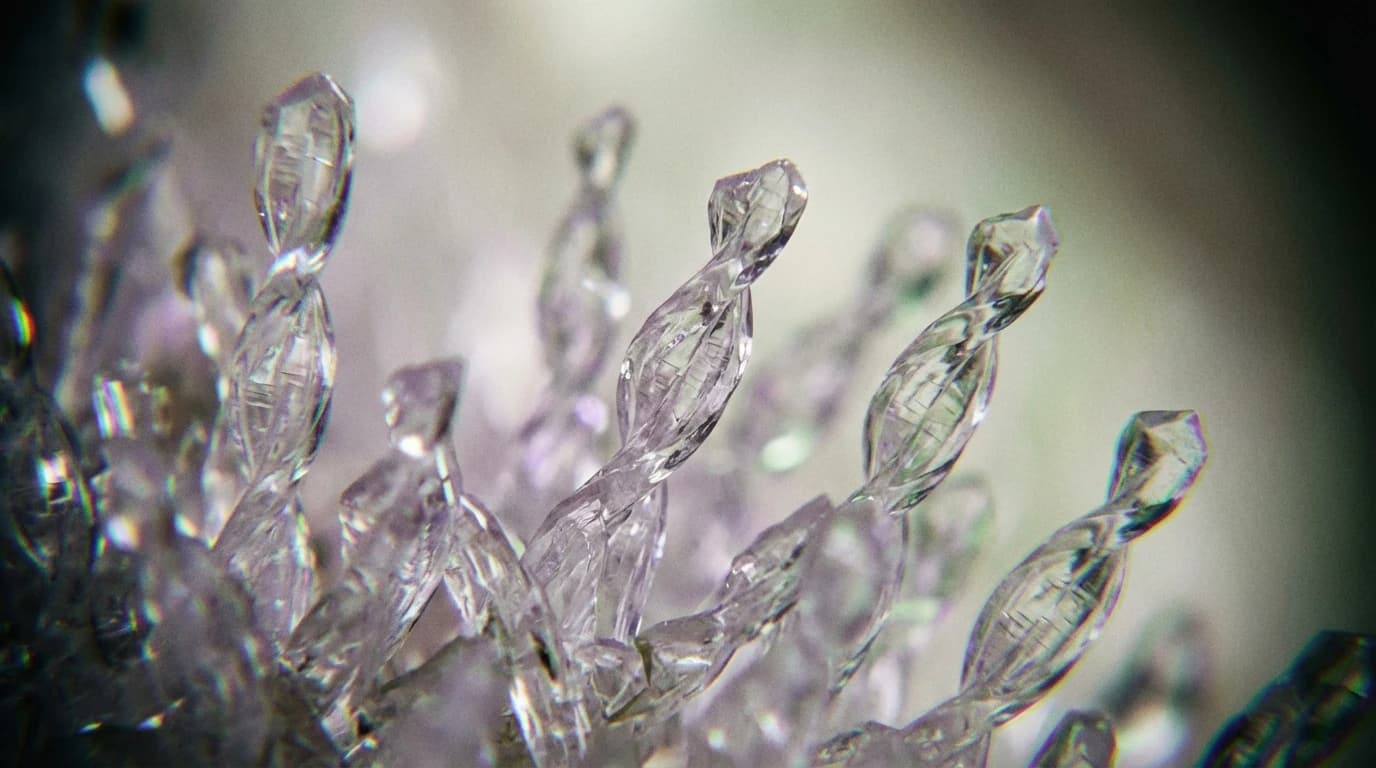
The Spin Asymmetry of Chiral cocrystals
Researchers have successfully fabricated a pair of Chiral cocrystals that demonstrate highly asymmetric spin polarisation when cooled. While studying quantum phenomena, researchers often utilise rigid frameworks where the spatial orientation remains fixed. The ability to induce dynamic structural shifts within a single lattice offers a compelling alternative to these static models.
These results were observed under controlled laboratory conditions, so real-world performance may differ.
Static Structures vs Dynamic Control
In conventional experimental setups, scientists often rely on static chiral frameworks to assess quantum behaviour. Once a material is synthesised as strictly left-handed or right-handed, its quantum properties and interactions with photon degrees of freedom typically remain fixed in place.
This static approach inherently restricts the ability to manipulate spin in real time, often requiring researchers to evaluate entirely separate samples to observe varying spin responses.
The current method diverges sharply from this convention by introducing a temperature-triggered phase transition. Instead of relying solely on separate static samples, the researchers measured active structural changes within a single dynamic lattice, offering a massive advantage in experimental flexibility within this specific homochiral system.
Measuring the Chiral Inversion
The laboratory team measured the magnetisation of both left-handed and right-handed enantiomers. They recorded three distinct physical behaviours during the experiment:
- Only the right-handed structure underwent a physical chiral inversion upon cooling.
- Spin polarisation in the right-handed variant increased nonlinearly and rapidly as temperatures dropped.
- The exact phase transition temperature could be actively tuned using circularly polarised light.
Because the spin degeneracy lifting is directly affected by this inversion, the material displays a mirror response in the magnetic field control of circularly polarised transmittance. These measurements suggest that optical and thermal inputs can directly dictate the geometric lattice of the compound.
What the Data Does Not Resolve
Despite these precise measurements, the study leaves a substantial gap regarding practical implementation. While the distinct lattice structure predominantly accounts for the observed magnetisation variations, the precise underlying reasons why only the right-handed crystal inverts—while the left-handed crystal remains structurally stable—warrant further investigation.
Furthermore, these measurements occurred under strictly controlled laboratory conditions requiring continuous cooling. The research does not solve how to maintain this dynamic spin control at room temperature, which poses a significant hurdle for many practical spintronic applications.
Future Implications for Quantum Optics
This dynamic structural shift could theoretically alter how we design optical and magnetic components. By linking thermal and optical inputs directly to spin degeneracy, engineers may eventually build highly responsive quantum systems that adapt to environmental changes.
The findings indicate a clear departure from rigid materials engineering. Future studies will need to determine if this asymmetric behaviour applies to a broader class of homochiral materials, or if it is an isolated anomaly.