Shaking Up the Hydrogen Evolution Reaction: How Vibrating Catalysts Boost Clean Fuel
Source PublicationSpringer Science and Business Media LLC
Primary AuthorsMonai, Yu, Bianco et al.
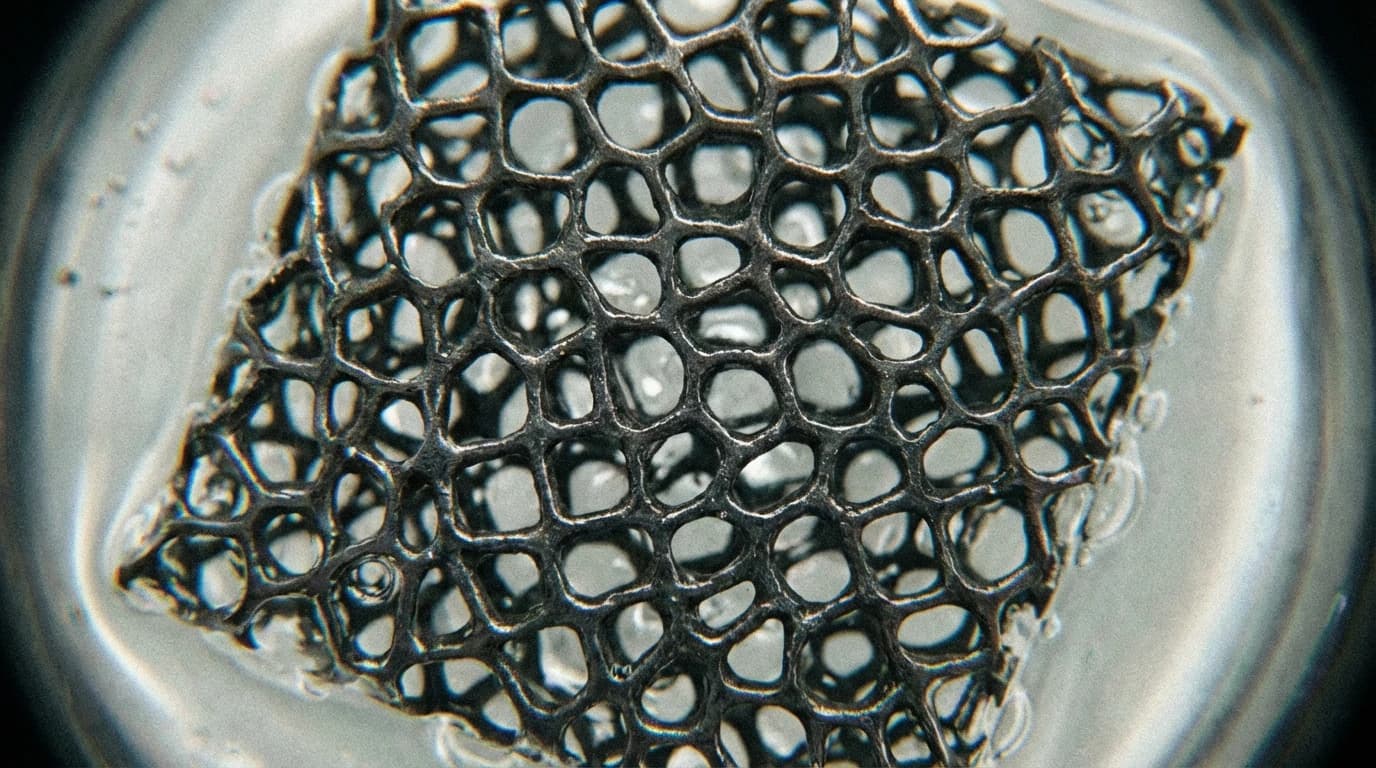
The Ketchup Bottle Effect
Imagine trying to get stubborn ketchup out of a glass bottle. Simply holding it upside down and waiting rarely works well. But if you tap the glass at exactly the right rhythm, the sauce suddenly flows freely.
Note: This article is based on a preprint. The research has not yet been peer-reviewed and results should be interpreted as preliminary.
Chemical reactions often face a remarkably similar bottleneck. The materials we use to speed them up, known as catalysts, usually sit perfectly still in a liquid or gas. Because they remain static, their efficiency hits a hard physical limit.
Why the Hydrogen Evolution Reaction Matters
To manufacture clean fuels, scientists rely heavily on the hydrogen evolution reaction. This electrochemical process splits water to create hydrogen gas, a vital zero-carbon energy source.
However, the metals used to speed up this process, like platinum or copper, are entirely rigid. Researchers have long suspected that physically stretching or squeezing these metals could alter their internal electronic structure.
Applying this physical 'strain' should theoretically make the active sites on the metal work faster. The problem is doing it quickly enough to matter. Until now, no one could vibrate these solid metals at the intermediate frequencies required to truly test the theory.
Vibrating Metals at 1,000 Hertz
A fascinating new preprint, currently awaiting peer review, proposes a clever mechanical solution. Researchers attached piezoelectric actuators to metal foils made of copper, platinum, and nickel. These actuators are small devices that buzz intensely when exposed to electricity.
By pulsing these actuators, the team rapidly stressed and strained the catalysts up to 1,000 times a second. They then measured the resulting chemical output from the metals.
The early-stage results were surprising. When the team hit specific vibrational sweet spots, the electrical current linked to hydrogen production spiked massively. For anodised copper electrodes, the output jumped to an astonishing 30 times its normal static rate.
The researchers used lasers to measure the surface vibration velocity while the reaction happened. They found that at these peak frequencies, the physical strain on the metal amplified, forcing electrons to transfer much faster than usual.
Rethinking Chemical Limits
Because this is an early-stage preprint, other scientists still need to verify the measurements and test the methods. Yet, the data suggests a totally new way to design chemical manufacturing processes.
Instead of relying entirely on discovering rare new materials, we might simply need to vibrate the ones we already have. The authors suggest this technique could create 'catalytic ratchets'.
These ratchets could theoretically push chemical reactions past their standard thermodynamic limits. If validated, this method may help us:
- Produce clean hydrogen fuel much faster and cheaper.
- Steer chemical reactions to create highly specific sustainable products.
- Design highly efficient, dynamic industrial plants that rely on mechanical pulsing.
Sometimes, you just need to know exactly how hard to tap the bottle.