Severe Mental Health Issues May Share Biological Aging Roots in DNA
A study suggests that major depression, bipolar illness, and schizophrenia share inherited DNA signals with biological aging markers, pointing to common underlying genes rather than direct cause and effect.
Reading level
The full story with proper science words explained.
Shared lines in our code
People facing severe mental health struggles often die earlier than others. Why does this happen? To explore this question, researchers tracked cellular aging genetics. They compared DNA code across major depression, bipolar illness, and schizophrenia with markers of physical aging.
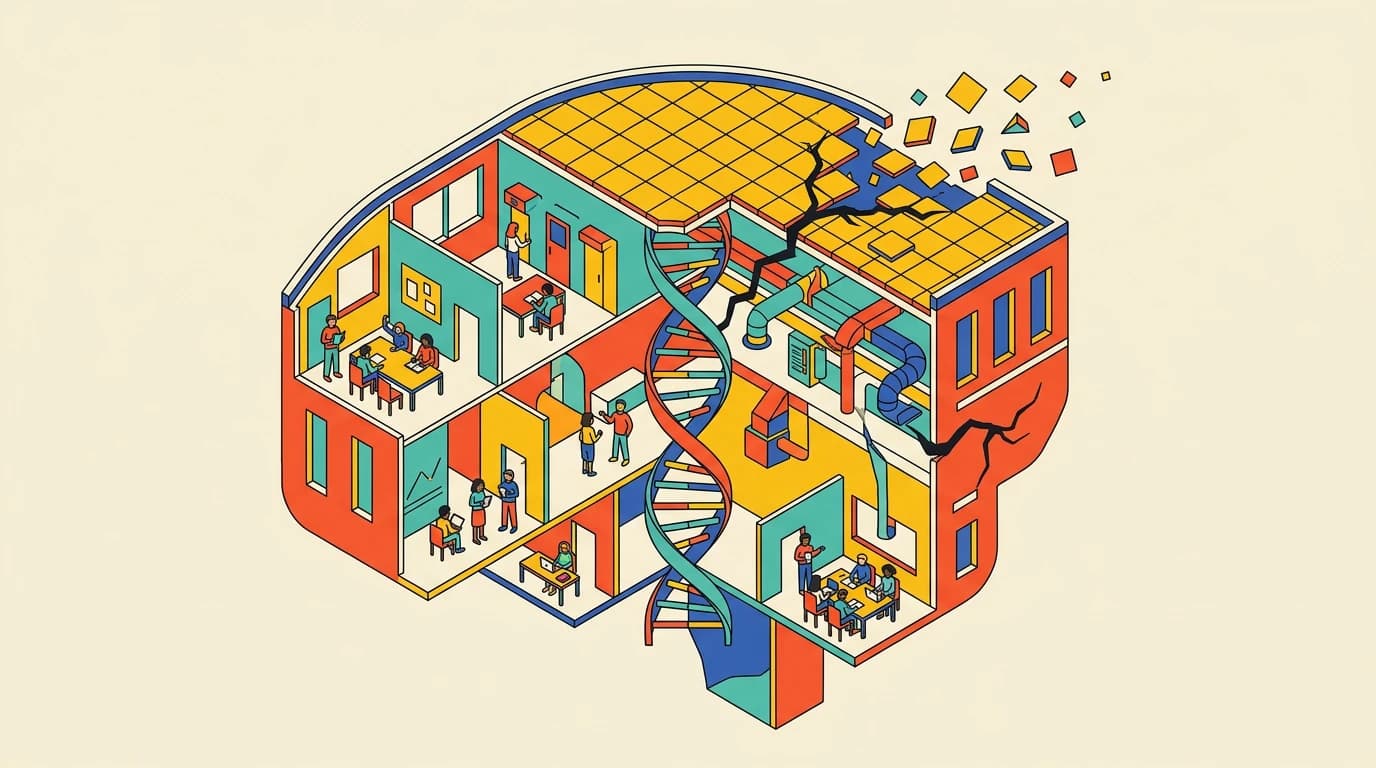
Think of DNA as a house plan. If one line contains a flaw, it might cause poor air flow inside. That same line could also make the roof wear down fast. In this way, a single line in the plan leads to two separate problems.
Matching DNA to biological clocks
The team analysed large gene databases to spot matching code. All three mental health issues showed negative links with long life and healthy aging. Major depression stood out with clear cell markers. It linked to shorter leucocyte telomere length, which refers to the protective end caps on white blood cell chromosomes that wear down over time. It also linked to higher epigenetic age acceleration, a chemical score showing that cells age faster than calendar years.
The study found nine pleiotropic genes shared across all three mental illnesses and aging markers. These are single genes that guide two or more unrelated bodily traits. Next, the team used Mendelian randomisation. This statistical method tests if an association represents a true causal link by using inherited genetic variants. The test showed that higher activity of a brain gene called CRHR1 tracks with both depression risk and an increased brain age gap. That term means a person's biological brain looks older than their true age in years.
What remains unknown
Finding shared DNA does not prove that quick aging causes mental illness, nor that mental illness speeds up cell aging. It simply shows that both outcomes share inherited code. Also, markers like shorter chromosome caps appeared only with depression. We do not yet know if medicines aimed at CRHR1 can treat symptoms or slow cell aging, nor how nutrients like magnesium and folate interact with these genes.
Science words
- Pleiotropic genes
- Individual genes that influence two or more seemingly unrelated physical traits or conditions.
- Leucocyte telomere length
- The length of protective caps on white blood cell chromosomes, which usually shorten as cells grow older.
- Epigenetic age acceleration
- A measure showing that cells are aging faster than calendar time, based on chemical marks on DNA.
- Mendelian randomisation
- A statistical method that uses measured genetic variants to test whether an association represents a causal relationship.
- Brain age gap
- The difference between an individual's estimated biological brain age and their actual chronological age.
Check it yourself
This story is based on a real research paper in Molecular Psychiatry by Pisanu, Nishioka, Manchia et al. We write with AI help and check it against the paper, but the original is the final word.