Removing brain clots three days after a stroke aids recovery but raises risks
In a trial of 336 patients arriving 24 to 72 hours after an ischemic stroke, late stroke thrombectomy improved 90-day recovery but increased the risk of brain bleeds and death.
Reading level
The full story with proper science words explained.
Race against the clock
Every minute without blood starves brain tissue. For years, doctors treated severe stroke within 24 hours or assumed it was simply too late. When a major vessel clogs, hungry brain cells shut down quickly. Yet advanced scans reveal that some threatened tissue can stay alive for days, hanging on even with poor blood flow.
Clearing blocked pipes
Doctors tested whether late stroke thrombectomy could help people reaching the hospital 24 to 72 hours after symptoms began. They studied 336 patients across China. Each patient had scans showing brain tissue that could still be saved, alongside a large-vessel occlusion, which is a clot blocking a main brain vessel. The blockages were all in the anterior circulation, the set of vessels feeding the front and middle parts of the brain. Half the patients got standard pills and bedside care. The other half also had an endovascular thrombectomy, a procedure where doctors thread tools through the vessels to pull the plug out.
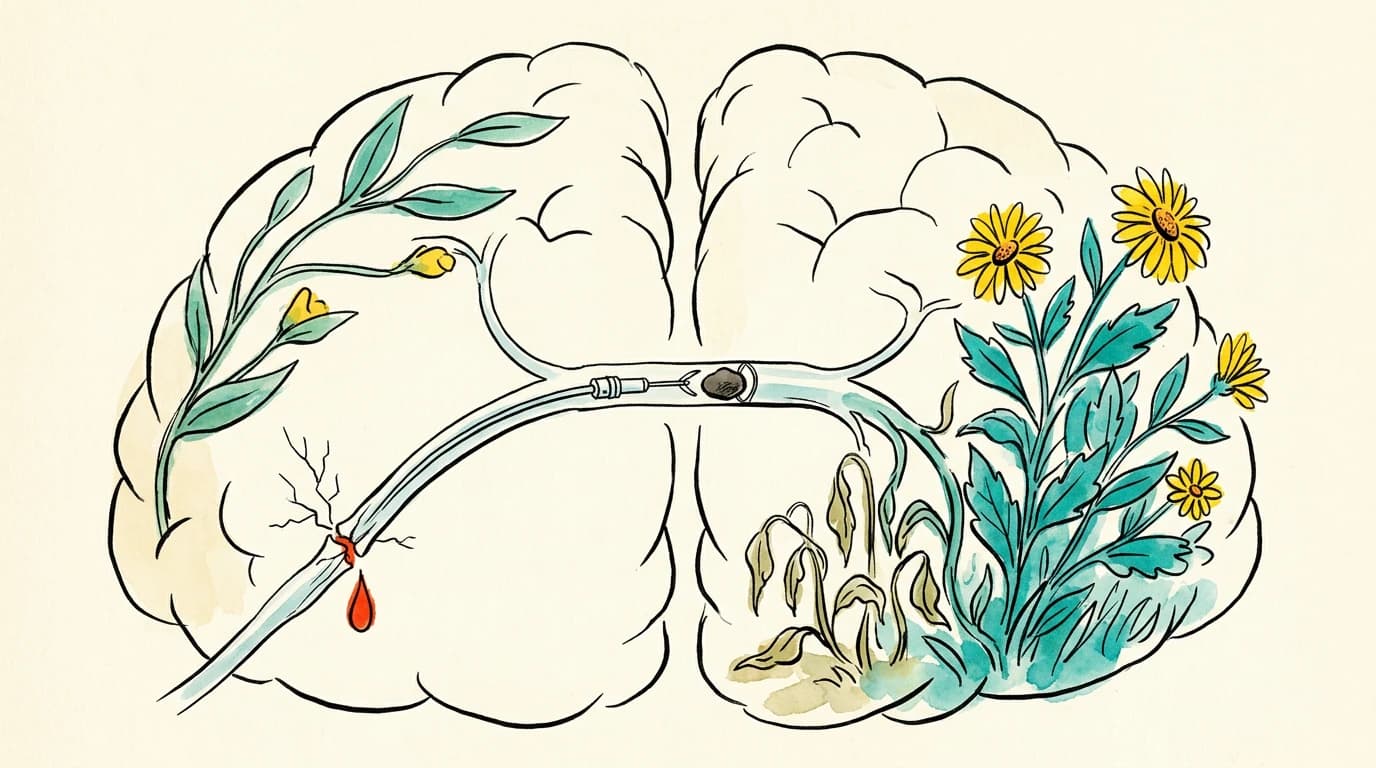
Clearing the plug acts like fixing a jammed farm pipe during a drought. Turning the flow back on saves dying crops before they dry out. However, worn pipes can burst when the flow returns. At 90 days, patients who had the clot pulled out showed much better daily function. Researchers scored them on the modified Rankin scale, a tool that tracks post-stroke disability and daily independence.
A dangerous trade-off
While clearing the clog improved daily living skills for many, the procedure came with sharp risks. Returning blood flow triggered a symptomatic intracranial hemorrhage, which is dangerous bleeding in the head that worsens symptoms, in 4.8% of surgical patients. No patients on basic care suffered this bleed. Death rates at 90 days were also higher in the surgical group, reaching 6.0% compared to 1.8% for standard care.
What we still do not know
This balance between better mobility and higher early danger leaves several questions open. The trial ran only in Chinese stroke centres, and doctors knew which treatment each patient received. Scientists still do not know if these results match other populations or how patients fare past 90 days.
Science words
- Endovascular thrombectomy
- A minimally invasive procedure to physically pull a blood clot out of an artery.
- Large-vessel occlusion
- A blockage in one of the main arteries supplying blood to the brain.
- Anterior circulation
- The network of arteries feeding blood to the front and middle parts of the brain.
- Modified Rankin scale
- A clinical scale measuring degrees of disability and daily dependence after a stroke.
- Symptomatic intracranial hemorrhage
- Bleeding inside the skull that causes a noticeable worsening of neurological symptoms.
Check it yourself
This story is based on a real research paper in New England Journal of Medicine by Yang, Shen, Yi et al. We write with AI help and check it against the paper, but the original is the final word.