Inside the lithium ion battery, positive ions huddle in unexpected packs
Machine-learning models and frozen tests reveal that lithium ions cluster together rather than travelling as lone particles in battery liquids.
Reading level
The full story with proper science words explained.
A crowded swim in battery liquid
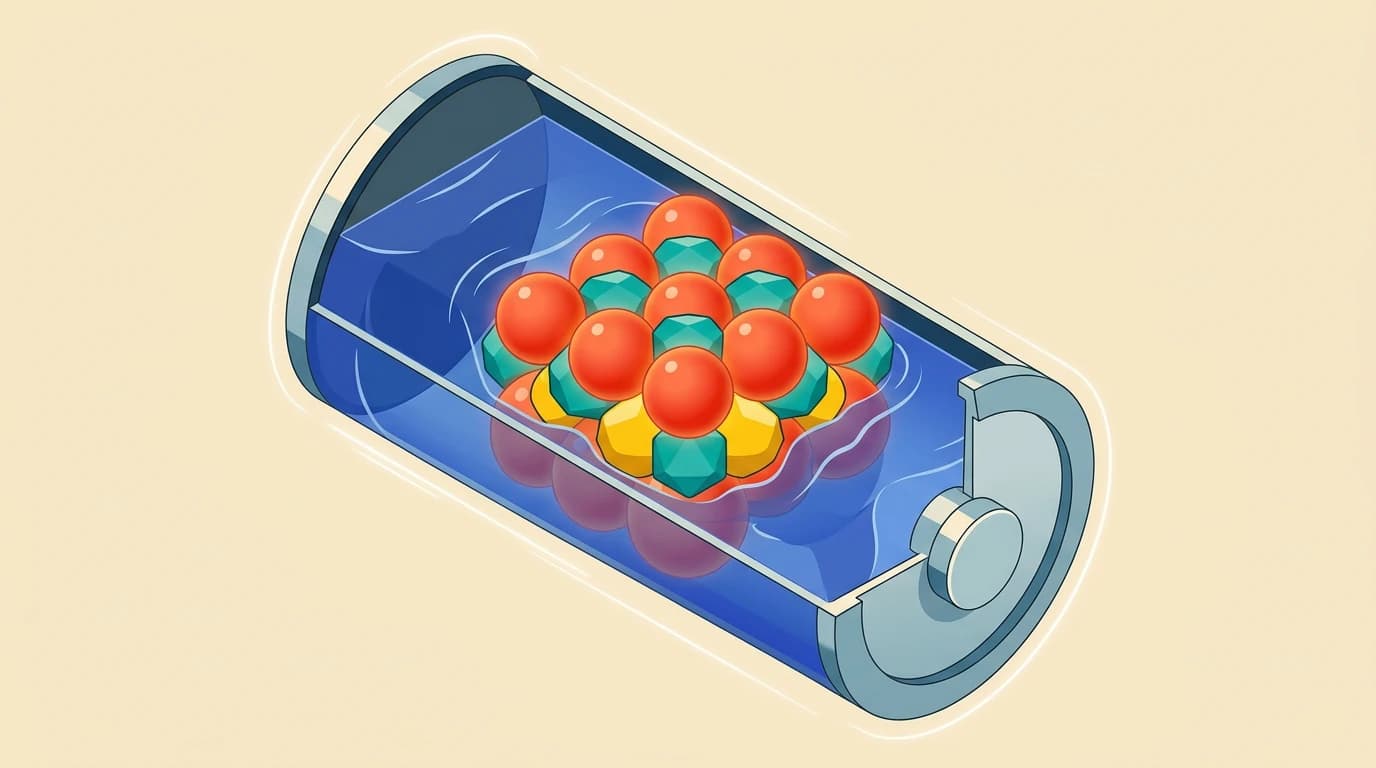
Like charges push away from one another. For decades, researchers thought that inside a lithium ion battery, positive charges swam alone through the fluid. Standard chemistry books assumed each was wrapped tightly in its own separate shell of liquid solvent. Yet new digital simulations reveal that this old view misses a busy crowd. Instead of floating alone, the charges gather together in tight clusters.
To study this, scientists looked at a common salt dissolved in ethylene carbonate, an oily liquid solvent. Traditional simulation tools, such as the older OPLS4 model, predicted that over 99% of positive ions stay completely apart. To look closer, researchers built a machine-learning force field called a charge-recursive neural network, or QRNN. This tool predicts forces and energy with quantum accuracy. The simulations showed that ions actually pull into close bunches, sitting just 3 ångströms apart. Surprisingly, these groups are held and cushioned solely by the surrounding solvent liquid.
Freezing the fluid to spot tiny groups
In these models, clusters became much more common as the fluid grew thicker with dissolved salt. At 0.5 moles per litre, about 23% of the ions grouped together. At 1.2 moles per litre, that share rose to 40%. At 2.0 moles per litre, it passed 68%. The team ran tests at 313 kelvin, or 40 degrees Celsius, because pure ethylene carbonate is solid at room temperature.
Next, the researchers set out to check these simulations in the real world. They used solid-state nuclear magnetic resonance, or ssNMR, which reads radio signals from atomic nuclei placed in strong fields. Doing this in warm liquid is tricky. Molecules exchange places far too fast at 313 kelvin, which blurs the readouts completely. To fix the issue, the team flash-froze the samples down to 116 kelvin and 210 kelvin. Freezing stopped the rapid shuffle in its tracks. The frozen tests proved the software correct, showing matching carbon signals and confirming that negative partner ions rarely touched the positive clusters.
Why ion clusters matter for cell surfaces
These grouped charges do far more than change diagrams in school textbooks. When a cell charges for the very first time, the liquid breaks down chemically at the negative terminal, called the anode. This breakdown creates a protective coat known as the solid electrolyte interphase, or SEI. The models showed that pairs of positive ions break down at 0.8 volts. That matches the real-world start of SEI growth on graphite and silicon anodes. By contrast, lone ions react only at much lower voltages.
What researchers still need to explore
The findings offer exciting insights, but open questions remain. Running the QRNN calculations requires massive digital power, costing hundreds of times more work than older formulas. Scientists also do not know how these clusters break apart right at an active surface under applied voltage. Furthermore, future studies must explore how clusters shed solvent during rapid charging and how they act in commercial blends containing multiple liquids and additives.
Science words
- QRNN
- Charge-recursive neural network: a specialised machine-learning tool trained to calculate molecular forces and energy while tracking electrical charge.
- ssNMR
- Solid-state nuclear magnetic resonance: a laboratory technique that uses magnetic fields to inspect the local chemical neighbourhood of atomic nuclei.
- SEI
- Solid electrolyte interphase: a protective coating that forms on battery anodes as the electrolyte breaks down during initial charging.
Check it yourself
This story is based on a real research paper in Nature by Stevenson, Agarwal, Debnath et al. We write with AI help and check it against the paper, but the original is the final word.