How your gut brain axis lets tiny passengers talk to your mind
Trillions of gut microbes release tiny molecules that help coat nerve wires and link to thinking skills, though direct mind control remains unproven.
Reading level
The full story with proper science words explained.
A hidden crowd inside your belly
More than 99 percent of the genes inside your body do not belong to human cells. Your digestive tract hosts roughly 38 trillion bacteria across 400 to 500 species, carrying about 46 million genes. Researchers who study the gut-brain axis want to know how these tiny passengers interact with your thoughts, memory, and everyday choices.
The body's chemical wire
Your gut talks to your brain day and night using nerves and chemical cues. Gut bacteria break down dietary fibre to create short-chain fatty acids, which are tiny fats made during fermentation. These microscopic bugs also make well-known signalling chemicals such as dopamine and serotonin.
However, a tight biological wall called the blood-brain barrier blocks these large chemicals from passing into brain tissue. They stay trapped in your bloodstream instead. To send their signals north, they stimulate the vagus nerve, a thick nerve cable that runs from your internal organs up into your brainstem.
Coating nerve wires
Smaller bacterial products do manage to pass across this protective brain border. A simple short-chain fatty acid called acetate slips straight through into your central nervous system. Brain cells called oligodendrocytes take in this acetate and turn it into fresh building blocks.
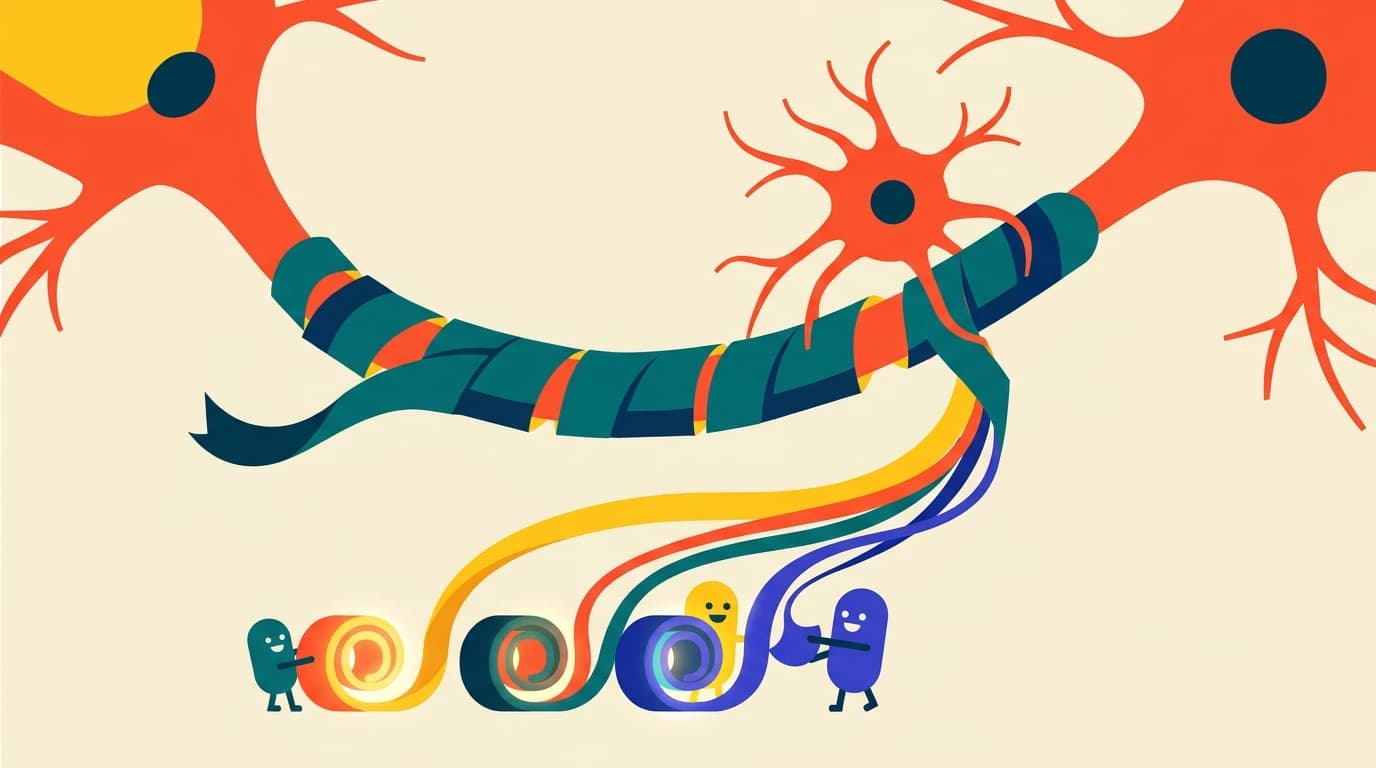
These brain cells use the converted acetate to build the myelin sheath, an insulating fatty wrap that covers nerve fibres. Think of your nerves as copper wires that need plastic coating to send rapid signals. Acetate acts like raw tape supplied by gut bacteria to help wrap those wires. When nerves keep their fatty wrap intact, electrical pulses travel swiftly and smoothly without leaking out.
Clues from young minds
To see how this works in growing bodies, researchers tracked 381 healthy children aged between 40 days and 10 years. In children older than 18 months, cognitive test scores showed clear statistical links to specific microbial genes in the gut. Higher thinking scores matched higher counts of bugs such as Faecalibacterium prausnitzii and Alistipes obesi.
Studying this age window matters because early childhood is when the brain rapidly builds its wiring networks. Seeing which bacteria line up with early learning helps researchers map how nutrition and gut activity walk hand in hand with normal brain growth.
What remains unproven
These strong links do not prove that gut bacteria control human choices or thoughts. Most hands-on evidence comes from mice and cell dishes in labs, which work differently from human bodies. The child study only noted a correlation, meaning it cannot show that bacteria directly cause higher test scores.
Broad traits like human intelligence and conscious thought are tricky to measure in a laboratory test. Researchers do not yet know if shifting bacterial groups can change human decisions, or if gut therapies can rebuild broken nerve coating in conditions like multiple sclerosis. For now, gut bacteria work as helpful suppliers to the brain, not as its secret rulers.
Science words
- Gut-brain axis
- The two-way communication network linking the digestive tract and the central nervous system.
- Short-chain fatty acids
- Tiny fatty molecules made when gut bacteria break down and ferment dietary fibre.
- Vagus nerve
- A large nerve that carries sensory and regulatory signals back and forth between organs and the brainstem.
- Oligodendrocytes
- Specialised brain cells that build and maintain insulating fatty wraps around nerve fibres.
- Myelin sheath
- A protective fatty layer wrapped around nerve fibres to speed up electrical signals.
Check it yourself
This story is based on a real research paper in Gut Microbes by Dicks, Botha, Pohl. We write with AI help and check it against the paper, but the original is the final word.