How your brain rates subliminal beauty without you noticing
Brain imaging reveals that valuation circuits automatically calculate facial attractiveness even when visual noise renders the faces invisible to conscious awareness.
Reading level
The full story with proper science words explained.
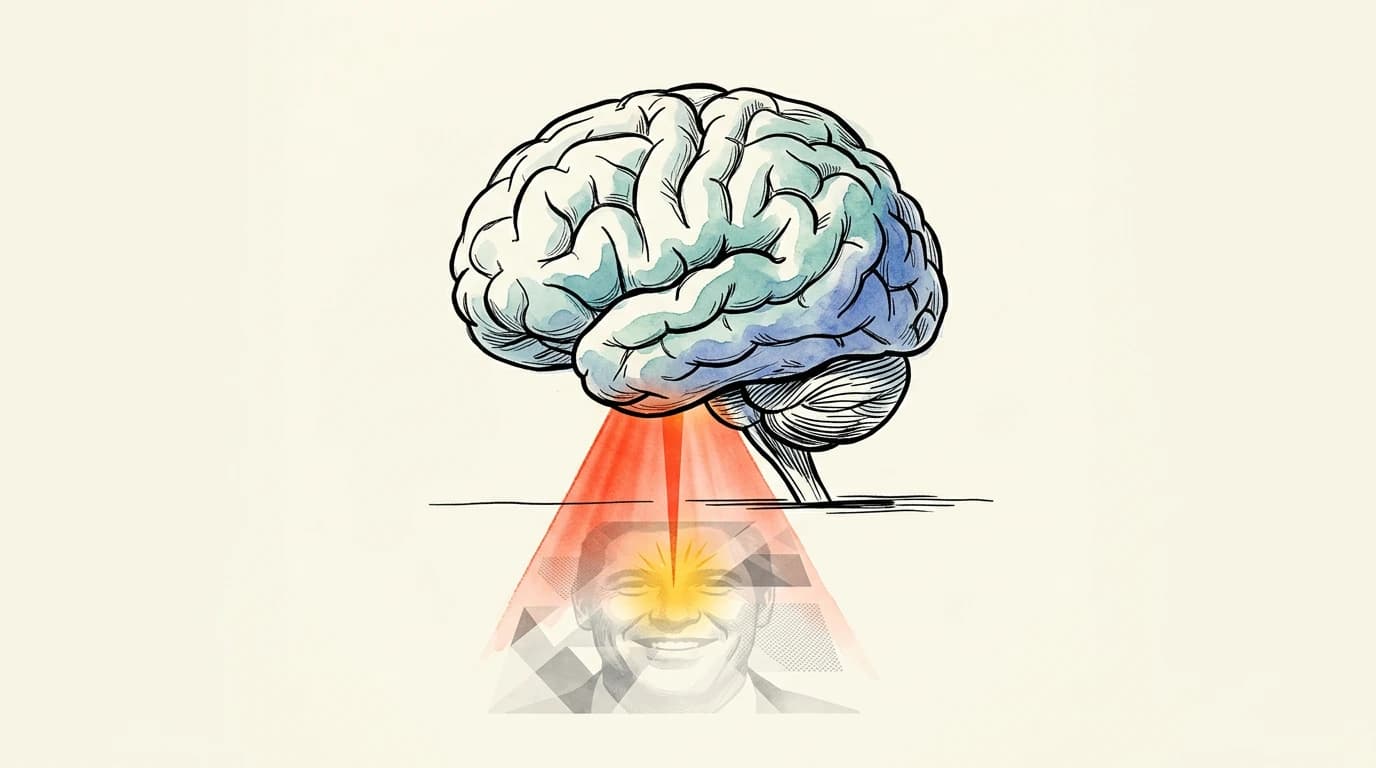
Grading what you cannot see
Can your brain spot an attractive face before you know you are looking at one? Many experts once thought that front-brain choice circuits needed conscious sight to work. They believed your mind had to see an object clearly to work out how much it liked it. A recent brain-scan test challenged this view. It asked whether the brain can judge subliminal beauty without any conscious help.
Flashing patterns and hidden faces
The researchers put 29 adults (24 women and 5 men) into an fMRI scanner to track their brain responses. They showed faces to one eye. At the same time, they flashed bright, shifting patterns into the other eye. This method is called continuous flash suppression (CFS), a visual trick that blocks an image from conscious sight. CFS floods visual input so the person never sees the portrait.
To prove the faces stayed hidden, the team checked a score called d-prime (d'). This score tests if someone can spot an image above pure guesswork. The participants scored at chance level. This confirmed that the faces were truly out of conscious sight.
After the scan, the participants viewed the faces and rated each one for subjective value (SV). This term means how attractive or appealing a person finds something. The scans revealed that a visual zone called the fusiform face area (FFA) still logged the hidden faces. It also linked with deeper value hubs. One front region, the ventromedial prefrontal cortex (vmPFC), fired harder as attractiveness rose, even for unseen faces. Another reward hub, the anterior ventral striatum (aVS), tracked this value only during the hidden trials.
What we still do not know
This method matters because it shows value circuits can fire without conscious awareness. Yet, questions remain. The trial was small, skewed female, and tested only faces rather than goods like food or cash. Also, brain signals alone do not prove that unseen ratings change our real-world choices.
Science words
- Continuous flash suppression (CFS)
- A visual method where rapidly flashing patterns in one eye hide an image shown to the other eye from conscious awareness.
- d'
- A test score showing whether someone detects an image better than random guessing.
- Subjective value (SV)
- The internal worth, appeal, or attractiveness an individual gives to an item or face.
- Fusiform face area (FFA)
- A visual brain region specialised for recognising and processing human faces.
- Ventromedial prefrontal cortex (vmPFC)
- A region at the front of the brain that computes value and helps guide decisions.
- Anterior ventral striatum (aVS)
- A deep brain structure involved in processing rewards and motivation.
Check it yourself
This story is based on a real research paper in The Journal of Neuroscience by Fernandes, Kable, Almeida et al. We write with AI help and check it against the paper, but the original is the final word.