How wood anatomy helps Southern African trees survive extreme droughts
A review reveals that microscopic structures inside Southern African trees dictate how well they store carbon and resist severe water shortages.
Reading level
The full story with proper science words explained.
Heads up: this study is a preprint, which means other scientists haven’t finished checking it yet.
Tiny pipes with a massive job
Slice into a living tree trunk, and you will find a complex plumbing network. In dry landscapes, studying wood anatomy—the cellular layout inside the trunk—shows how native trees cope when moisture vanishes. A recent review pulled data from published papers, reports, and dissertations on Southern African trees to understand how these inner structures work.
Thin straws beat wide fire hoses
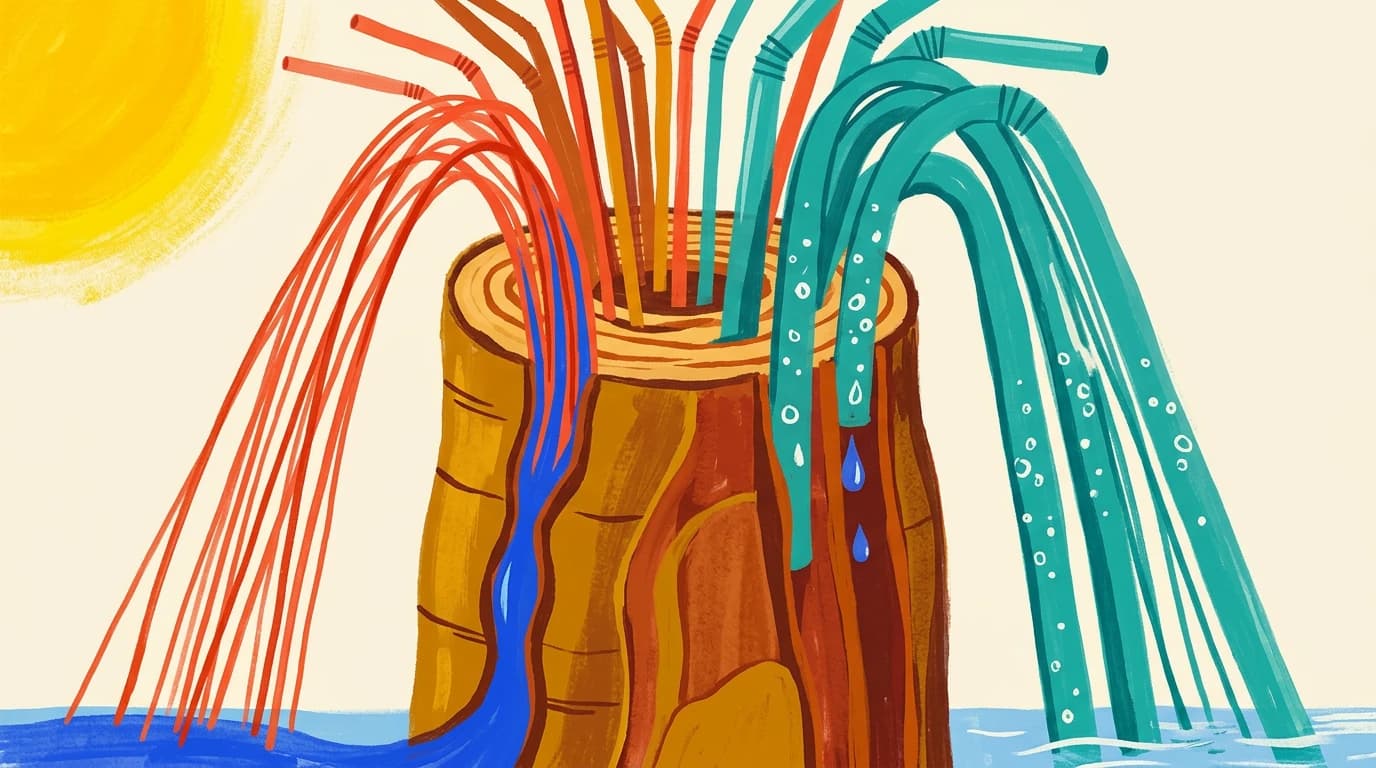
A tree pulls moisture upward from its roots through tiny tubes. Vessel diameter, the width of these water-carrying cells, sets a clear trade-off. Think of them like drinking straws. A wide straw moves a lot of liquid quickly. However, sipping hard when the cup is nearly dry makes it collapse or suck in air bubbles. Trees face the exact same problem.
When a severe dry spell strikes, high tension in the sap can trigger air bubbles that block the flow. Narrow pipes provide higher cavitation resistance, which is the ability to stop these dangerous bubbles from forming. In contrast, wider pipes offer higher hydraulic conductivity, meaning they move water faster when rain is abundant.
Built like reinforced concrete
Staying alive is not just about avoiding air blocks. The review found that trees with narrow tubes packed tightly together survive dry spells best. The authors also checked fibre morphology, which refers to the shape and wall thickness of reinforcing cells. They found that thick walls create high wood density. Combined with parenchyma, which is living tissue that stores water and carbohydrates, dense trunks pack away extra biomass and support long-term carbon storage.
What we still do not know
This method matters because it helps forest managers select resilient species to replant drying woodlands. Yet, existing records remain scattered across different regions. Many native species still lack detailed data on their inner wood. Without long-term monitoring records over decades, scientists also cannot yet say how these cellular patterns will hold up against shifting climate extremes.
Science words
- Wood anatomy
- The structural layout and arrangement of microscopic cells inside a tree trunk.
- Vessel diameter
- The width of the microscopic tube-like cells in wood that transport water upward from the roots.
- Cavitation resistance
- The ability of a tree's water-transport vessels to resist forming air bubbles that block water flow under drought stress.
- Hydraulic conductivity
- A measure of how easily water flows through a tree's internal plumbing system.
- Fibre morphology
- The structural shape, length, and wall thickness of elongated cells that provide mechanical support to the tree.
- Parenchyma
- Living plant tissue within wood that stores nutrients, water, and carbohydrates.
Check it yourself
This story is based on a real research paper in Scientific Publication by Nsofu. We write with AI help and check it against the paper, but the original is the final word.